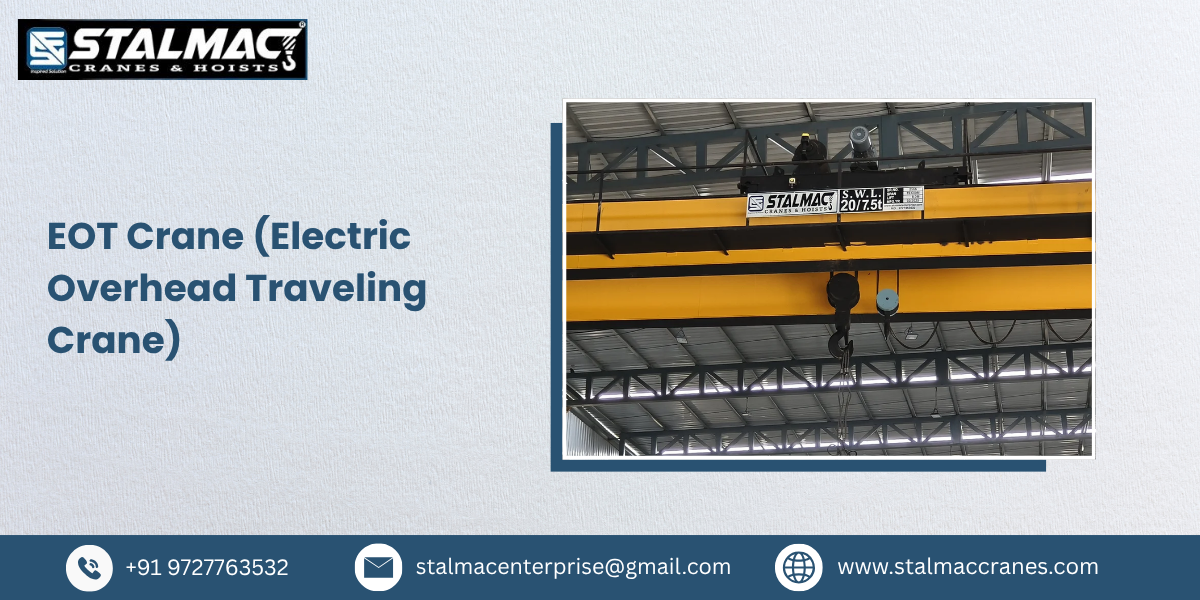
EOT Crane (Electric Overhead Traveling Crane) Manufacturer in India – Stalmac Enterprise
An EOT Crane (Electric Overhead Traveling Crane) is an electrically operated overhead lifting system designed to move heavy materials horizontally and vertically within industrial facilities. EOT cranes are widely used in manufacturing plants, engineering industries, warehouses, fabrication units, steel plants, foundries, power plants and other industrial applications where controlled and efficient material handling is required. Stalmac Enterprise is an EOT Crane Manufacturer and EOT Crane Supplier in India, providing industrial overhead crane solutions based on lifting capacity, span, lifting height, working duty, plant layout and customer requirements. Our crane solutions are designed for applications requiring reliable lifting, travelling and load-positioning operations.
What Is an EOT Crane (Electric Overhead Traveling Crane)?
An EOT Crane (Electric Overhead Traveling Crane) is a type of overhead crane that uses electric-powered mechanisms to lift and move loads. The crane generally travels along parallel runway rails installed within the building, while the hoisting mechanism moves the load vertically and the trolley travels horizontally across the bridge.
The three primary movements of an EOT crane are:
- Hoisting: Vertical movement of the load.
- Cross Travel: Horizontal movement of the hoist or trolley along the crane bridge.
- Long Travel: Movement of the complete crane along the runway rails.
This combination allows operators to position heavy materials accurately within a defined working area.
How Does an EOT Crane Work?
An EOT crane operates through coordinated electrical and mechanical systems. When the operator gives a lifting command, the electric hoist motor drives the lifting mechanism to raise or lower the load. The trolley allows the hoisting unit to move across the bridge girder, while electrically powered end-carriage mechanisms move the complete crane along the runway.
The crane's electrical controls coordinate these movements and allow the operator to position loads according to the requirements of the material-handling operation.
A typical EOT crane consists of:
- Bridge girder
- End carriages
- Electric hoist
- Trolley mechanism
- Hoisting motor
- Cross-travel motor
- Long-travel motors
- Wheels and wheel assemblies
- Electrical control panel
- Festoon or conductor power supply system
- Pendant or remote control system
- Braking system
- Limit switches
- Hook and lifting accessories
The exact arrangement varies according to crane capacity, configuration, duty and application.
EOT Crane Design and Construction
The design of an EOT crane depends on the customer's lifting requirements and the available building structure.
Important design parameters include:
- Safe working load
- Maximum load to be lifted
- Crane span
- Hook lifting height
- Runway length
- Working duty
- Lifting speed
- Cross-travel speed
- Long-travel speed
- Available headroom
- Operating environment
- Frequency of operation
- Required controls
- Building and runway conditions
Stalmac Enterprise can evaluate these parameters before developing the appropriate crane configuration for a project.
Types of EOT Crane
Different industrial applications require different EOT crane configurations.
Single Girder EOT Crane
A Single Girder EOT Crane uses one main bridge girder and is generally suitable for applications involving moderate lifting requirements. It can be an efficient solution where building conditions, load capacity and duty requirements are suitable.
Double Girder EOT Crane
A Double Girder EOT Crane uses two bridge girders and is generally selected for heavier loads, larger spans, higher lifting heights or demanding operating conditions.
Heavy Duty EOT Crane
Heavy Duty EOT Cranes are engineered for applications involving frequent lifting cycles, high loads and demanding industrial operations.
Customized EOT Crane
Customized EOT cranes can be developed according to specific plant layouts, lifting requirements, available headroom, runway arrangements and operating conditions.
Key Components of an EOT Crane
Understanding the main components helps customers select the right EOT Overhead Crane.
Bridge Girder
The bridge girder forms the main structural portion of the crane and carries the trolley and lifting mechanism.
End Carriage
End carriages are positioned at both ends of the bridge and support the travelling wheels and drive arrangements.
Electric Hoist
The electric hoist performs the primary lifting and lowering operation.
Trolley
The trolley carries the hoisting mechanism and travels across the crane bridge.
Motors
Electric motors provide the power required for hoisting, cross travel and long travel.
Brakes
Braking systems help control and stop crane movements and maintain controlled load handling.
Control Panel
The electrical control panel coordinates the crane's operating functions.
Hook Block
The hook block connects the lifting mechanism to the load and may be configured according to the required lifting capacity.
Limit Switches
Limit switches help restrict specific crane or hoist movements according to the crane's design.
Features of EOT Crane
A properly engineered EOT crane can provide:
- Efficient overhead material handling
- Electrically powered operation
- Controlled lifting and lowering
- Horizontal load movement
- Smooth crane travelling
- Customized lifting capacity
- Single or double girder configurations
- Pendant or remote operation options
- Overload protection
- Limit protection
- Braking arrangements
- Emergency stop provisions
- Robust structural construction
- Application-specific controls
- Custom span and lifting height
The final features depend on the crane model and project requirements.
Applications of EOT Crane
EOT Crane Manufacturers in India serve a wide range of industries because overhead travelling cranes can be configured for different load-handling requirements.
Manufacturing Industries
EOT cranes are used for moving machinery, components, raw materials and finished products within manufacturing facilities.
Steel Industries
Steel plants can use overhead cranes for handling steel products, equipment and production-related materials.
Fabrication Industries
Fabrication workshops use EOT cranes to move heavy fabricated structures, plates and machinery.
Engineering Industries
Engineering plants use cranes for equipment assembly, maintenance and material movement.
Warehouses
EOT cranes can support organized handling of heavy materials where suitable runway infrastructure is available.
Foundries
Specialized overhead crane configurations can be used for handling heavy components and materials in foundry operations.
Power Plants
EOT cranes can assist with equipment handling, maintenance and installation operations.
Automobile Industries
Automotive manufacturing facilities may use EOT cranes for dies, machinery, components and maintenance activities.
Advantages of Electric Overhead Traveling Crane
An Electric Overhead Traveling Crane provides several advantages for industrial material handling.
Better Utilization of Floor Space
Because the crane operates overhead, valuable floor space can remain available for production and storage activities.
Efficient Heavy Load Handling
The crane can move heavy materials with significantly less manual effort.
Controlled Load Positioning
Electric lifting and travelling mechanisms allow controlled movement of loads within the crane's operating area.
Improved Productivity
Efficient material movement can reduce handling time during manufacturing and maintenance activities.
Flexible Configuration
EOT cranes can be designed with different capacities, spans, lifting heights and operating arrangements.
Reduced Manual Handling
Mechanized lifting reduces dependence on manual movement of heavy materials.
EOT Crane Technical Specifications
The specifications of an EOT crane should be selected according to the application.
| Parameter | Typical Project Requirement |
|---|---|
| Crane Type | Single Girder / Double Girder |
| Lifting Capacity | As per application |
| Crane Span | As per building layout |
| Lifting Height | As required |
| Runway Length | As per facility |
| Hoist Type | Electric Hoist / Application-Specific |
| Lifting Speed | As required |
| Cross Travel Speed | As required |
| Long Travel Speed | As required |
| Working Duty | According to operating cycle |
| Control | Pendant / Remote / Other |
| Power Supply | As per project |
| Installation | Indoor / Outdoor as applicable |
| Customization | Available according to requirement |
How to Select the Right EOT Crane?
Choosing an EOT crane involves more than selecting a lifting capacity. The following factors should be evaluated.
1. Load Capacity
Determine the maximum weight that the crane needs to lift.
2. Crane Span
Measure the distance between the runway rails to determine the required bridge span.
3. Lifting Height
Determine the required hook height and available building headroom.
4. Runway Length
The runway length determines the total travelling distance of the crane.
5. Working Duty
Consider the number of lifting cycles, operating hours and frequency of crane usage.
6. Load Characteristics
The size, shape and type of materials being handled can affect the appropriate crane configuration and lifting accessories.
7. Building Structure
The existing columns, roof height, runway beams and available installation space should be evaluated.
8. Operating Method
Pendant, remote or other control methods can be selected according to the application.
9. Indoor or Outdoor Installation
Environmental conditions can influence the crane's protection and component selection.
EOT Crane for Sale
If you are searching for an EOT Crane for Sale, the first step should be identifying the exact application requirements.
Before purchasing an EOT crane, consider:
- Required safe working load
- Required span
- Hook height
- Runway length
- Working frequency
- Crane duty
- Available headroom
- Operating environment
- Control system
- Installation requirements
- Maintenance support
A technically suitable crane can provide better long-term value than simply choosing the lowest initial purchase price.
EOT Crane Supplier in India
As an EOT Crane Supplier in India, Stalmac Enterprise can assist customers with project-specific requirements for manufacturing plants, engineering facilities, fabrication units, warehouses and other industrial applications.
Customers can approach us for:
- New EOT crane requirements
- Single girder EOT cranes
- Double girder EOT cranes
- Heavy-duty overhead cranes
- Customized crane requirements
- Plant expansion projects
- Replacement of existing cranes
- Industrial material-handling solutions
EOT Crane Exporter
Stalmac Enterprise can also support customers searching for an EOT Crane Exporter from India.
For export projects, crane specifications should be finalized according to the destination country's requirements, electrical standards, installation conditions, environmental factors and project specifications.
International customers can share their complete technical requirements with Stalmac Enterprise for project evaluation and quotation.
EOT Crane Manufacturing Company
Choosing an experienced EOT Crane Manufacturing Company is important because an overhead crane is an engineered lifting system rather than a simple off-the-shelf product.
The manufacturer should understand:
- Load requirements
- Crane structure
- Hoisting mechanism
- Travel mechanisms
- Electrical controls
- Building conditions
- Duty requirements
- Installation requirements
- Maintenance considerations
Stalmac Enterprise follows an application-oriented approach to EOT crane requirements, helping customers identify a suitable configuration for their industrial material-handling needs.
Why Choose Stalmac Enterprise for EOT Crane?
Stalmac Enterprise focuses on providing industrial crane solutions based on actual customer requirements.
Key advantages include:
EOT crane manufacturing expertise
Industrial crane manufacturing expertise.
Application-specific engineering
Solutions developed according to application requirements.
Customized crane configurations
Crane parameters can be configured according to project requirements.
Industrial material-handling solutions
Solutions for industrial lifting and material handling requirements.
Ahmedabad-based manufacturing facilities
Manufacturing facilities based in Ahmedabad.
Technical consultation
Technical consultation for crane requirements.
Support for Indian industrial customers
Support for industrial customers across India.
Export project support
Support for international project requirements.
Project-oriented approach
Application-focused approach to project requirements.
Frequently Asked Questions About EOT Crane
1. What is an EOT Crane?
An EOT Crane, or Electric Overhead Traveling Crane, is an electrically operated overhead crane used for lifting and horizontally transporting heavy materials within an industrial facility.
2. What are the three main movements of an EOT Crane?
The three primary movements are hoisting, cross travel and long travel. Hoisting moves the load vertically, cross travel moves the hoist across the bridge and long travel moves the complete crane along the runway.
3. What is the difference between a Single Girder and Double Girder EOT Crane?
A Single Girder EOT Crane has one main bridge girder, while a Double Girder EOT Crane has two main bridge girders. The appropriate design depends on factors such as load capacity, span, lifting height, duty and building conditions.
4. What factors determine EOT Crane Price?
EOT Crane Price depends on capacity, span, lifting height, girder configuration, runway length, duty, hoist, motors, electrical controls, crane speeds, accessories, installation requirements and customization.
5. Can Stalmac Enterprise customize an EOT Crane?
EOT cranes can be configured according to project requirements such as lifting capacity, span, lifting height, duty, building arrangement, operating method and other technical requirements.
6. Where are EOT Cranes used?
EOT cranes are used in manufacturing plants, engineering industries, steel plants, fabrication workshops, warehouses, foundries, power plants, automobile industries and other facilities requiring overhead material handling.
7. How do I get an EOT Crane quotation?
Provide the required lifting capacity, span, lifting height, runway length, operating duty, application and other available project details to Stalmac Enterprise for technical evaluation and quotation.
Get an EOT Crane Quote from Stalmac Enterprise
Looking for an EOT Crane Manufacturer, EOT Crane Supplier, EOT Crane Exporter or EOT Crane Manufacturing Company in India? Stalmac Enterprise provides industrial EOT Crane (Electric Overhead Traveling Crane) solutions based on customer-specific material-handling requirements.
Company: Stalmac Enterprise
Unit 1: Plot No. 19, Shiv Prerna Ind. Park, Pirana, Ahmedabad – 382425, Gujarat, India.
Unit 2: Plot No. 37, Om Prerna Ind. Estate, Pirana, Ahmedabad – 382427, Gujarat, India.
Official Website: https://stalmaccranes.com/
For an EOT crane enquiry, share your required lifting capacity, crane span, lifting height, runway length, working duty and application so the appropriate crane configuration can be evaluated.