Can an EOT Crane Operate in Heavy-Duty Industrial Conditions?
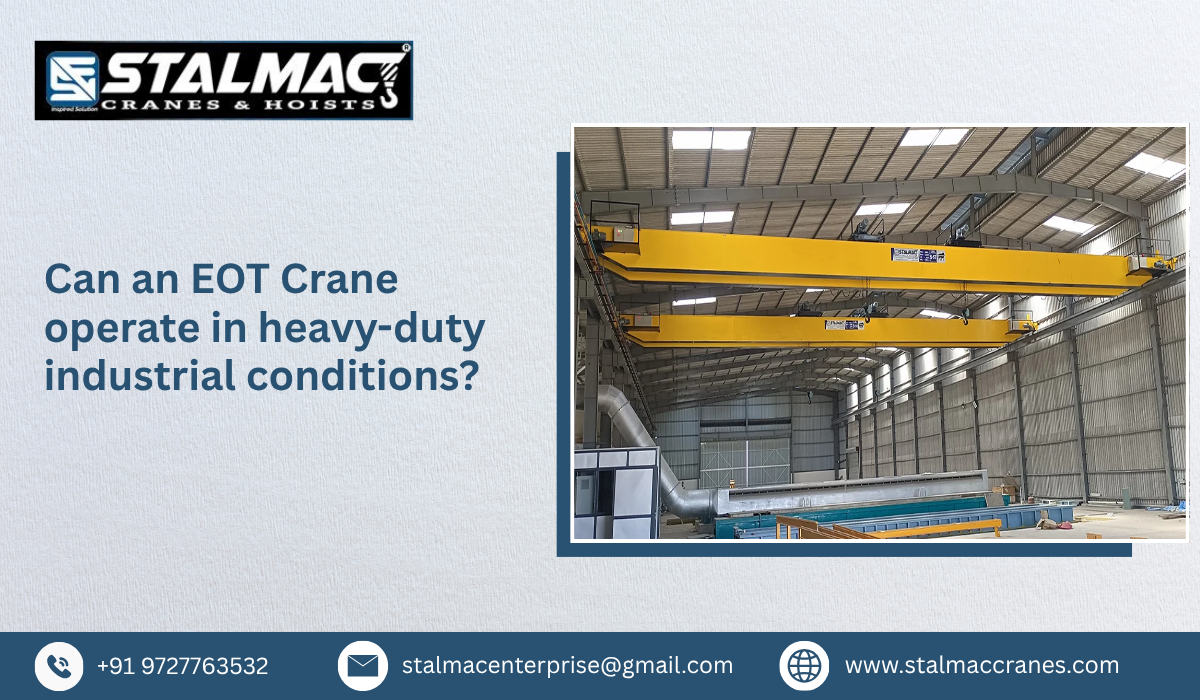
Yes, an EOT crane can operate effectively in demanding industrial environments when it is properly designed, engineered, installed, and maintained for the required duty cycle. A modern EOT Crane for Heavy-Duty Industrial Applications is built to handle repeated lifting, high loads, long operating hours, and challenging workplace conditions. Stalmac Cranes focuses on engineered lifting solutions where structural strength, reliable motion control, safety systems, and application-specific configurations are essential.
What Makes an EOT Crane Suitable for Heavy-Duty Conditions?
A Heavy-Duty EOT Crane is different from a standard lifting crane because its components are selected according to load capacity, operating class, lifting frequency, travel speed, span, lift height, and environmental conditions. For continuous industrial operations, the bridge structure, end carriages, wheels, gears, motors, brakes, ropes, drums, and electrical systems must work together reliably.
As an experienced Industrial EOT Crane Manufacturer in India, Stalmac Cranes can engineer crane systems around the actual operating requirements rather than relying on a one-size-fits-all design. This approach helps ensure suitable structural margins, smooth movement, controlled acceleration, and dependable performance during demanding lifting cycles.
How Does a Heavy-Duty EOT Crane Work?
A Heavy-Duty Overhead Crane generally consists of a bridge structure supported on runway rails, an electrically powered trolley, and a hoisting mechanism. The hoist raises and lowers the load, while the trolley moves across the bridge and the bridge travels along the runway.
The electrical control system coordinates these movements. Variable frequency drives, limit switches, overload protection, emergency stopping systems, brakes, and other safety components can be integrated according to the application. This makes an EOT Crane for Industrial Use suitable for controlled handling of heavy materials within defined work areas.
Technical Features for Demanding Industrial Operations
A Heavy-Duty Material Handling Crane requires carefully selected mechanical and electrical components. Important technical considerations include:
- Rated load and required safety factor
- Crane span and runway length
- Lifting height and hook approach
- Hoisting, cross-travel, and long-travel speeds
- Duty classification and operating frequency
- Motor power and braking capacity
- Gearbox configuration and transmission efficiency
- Bridge girder construction and wheel loading
- Pendant, cabin, or remote-control operation
- Overload protection and limit switches
- Emergency stop and electrical protection systems
A High-Capacity EOT Crane may also require reinforced structural members, higher-capacity hoisting machinery, specialized ropes and drums, and carefully calculated wheel loads. The final design should be based on the actual load spectrum and working conditions.
Performance in Steel and Manufacturing Industries
Heavy engineering facilities frequently require cranes to move raw materials, fabricated components, machinery, coils, plates, moulds, and finished products. An EOT Crane for Steel Industry must therefore withstand demanding production environments where high temperatures, dust, heavy loads, and frequent lifting cycles may be present.
Similarly, an EOT Crane for Manufacturing Plants can be configured for machine installation, production-line material movement, maintenance activities, fabrication work, and warehouse handling. Depending on the environment, specialized protection and component selection may be necessary.
Environmental Factors That Matter
Industrial conditions can vary significantly. Temperature, dust, humidity, corrosive substances, heat radiation, outdoor exposure, and frequency of operation can influence crane performance. A Robust Industrial Lifting Equipment solution should therefore consider environmental conditions during engineering.
For example, cranes operating near furnaces or hot material may need suitable heat-resistant components or increased protection. Dusty environments may require appropriate electrical enclosures and maintenance practices. Outdoor installations may require weather protection and corrosion-resistant finishing.
Why Choose a Properly Engineered EOT Crane?
An Industrial Overhead Crane Manufacturer must evaluate more than simply the maximum weight to be lifted. The crane's duty cycle determines how frequently the equipment will operate and how intensively its components will be used.
A Heavy-Duty Electric Overhead Travelling Crane can be configured with appropriate motors, brakes, gearboxes, electrical panels, controls, and structural components to match these operating requirements. Correct engineering helps reduce unnecessary mechanical stress and supports consistent load handling throughout the crane's intended service life.
Applications of Heavy-Duty EOT Crane Systems
A properly engineered Heavy-Duty Crane System can be used across numerous industries, including:
- Steel plants and metal processing facilities
- Heavy engineering and fabrication units
- Automotive manufacturing plants
- Machinery manufacturing facilities
- Foundries and forging industries
- Power generation projects
- Shipbuilding and industrial workshops
- Warehouses and large material-handling areas
The exact crane configuration should always be selected according to load characteristics, operating conditions, installation dimensions, and applicable safety requirements.
Maintenance Is Essential for Heavy-Duty Operation
Even the strongest crane requires preventive maintenance. Regular inspection should cover wire ropes, hooks, brakes, wheels, bearings, gearboxes, electrical panels, motors, limit switches, structural connections, and runway components. Lubrication, brake adjustment, electrical testing, and periodic inspections help identify developing problems before they affect production.
For organizations searching for an EOT Crane Supplier in India, it is important to consider engineering support, installation assistance, commissioning, spare-parts availability, and after-sales service along with the crane's rated capacity.
Stalmac Cranes for Heavy-Duty Industrial Applications
Stalmac Cranes develops industrial lifting solutions with attention to load capacity, duty requirements, operating environment, safety, and long-term functionality. Whether the requirement involves a standard industrial crane or a customized high-capacity configuration, proper technical assessment is essential before manufacturing.
A correctly engineered EOT Crane for Heavy-Duty Industrial Applications can provide controlled and efficient material movement even in demanding industrial conditions. The right combination of structural design, lifting machinery, electrical controls, safety devices, and preventive maintenance allows an EOT crane to become an important part of continuous industrial operations.
For businesses looking for a dependable EOT Crane for Industrial Use, Stalmac Cranes can provide application-focused solutions designed around the specific requirements of the facility. Contact Stalmac Cranes to discuss load capacity, duty class, span, lift height, operating environment, and other technical parameters required for your project.

