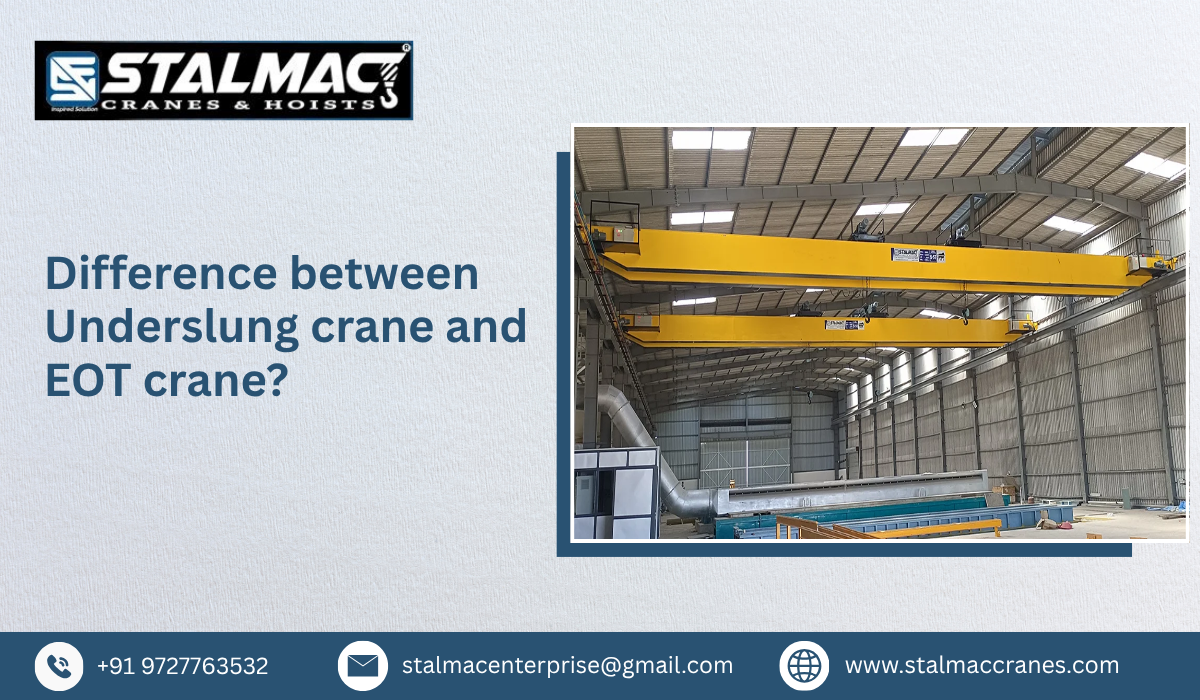
Difference Between Underslung Crane and EOT Crane | Stalmac Cranes
Choosing the right overhead material handling system is essential for improving productivity, workplace safety, and operational efficiency in industrial facilities. Two commonly used lifting solutions are underslung cranes and Electric Overhead Travelling (EOT) cranes. Although both systems are designed to lift and move heavy loads, they differ in structural design, runway arrangement, installation requirements, load capacity, and applications. Understanding Underslung Crane vs EOT Crane helps businesses select suitable equipment according to their factory layout and material handling requirements.
Stalmac Cranes provides industrial crane solutions designed to support efficient material movement across manufacturing plants, warehouses, engineering workshops, and other industrial environments. By understanding the Difference Between Underslung Crane and EOT Crane, businesses can make informed decisions about lifting capacity, available headroom, building structure, and long-term operating costs.
What Is an Underslung Crane?
An underslung crane is an overhead lifting system in which the crane bridge travels along the lower flange of elevated runway beams. The runway beams are generally supported by the building's roof structure or other suitably engineered supports. This arrangement can be particularly useful in facilities where floor space is limited and conventional crane support columns are undesirable.
An Underslung Overhead Crane is commonly considered when manufacturers need to maximise usable floor space, accommodate existing buildings, or handle materials within restricted working areas. Its configuration can provide flexibility in workshop layouts, depending on the building structure and the selected crane design.
Advantages of an Underslung Crane
- Space optimisation: Uses an overhead runway arrangement that can reduce the need for separate floor-mounted crane-support columns.
- Building integration: Can be suitable for buildings with properly designed roof trusses or supporting structures.
- Flexible coverage: Certain configurations allow the crane to serve multiple workstations and extend into areas that suit the runway layout.
- Restricted-space handling: Can be useful where floor space and available headroom require careful planning.
- Production efficiency: Supports the movement of components, tools, and materials between designated work areas.
Applications of an Underslung Crane
- Automotive component manufacturing units.
- Machine shops and engineering workshops.
- Assembly lines and production facilities.
- Light and medium-duty industrial material handling.
- Warehouses with suitable overhead support structures.
- Facilities requiring efficient use of available floor space.
The final suitability of an underslung crane depends on load capacity, runway geometry, building strength, headroom, and the required operating duty.
What Is an EOT Crane?
An Electric Overhead Travelling crane, commonly called an EOT crane, is a motorised lifting system that moves loads horizontally across a factory or industrial building. It typically consists of a bridge, end carriages, an electric hoist or trolley, runway rails, motors, controls, and safety devices.
An EOT Overhead Crane usually travels on rails mounted on runway beams supported by building columns or a purpose-designed supporting structure. Depending on the design, an EOT crane can be configured as a single-girder or double-girder system to meet different lifting and operational requirements.
Types of EOT Cranes
- Single Girder EOT Crane: Uses one main bridge girder and is commonly selected for suitable light- to medium-duty lifting applications.
- Double Girder EOT Crane: Uses two main bridge girders and can accommodate higher capacities, greater spans, and particular heavy-duty requirements, subject to engineering design.
- Custom EOT Crane: Designed around specific lifting capacity, building dimensions, operating frequency, and material handling needs.
Advantages of an EOT Crane
- Efficient lifting: Electric operation supports controlled lifting and movement of industrial loads.
- Wide working coverage: Can travel along an engineered runway to serve different areas of a facility.
- Capacity flexibility: Available in configurations suited to a broad range of industrial lifting requirements.
- Operational control: Pendant or radio remote controls can help operators position loads accurately.
- Industrial versatility: Suitable for production lines, fabrication units, warehouses, and heavy engineering operations.
Applications of EOT Cranes
- Steel and metal fabrication plants.
- Heavy engineering and machinery manufacturing.
- Automotive and industrial assembly facilities.
- Foundries and manufacturing workshops.
- Warehousing and logistics operations.
- Equipment maintenance and industrial material transfer.
Factors to Consider Before Choosing a Crane
Before selecting equipment from an Underslung Crane Manufacturer in India or an EOT Crane Manufacturer in India, evaluate the following points:
- Load capacity : Calculate the maximum load, including lifting attachments and other relevant suspended loads.
- Building structure : Verify that the roof members, runway beams, connections, columns, and foundations can withstand the applicable loads.
- Available headroom : Assess the distance between the roof, runway, hoist, and highest required lifting position.
- Span and travel : Determine the building width, required hook coverage, and longitudinal travel distance.
- Operating duty : Consider lifting frequency, working shifts, load spectrum, and environmental conditions.
- Safety requirements : Review brakes, limit switches, overload protection where applicable, emergency controls, and inspection requirements.
- Maintenance and cost : Compare installation, power consumption, maintenance access, spare parts, and expected operating life.
Manufacturing, Supply, and Export Solutions
Businesses looking for an Underslung Crane Supplier in India or an EOT Crane Supplier in India should assess product specifications, engineering support, installation planning, and after-sales service. Similarly, an Underslung Crane Exporter in India and an EOT Crane Exporter in India should be evaluated according to the project's technical documentation, destination requirements, and applicable safety standards.
For specialised installations, an Underslung Bridge Crane may provide a practical arrangement for moving materials along a defined production area. A suitable crane supplier should evaluate the building dimensions, load characteristics, operating conditions, and required travel before recommending a configuration.
Stalmac Cranes can be approached to discuss crane requirements, technical specifications, and potential configurations for industrial material handling. Confirm the available models, rated capacities, customisation options, installation scope, and service support directly with the company.
Frequently Asked Questions (FAQs)
1. What is the main difference between an underslung crane and an EOT crane?
An underslung crane runs on the lower flange of runway beams, while a conventional top-running EOT crane travels on rails positioned on top of runway beams. The main distinction is the travel and support arrangement.
2. Is an underslung crane suitable for low-headroom buildings?
It can be suitable for certain low-headroom applications, depending on the runway position, hoist dimensions, hook height, and building geometry. A technical assessment is necessary before selection.
3. Which is better for heavy-duty applications?
A properly engineered EOT crane, particularly a double-girder design, may suit higher-capacity applications. The appropriate choice depends on the required load, span, duty classification, and structural design.
4. Can an underslung crane be electrically operated?
Yes. An underslung crane can use an electric hoist and motorised travel mechanisms, depending on its design and specifications.
5. How do I select the right crane for my factory?
Evaluate load capacity, building structure, headroom, span, travel requirements, operating frequency, safety provisions, and maintenance needs before finalising a crane.
Conclusion
Understanding Underslung Crane vs EOT Crane helps industrial businesses choose an overhead lifting solution that matches their building layout, load requirements, and production processes. Underslung cranes can be suitable for facilities requiring a lower-flange runway arrangement, while conventional top-running EOT cranes offer configurations for diverse material handling needs, including demanding industrial operations.
For guidance on crane selection, Stalmac Cranes can be contacted to discuss project requirements and suitable configurations. Choose a crane system based on verified engineering calculations, safe installation, appropriate operating duty, and long-term maintenance requirements to support reliable industrial material handling.

