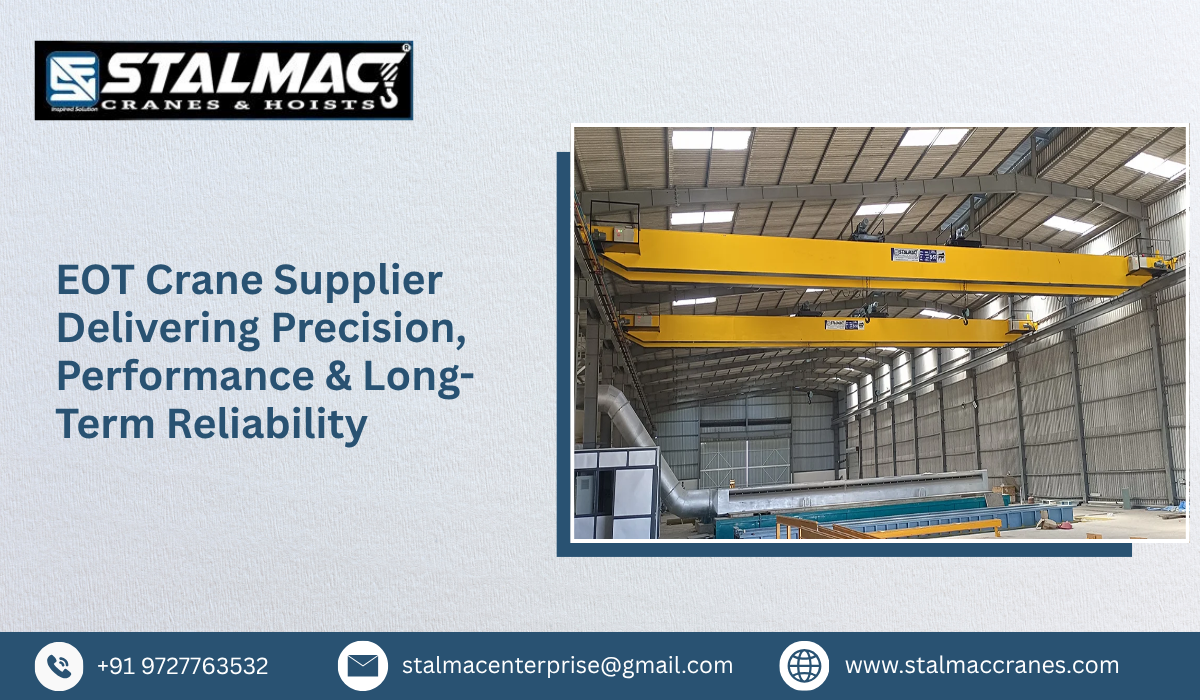
EOT Crane Supplier Delivering Precision, Performance & Long-Term Reliability
Introduction
In modern industrial environments, efficient material handling is essential for maintaining productivity, improving workplace safety, and reducing operational downtime. EOT (Electric Overhead Travelling) cranes are widely used to lift, move, and position heavy materials across manufacturing plants, warehouses, engineering workshops, and industrial facilities. Choosing the right crane supplier helps businesses obtain equipment that meets their lifting requirements, operating conditions, and long-term performance expectations.
Stalmac Cranes focuses on industrial crane solutions designed to support dependable material handling and efficient operations. Businesses looking for an EOT Crane Supplier can evaluate crane capacity, structural design, hoisting mechanisms, control systems, safety features, and maintenance requirements before selecting a suitable solution. A properly specified EOT crane can streamline production workflows, reduce manual handling, and improve the utilization of available factory space.
As industrial requirements continue to evolve, selecting an experienced supplier that understands application-specific lifting needs becomes increasingly important. The right equipment configuration can help businesses achieve precision, performance, and long-term operational reliability.
What Is an EOT Crane?
An Electric Overhead Travelling crane is a material-handling system that moves loads horizontally along elevated runway rails while using an electric hoist to lift and lower materials. It typically consists of a bridge structure, end carriages, wheels, an electric hoist or trolley, motors, brakes, electrical controls, and safety devices.
The crane travels along the runway, while the trolley moves across the bridge to position the load. This arrangement allows operators to transport materials throughout a defined working area without occupying valuable floor space.
A professional EOT Crane Supplier in India can help businesses identify the appropriate crane configuration according to load weight, lifting height, span, duty cycle, travel speed, and installation conditions.
Why Choose Stalmac Cranes?
Selecting an industrial crane involves more than comparing prices. Businesses need equipment that aligns with their production processes, available workspace, and expected operating cycles. Stalmac Cranes aims to address these requirements through application-focused crane solutions and attention to functional design.
When evaluating an EOT Crane Supplier, consider the following factors:
- Application-specific configuration: Crane capacity, span, lifting height, and travel requirements should match the intended operation.
- Structural strength: The bridge girder, end carriages, runway arrangement, and supporting structure must be suitable for the specified loads.
- Reliable operating components: Motors, brakes, hoists, wheels, and electrical systems should be selected for the required duty conditions.
- Operator-friendly controls: Pendant controls or radio remote controls can support convenient operation when appropriately specified.
- Safety provisions: Overload protection, emergency stops, limit switches, and other suitable protective devices help manage operational risks.
- Maintenance accessibility: Components should be accessible for routine inspections, servicing, and replacement.
Businesses comparing EOT Crane Suppliers in India should also review technical documentation, warranty conditions, installation requirements, and after-sales support.
Types of EOT Cranes Available for Industrial Applications
Different industries require different crane configurations. The correct choice depends on lifting capacity, workspace dimensions, operating frequency, and the nature of the material being handled.
1. Single Girder EOT Crane
A single girder crane uses one main bridge girder with a suitable hoist and trolley arrangement. It is commonly considered for light-to-medium-duty material handling, depending on the design and rated capacity.
A Single Girder EOT Crane Supplier can help businesses assess whether this configuration suits workshops, assembly lines, storage areas, and general manufacturing applications. Its relatively compact structure can be beneficial where building height and available space are limited.
2. Double Girder EOT Crane
A double girder crane uses two main bridge girders and is often selected for heavier loads, greater spans, or demanding operating requirements. Depending on the design, it can accommodate higher lifting heights and specialized hoisting arrangements.
A Double Girder EOT Crane Supplier should assess the required capacity, duty classification, hook approach, runway loads, and operating environment before recommending a configuration.
3. Customized Electric Overhead Travelling Cranes
Specialized facilities may require particular lifting heights, travel speeds, control arrangements, or environmental protection. An Electric Overhead Travelling Crane Supplier can help evaluate these parameters and identify a configuration suitable for the intended application.
Advantages of EOT Cranes
EOT cranes provide several operational benefits when correctly designed, installed, and maintained.
- Improved productivity: Efficient horizontal and vertical movement reduces delays in material transportation.
- Better space utilization: Overhead movement keeps floor areas available for production, storage, and personnel movement.
- Reduced manual handling: Mechanized lifting reduces dependence on manual movement of heavy loads.
- Precise load positioning: Appropriate controls and variable-speed systems can support accurate placement.
- Consistent material flow: Cranes help transfer components between workstations and production stages.
- Operational flexibility: Suitable configurations can handle different load types within their rated operating limits.
- Long-term service potential: Proper maintenance and correct duty selection help extend equipment service life.
Working with a Reliable EOT Crane Supplier helps businesses consider these advantages alongside installation conditions, operating costs, and safety requirements.
Industrial Applications of EOT Cranes
EOT cranes support material handling across a broad range of industries.
- Manufacturing plants: Moving machine components, fabricated parts, and production materials.
- Engineering workshops: Handling heavy assemblies, tools, and equipment during fabrication and maintenance.
- Warehouses: Transferring bulky goods and industrial materials within designated storage areas.
- Automotive facilities: Positioning vehicle components, dies, and production assemblies.
- Steel and metal industries: Handling metal sections, fabricated structures, and suitable processed materials.
- Power and infrastructure projects: Moving heavy components during manufacturing, assembly, and servicing.
- Cement and process industries: Supporting maintenance and material-handling activities where suitable crane configurations are required.
A Heavy Duty EOT Crane Supplier should consider load characteristics, environmental conditions, lifting frequency, and the applicable duty classification for demanding applications.
Technical Factors to Consider Before Selecting an EOT Crane
A suitable crane specification starts with a detailed assessment of the workplace and its lifting requirements. A Precision EOT Crane Manufacturer or experienced supplier should help clarify the following technical parameters:
- Rated lifting capacity: Determine the maximum intended load, including the relevant lifting attachment where applicable.
- Span: Measure the distance between the runway rail centre lines.
- Lifting height: Establish the required vertical travel and hook approach.
- Duty classification: Assess operating frequency, load spectrum, and expected working cycles.
- Travel speeds: Select appropriate hoisting, cross-travel, and long-travel speeds for the application.
- Building structure: Verify runway beams, supporting columns, wheel loads, and available headroom.
- Electrical requirements: Confirm supply voltage, frequency, motor ratings, and control arrangements.
- Safety and compliance: Review applicable Indian standards, site safety requirements, and inspection procedures.
Businesses seeking a High Quality EOT Crane Supplier should request a detailed technical proposal rather than selecting equipment based solely on rated capacity or initial cost.
EOT Crane Manufacturer and Supplier in India
India's manufacturing, engineering, logistics, and infrastructure sectors rely on effective material-handling equipment. Companies researching an EOT Crane Manufacturer in India or EOT Crane Manufacturers in India should compare engineering capabilities, available crane configurations, documentation, component specifications, and service arrangements.
An Industrial EOT Crane Supplier should provide clear information about crane design, rated capacity, installation requirements, operating limitations, and maintenance schedules. Buyers looking for the Best EOT Crane Supplier in India or Top EOT Crane Suppliers in India can evaluate these measurable factors against their individual project requirements.
For businesses sourcing equipment internationally, an EOT Crane Exporter in India should also be able to clarify packaging, shipping arrangements, technical documentation, destination-country requirements, and commissioning responsibilities.
Maintenance for Long-Term Reliability
Regular inspection and preventive maintenance are essential for safe crane operation. Recommended activities should follow the manufacturer's instructions, applicable standards, and site-specific maintenance procedures.
Key maintenance practices include:
- Inspecting wire ropes, chains, hooks, and lifting attachments.
- Checking brakes, limit switches, and overload protection systems.
- Examining wheels, rails, bearings, and structural connections.
- Monitoring motors, gearboxes, electrical panels, and control devices.
- Lubricating designated components at the recommended intervals.
- Maintaining inspection records and addressing identified defects promptly.
A qualified maintenance team should remove defective equipment from service when required and verify safe operation before returning it to use.
Frequently Asked Questions
1. What does an EOT crane supplier provide?
An EOT crane supplier helps businesses select suitable crane configurations and may coordinate equipment supply, technical specifications, installation, commissioning, and maintenance support according to the agreed scope.
2. What is the difference between single girder and double girder EOT cranes?
Single girder cranes use one main bridge girder and are often selected for lighter applications. Double girder cranes use two main girders and can suit heavier loads or greater lifting requirements, depending on their design.
3. How do I select the correct EOT crane capacity?
Consider the maximum intended load, lifting attachments, operating frequency, load characteristics, span, lifting height, and structural limitations. A qualified crane specialist should verify the final specification.
4. What affects EOT crane cost?
Price depends on rated capacity, span, lifting height, duty classification, hoist configuration, travel speeds, safety systems, installation requirements, and customization.
Conclusion: Contact Stalmac Cranes
Choosing the right crane solution can improve material flow, support workplace safety, and contribute to consistent industrial productivity. From single girder systems to heavy-duty double girder configurations, every installation should be selected according to verified technical requirements and operating conditions.
Stalmac Cranes is a starting point for businesses exploring industrial overhead crane solutions. Visit stalmaccranes.com to learn more about the company and enquire about a suitable crane configuration for your facility. Share your lifting capacity, span, lifting height, application, and duty requirements to help establish an appropriate technical specification focused on precision, performance, and long-term reliability.

