Exploring the Benefits and Impact of Jib Cranes Manufactured in India
Introduction to Stalmac Cranes
Jib cranes are essential material-handling equipment used in manufacturing plants, warehouses, workshops, assembly units, and industrial facilities. They help lift, lower, and move heavy materials safely and efficiently within a designated working area. As industries focus on improving productivity, reducing manual handling, and optimizing workspace utilization, jib cranes have become an important part of modern lifting operations.
Stalmac Cranes provides industrial crane solutions designed to support material-handling requirements across different applications. Businesses looking for Jib Crane Manufacturers in India often consider factors such as lifting capacity, operating radius, installation space, structural strength, and maintenance requirements before selecting equipment. A properly designed jib crane can streamline repetitive lifting tasks, improve workflow, and support safer industrial operations.
India's growing manufacturing and infrastructure sectors have increased the demand for dependable lifting equipment. Working with an experienced Jib Crane Manufacturer in India can help businesses identify suitable crane configurations according to their operational requirements, available space, and load-handling needs.
What Is a Jib Crane and How Does It Work?
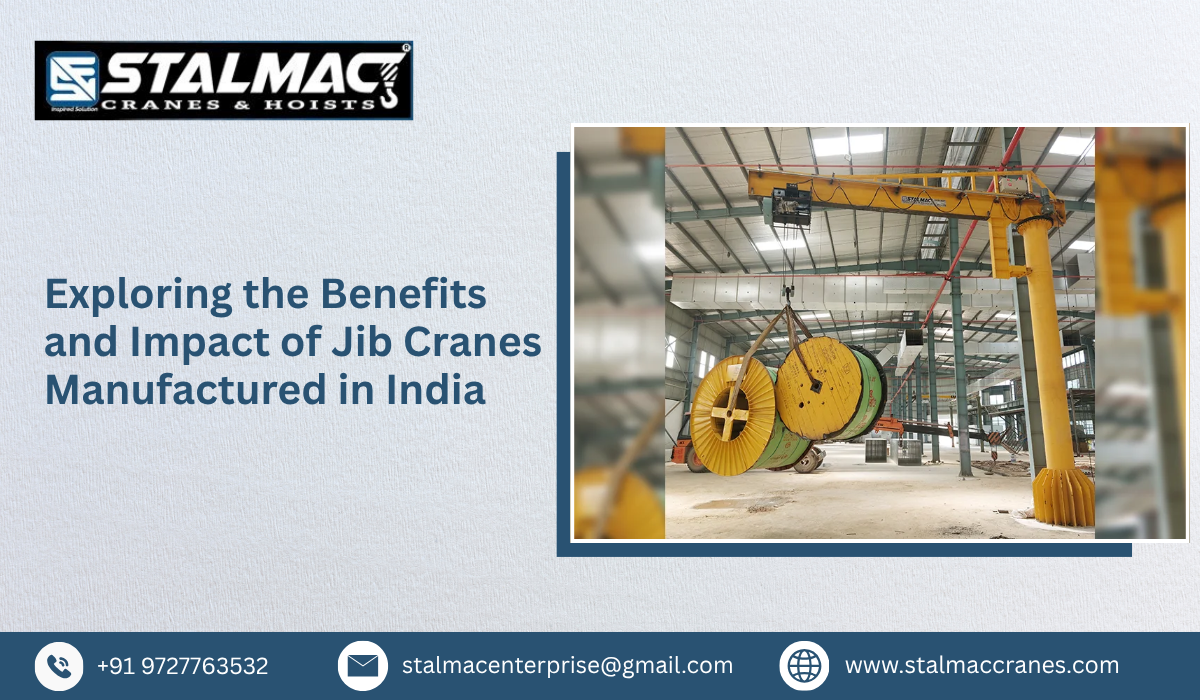
A jib crane is a lifting system consisting of a horizontal or angled boom, known as a jib, supported by a vertical structure or wall-mounted bracket. A hoist travels along the jib to lift and lower materials, while the boom may rotate to transfer loads between designated positions.
Depending on the design, jib cranes can offer manual or motorized rotation and electric or manual hoisting arrangements. Their compact structure makes them suitable for individual workstations and production areas where a large overhead crane system may not be necessary.
Businesses comparing Jib Crane Suppliers in India should evaluate the crane's rated capacity, boom length, rotation angle, hoist speed, duty classification, and mounting arrangement. These technical considerations help ensure that the selected equipment matches the intended lifting application.
Advantages of Jib Cranes Manufactured in India
Jib cranes offer several operational advantages when appropriately selected, installed, and maintained.
- Improved productivity: Jib cranes simplify repetitive lifting operations and help workers move components between nearby workstations with less manual effort.
- Efficient space utilization: Wall-mounted and column-mounted configurations can support localized lifting without requiring a complete overhead crane runway.
- Enhanced workplace safety: Properly rated cranes, suitable lifting accessories, and defined operating procedures can reduce the risks associated with manual material handling.
- Flexible material handling: Different boom lengths, rotation angles, and hoist arrangements accommodate varied workstation layouts.
- Reduced material-handling time: Dedicated lifting equipment can shorten loading, unloading, assembly, and component-transfer cycles.
- Application-specific configurations: Industrial facilities can select crane arrangements according to their load weights, operating frequency, and available installation space.
- Maintenance accessibility: Accessible hoists, electrical components, and mechanical assemblies can simplify routine inspection and servicing when the equipment is designed appropriately.
The value offered by Best Jib Crane Manufacturers in India depends on engineering quality, component selection, safety provisions, and the suitability of the crane for its working environment.
Types of Jib Cranes for Industrial Applications
Selecting the right configuration is important for achieving safe and efficient lifting performance.
1. Wall-Mounted Jib Cranes
A wall-mounted jib crane attaches to a suitable building column or structural wall. It can be useful where floor space is limited and the supporting structure has sufficient strength to withstand the crane's operating loads.
A reliable Wall Mounted Jib Crane Manufacturer should consider the mounting arrangement, boom reach, rotation requirements, and structural forces transferred to the building.
2. Floor-Mounted Jib Cranes
Floor-mounted jib cranes generally use a vertical mast secured to an engineered foundation. They provide a dedicated lifting station and can be installed in workshops, manufacturing facilities, and assembly areas.
A qualified Floor Mounted Jib Crane Manufacturer should assess the foundation, anchor bolts, load capacity, boom length, and required operating radius before installation.
3. Freestanding and Articulating Jib Cranes
Freestanding designs provide localized lifting independent of a wall attachment, subject to suitable foundation requirements. Articulating jib cranes use jointed boom sections to reach around obstacles or into confined work areas.
An experienced Industrial Jib Crane Manufacturer can help determine which configuration is appropriate for the layout, lifting cycle, and operating environment.
Applications of Jib Cranes Across Industries
Jib cranes are used in a wide range of industrial environments because they provide localized lifting and positioning capabilities.
- Manufacturing plants: Moving machine parts, metal components, tools, and assemblies between production stations.
- Automotive workshops: Handling engines, gearboxes, vehicle components, and maintenance equipment.
- Warehouses: Supporting localized loading, unloading, and movement of materials near workbenches or storage areas.
- Fabrication units: Positioning steel sections, fabricated components, and welding assemblies.
- Engineering workshops: Lifting machinery components during maintenance, repair, and equipment installation.
- Packaging and processing facilities: Transferring containers, equipment parts, and production materials.
- Power and infrastructure projects: Supporting suitable component-handling tasks during equipment assembly and servicing.
Businesses evaluating Jib Crane Suppliers in India should confirm that the proposed equipment is appropriate for the load, lifting frequency, environmental conditions, and available working clearance.
Factors to Consider When Choosing a Jib Crane
Before purchasing a jib crane, businesses should assess several technical and operational factors.
- Lifting capacity: Determine the maximum load, including the relevant lifting accessories, and select equipment with an appropriate rated capacity.
- Working radius: Measure the horizontal distance required to move materials safely between lifting and placement points.
- Mounting structure: Confirm that the wall, column, floor, and foundation can withstand the applicable loads and moments.
- Rotation requirements: Choose the required rotation range based on workstation layout and operating clearances.
- Hoist selection: Evaluate lifting height, lifting speed, control method, and duty cycle.
- Operating environment: Consider dust, humidity, temperature, corrosive exposure, and indoor or outdoor use.
- Safety and maintenance: Review limit switches where applicable, overload protection, braking systems, inspection access, and servicing requirements.
When comparing a Jib Crane Supplier in India with other equipment providers, businesses should also check technical documentation, installation support, spare-parts availability, and after-sales service.
Impact of Indian Jib Crane Manufacturing on Industry
The availability of locally manufactured lifting equipment supports industrial material-handling requirements across India's manufacturing ecosystem. Domestic sourcing can offer practical advantages in communication, customization discussions, component availability, and service coordination, depending on the supplier's capabilities.
A dependable Jib Crane Manufacturing Company in India can help businesses select equipment for their production layouts and operating conditions. Local manufacturing may also simplify coordination during installation, commissioning, inspection, and maintenance.
Companies searching for Top Jib Crane Manufacturers in India should compare documented engineering capabilities, product specifications, quality-control processes, applicable safety standards, and service arrangements rather than relying only on marketing claims.
For organizations seeking an export-oriented solution, a Jib Crane Exporter in India should also be able to address destination-country requirements, documentation, packaging, shipping arrangements, and applicable technical standards.
Why Choose Stalmac Cranes?
Stalmac Cranes focuses on industrial crane solutions for businesses with material-handling requirements. When evaluating equipment from Stalmac Cranes, customers should discuss the intended application, maximum load, lifting height, boom reach, mounting conditions, and frequency of operation.
As part of the selection process, businesses can request technical specifications, configuration details, installation requirements, and maintenance recommendations to assess the suitability of the proposed crane. This approach helps align equipment selection with operational objectives and workplace safety requirements.
For businesses researching Jib Crane Manufacturers in India, a clear understanding of application needs and technical specifications is an important starting point for selecting the right lifting system.
Frequently Asked Questions (FAQs)
1. What is the primary purpose of a jib crane?
A jib crane lifts, lowers, and positions materials within a defined working area, helping simplify repetitive industrial lifting tasks.
2. Which industries commonly use jib cranes?
Manufacturing, automotive, fabrication, warehousing, engineering, maintenance, and processing facilities commonly use jib cranes.
3. What is the difference between wall-mounted and floor-mounted jib cranes?
Wall-mounted cranes attach to a suitable building structure, while floor-mounted cranes use a mast secured to an engineered foundation.
4. How do I choose the right jib crane capacity?
Consider the maximum load, lifting accessories, operating frequency, reach, and relevant design requirements. Consult a qualified crane professional before finalizing the capacity.
5. Are jib cranes suitable for small workshops?
Yes. When the load and installation conditions are suitable, compact jib cranes can provide an effective lifting solution for small workshops and individual workstations.
Conclusion
Jib cranes play an important role in improving material flow, supporting workplace safety, and simplifying localized lifting operations. Their effectiveness depends on selecting the correct design, capacity, mounting arrangement, and hoist configuration for the intended application.
Stalmac Cranes can be considered when exploring industrial crane solutions for manufacturing plants, workshops, and other material-handling environments. Visit stalmaccranes.com to learn more about the company's offerings and discuss your jib crane requirements with its team.

