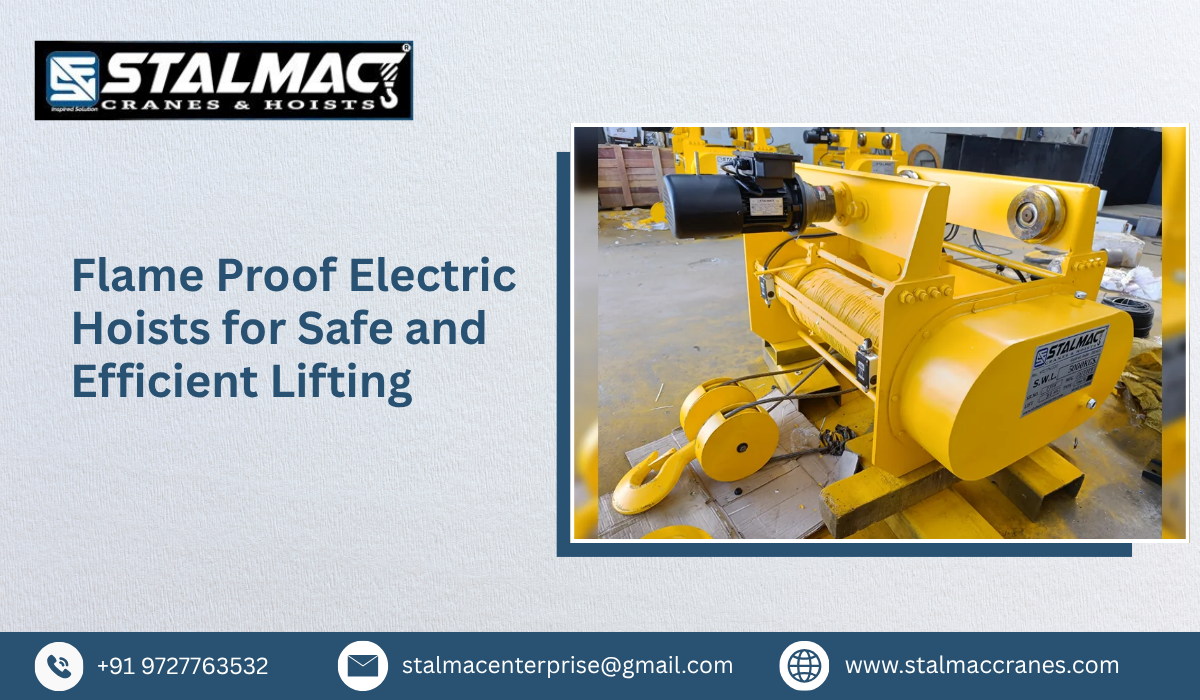
Flame Proof Electric Hoist – Flame Proof Electric Hoists for Safe and Efficient Lifting
Introduction
Industrial lifting operations require equipment that combines high performance, operational reliability, and workplace safety. In industries where flammable gases, vapours, combustible dust, or hazardous materials may be present, standard lifting equipment may not provide the required level of protection. A Flame Proof Electric Hoist is designed for lifting and lowering heavy loads in specified hazardous environments using appropriately protected electrical components and construction.
Stalmac Cranes focuses on industrial material handling and lifting solutions designed to support demanding operational requirements. Choosing a suitable flame-proof hoist can help businesses improve material handling efficiency, reduce manual lifting, and support safer working practices. The selection process should consider the hazardous-area classification, lifting capacity, operating frequency, lifting height, and applicable safety standards.
For businesses seeking a Flame Proof Electric Hoist Manufacturer in India, understanding the equipment's technical specifications and intended working environment is essential. A correctly selected hoist can support consistent lifting performance in facilities where ignition risks must be carefully controlled.
What Is a Flame Proof Electric Hoist?
A Flame Proof Electric Hoist is an electrically powered lifting device engineered for use in designated hazardous areas. Depending on its certified design, the hoist may incorporate protected motors, electrical enclosures, switching components, braking systems, and cable or pendant controls intended to minimise ignition risks.
Flame-proof equipment is generally designed so that an internal ignition, under specified conditions, does not ignite the surrounding explosive atmosphere. The enclosure and other protection measures must be suitable for the relevant gas or dust group, temperature classification, and hazardous-zone requirements.
Unlike a conventional electric hoist, a properly certified flame-proof model is selected according to the area's specific explosion-protection requirements. It should never be assumed that a product is suitable for every hazardous environment simply because it is described as flame-proof.
How Does a Flame Proof Electric Hoist Work?
An electric hoist uses an electric motor to drive a lifting mechanism through a gearbox, drum, or load chain, depending on its design. The mechanism raises or lowers the load using a chain or wire rope, while a braking system helps hold the load when lifting stops.
A typical flame-proof hoist includes the following components:
- Flame-proof motor: Provides lifting power with protection appropriate to the specified hazardous environment.
- Lifting mechanism: Uses a chain or wire rope to handle the load.
- Gearbox: Transfers motor power to the lifting mechanism.
- Braking system: Helps control movement and hold suspended loads.
- Control system: Enables the operator to operate lifting and lowering functions.
- Limit switches: Restrict travel where fitted and configured for the application.
- Protective enclosure: Provides the specified protection for electrical components.
The complete assembly must be suitable for the intended hazardous area. Correct installation, grounding, inspection, and maintenance are essential to maintaining safe operation.
Advantages of Flame Proof Electric Hoists
Installing a suitable flame-proof lifting system can improve material handling efficiency while supporting hazardous-area safety procedures. The major advantages include:
- Enhanced workplace safety: Properly certified components help reduce the risk of ignition from electrical equipment in designated hazardous environments.
- Efficient load handling: Motor-driven lifting reduces manual effort and supports faster movement of materials.
- Controlled lifting operations: Braking systems and suitable travel controls help operators position loads more accurately.
- Durable construction: Industrial-grade mechanical components are designed to withstand demanding working conditions.
- Reduced manual handling: Mechanised lifting can minimise physical strain and improve workflow.
- Flexible installation: Depending on the model, hoists can be integrated into compatible overhead cranes, monorail systems, and other lifting arrangements.
- Maintenance convenience: Accessible components and planned servicing can help minimise avoidable downtime.
Businesses evaluating an Industrial Flame Proof Hoist should select a configuration based on actual operating conditions, rather than capacity alone. The required explosion-protection certification, duty cycle, and installation arrangement are equally important.
Industrial Applications of Flame Proof Electric Hoists
Typical application environments include:
-
Oil and Gas Industry
Hoists can support equipment maintenance, component replacement, and material movement in appropriately classified refinery, petroleum storage, and gas-processing areas.
-
Chemical and Petrochemical Plants
Suitable systems help handle pumps, machine parts, tools, and production components in areas where flammable substances may be present.
-
Pharmaceutical and Process Industries
Certified lifting equipment can be used for maintenance and material handling in designated hazardous process areas, subject to facility requirements.
-
Mining and Industrial Workshops
Appropriate hoists support the handling of machinery components, tools, and heavy parts where the area's dust, gas, and environmental classifications permit their use.
Other potential applications include gas power plants, oil warehouses, paint and solvent handling facilities, and selected manufacturing units. The exact equipment protection must match the identified hazards.
Technical Features to Consider Before Buying
When comparing models from a Flame Proof Electric Hoist Supplier in India, review these technical parameters:
- Rated lifting capacity: Determine the maximum working load, including the weight of any lifting attachments where applicable.
- Lifting height: Select a suitable hook travel distance based on the facility layout.
- Lifting speed: Consider standard or dual-speed operation according to the required positioning accuracy and productivity.
- Duty classification: Match the mechanism's rated duty to the expected operating frequency, load spectrum, and working hours.
- Explosion protection: Verify the applicable equipment protection level, gas or dust group, temperature class, and hazardous-zone suitability.
- Power supply: Confirm voltage, phase, frequency, motor ratings, and control-system requirements.
- Braking and limits: Review brake performance, upper and lower limit switches, overload protection, and emergency-stop arrangements where applicable.
- Installation and servicing: Assess available headroom, supporting structure, inspection access, and spare-parts availability.
Stalmac's published flame-proof hoist information describes applications in hazardous industrial environments and references IS-2148. Buyers should verify the current applicable standards and the exact certification of the proposed model before installation.
Choosing the Right Manufacturer, Supplier, and Exporter
A dependable Flame Proof Electric Hoist Manufacturer in India should understand the customer's load requirements, operating environment, and relevant safety obligations. Technical documentation, quality checks, installation guidance, and after-sales support are important considerations when purchasing industrial lifting equipment.
Companies comparing Flame Proof Electric Hoist Supplier in India options should request detailed specifications, drawings, inspection records, warranty terms, and confirmation of the equipment's hazardous-area certification.
For international procurement, a Flame Proof Electric Hoist Exporter in India should also clarify destination-country requirements, documentation, packaging, and shipping arrangements.
Similarly, businesses researching Flameproof Hoist Manufacturers in India and Flameproof Electric Hoist Suppliers in India should compare product configurations, maintenance requirements, and technical support rather than relying exclusively on price.
An Explosion Proof Electric Hoist is another commonly used term for lifting equipment designed for specified explosive atmospheres. The precise protection method and certification must still be verified. When sourcing from an Explosion Proof Hoist Manufacturer in India, ensure that the complete hoist assembly is appropriate for the intended application.
Why Choose Stalmac Cranes?
Stalmac provides industrial lifting and material handling solutions for different manufacturing and process-industry requirements. Its published product range includes flame-proof hoists designed for hazardous-area applications.
Businesses considering Stalmac Cranes can discuss lifting capacity, lifting height, installation requirements, operating frequency, and suitable protection specifications with the company before finalising an order. This helps align equipment selection with operational needs and applicable safety requirements.
The objective is to obtain a lifting solution that combines dependable mechanical performance, appropriate electrical protection, manageable maintenance, and efficient material handling.
Frequently Asked Questions (FAQs)
1. What is a Flame Proof Electric Hoist used for?
It is used for lifting and lowering loads in designated hazardous environments where equipment must meet specific explosion-protection requirements.
2. What is the difference between a flame-proof and a standard electric hoist?
A flame-proof model incorporates protection designed for specified hazardous-area conditions, whereas a standard hoist may not be certified for explosive atmospheres.
3. Which industries use flame-proof hoists?
Common applications include oil and gas, petrochemical, chemical processing, selected pharmaceutical operations, and other facilities with classified hazardous areas.
4. How do I select the correct hoist capacity?
Consider the maximum load, lifting accessories, lifting height, operating frequency, and duty classification. The supporting structure must also be suitable for the imposed loads.
5. Does every flame-proof hoist suit every hazardous area?
No. Equipment must be selected according to the area's classification, the type of explosive atmosphere, temperature requirements, and the hoist's certification.
Conclusion: Contact Stalmac Cranes for Industrial Lifting Solutions
A properly specified Flame Proof Electric Hoist supports controlled lifting, improved material handling efficiency, and safer operations in designated hazardous environments. Choosing the correct capacity, protection level, braking arrangement, and duty rating is essential for dependable performance.
Stalmac Cranes can be contacted to discuss suitable lifting configurations for your facility. Share your load capacity, lifting height, operating conditions, and hazardous-area classification to help identify an appropriate solution for your industrial requirements.

