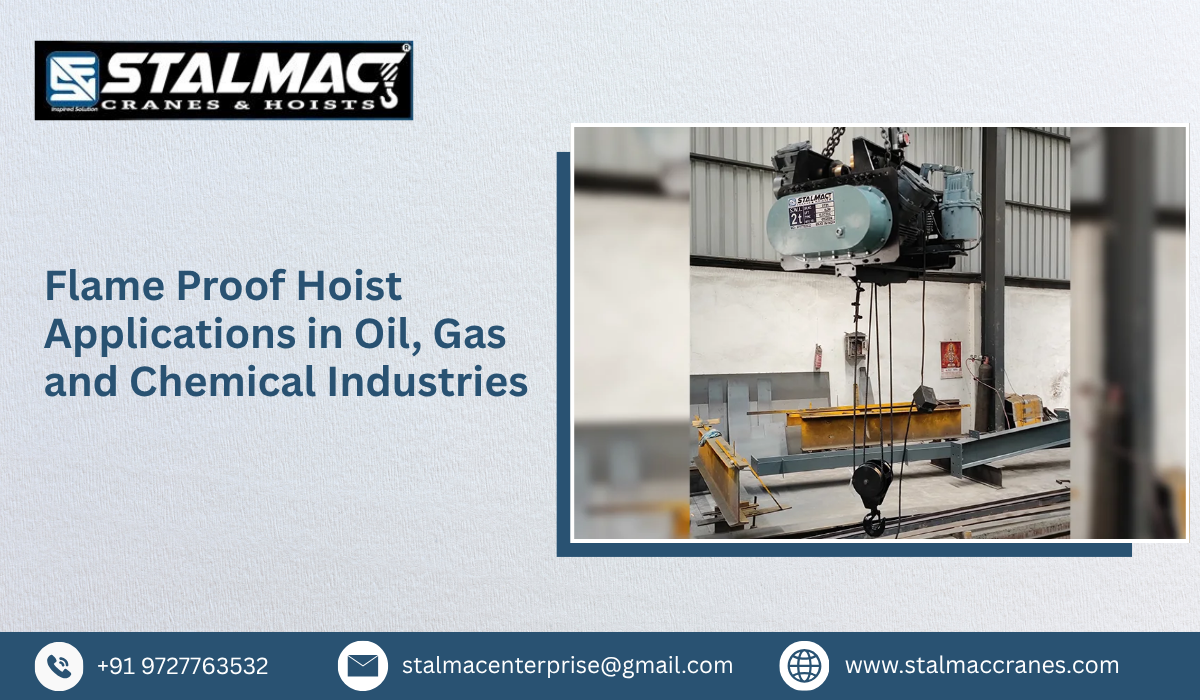
Flame Proof Hoist Applications in Oil, Gas and Chemical Industries
Introduction to Flame Proof Hoists
In industries where flammable gases, combustible vapours, and hazardous chemicals are present, safe material handling is a critical operational requirement. Oil refineries, gas processing plants, petrochemical facilities, and chemical manufacturing units require specialised lifting equipment designed to minimise the risk of ignition in potentially explosive environments. A Flame Proof Hoist is engineered for lifting and lowering heavy loads in designated hazardous areas when configured with suitable explosion-protection features.
Stalmac Cranes focuses on industrial lifting solutions designed to support material handling requirements across different industrial sectors. Selecting the right hoist involves evaluating the hazardous-area classification, load capacity, lifting height, operating frequency, and applicable safety standards. A properly specified Industrial Flame Proof Hoist can help improve workplace safety, operational efficiency, and equipment reliability.
What Is a Flame Proof Hoist?
A flame proof hoist is a specialised lifting device designed for operation in specified hazardous environments. Depending on its certified design, the hoist may incorporate protected electrical components, suitable motors, enclosed switching arrangements, and other features intended to prevent an internal ignition from igniting the surrounding explosive atmosphere.
A Flame Proof Electric Hoist may be supplied with a wire rope or chain lifting mechanism, depending on the application. For higher capacities and demanding industrial duties, a Flame Proof Wire Rope Hoist can provide controlled lifting, dependable load positioning, and suitability for repetitive material handling operations.
When choosing a Hazardous Area Electric Hoist, it is important to verify that the complete equipment configuration is suitable for the intended gas or dust group, temperature class, zone or division, and environmental conditions. Flame-proof construction alone does not automatically make equipment suitable for every hazardous location.
Flame Proof Hoist Applications in Oil, Gas and Chemical Industries
The Flame Proof Hoist Applications across hazardous industries vary according to plant layout, material weight, process requirements, and the nature of the surrounding atmosphere. These hoists are commonly considered for maintenance operations, equipment installation, component replacement, and the movement of industrial materials.
Oil Refineries and Petroleum Processing Plants
Oil refineries handle flammable hydrocarbons throughout storage, processing, and transfer operations. Appropriate hazardous-area lifting equipment can support maintenance and material handling in designated refinery areas.
Common applications include:
- Lifting pumps, valves, and mechanical assemblies during maintenance.
- Handling replacement components around processing equipment.
- Moving tools and spare parts in designated hazardous work zones.
- Supporting equipment installation and planned shutdown activities.
- Positioning heavy components where controlled vertical lifting is required.
A Flame Proof Hoist for Oil and Gas Industry applications must be selected according to the refinery's hazardous-area classification and operating requirements.
Oil and Gas Exploration and Processing
Oil and gas facilities often require lifting equipment for equipment maintenance, machinery handling, and the replacement of heavy components. Depending on the site design, suitable hoists may be used in onshore processing plants, gas treatment facilities, and other classified industrial locations.
Typical applications include:
- Lifting compressor components and auxiliary equipment.
- Handling valves, flanges, and pipeline maintenance components.
- Supporting repair work on processing skids.
- Moving heavy spare parts in designated hazardous areas.
- Assisting with installation and maintenance of gas processing equipment.
A Heavy Duty Flame Proof Hoist may be appropriate for frequent lifting cycles or demanding loads when its rated capacity, duty classification, and operating limits match the application.
Chemical Manufacturing Industries
Chemical plants may contain flammable solvents, reactive chemicals, combustible vapours, or other substances that require specialised equipment selection. A Flame Proof Hoist for Chemical Industry applications can support maintenance and production-related lifting in appropriately classified areas.
Key applications include:
- Lifting agitator assemblies and mixer components.
- Handling pumps, motors, and chemical-processing equipment.
- Moving maintenance components near solvent-handling systems.
- Supporting equipment replacement in designated production zones.
- Handling heavy parts during plant maintenance and shutdowns.
Equipment selection should account for both explosion hazards and chemical corrosion. Suitable protective coatings, materials, ingress protection, and environmental ratings may be necessary depending on the site conditions.
Petrochemical and Gas Storage Facilities
Petrochemical plants and gas storage terminals may require lifting systems for equipment servicing, component movement, and infrastructure maintenance.
Typical applications include:
- Handling pump and valve assemblies.
- Lifting mechanical components during scheduled inspections.
- Moving spare parts in approved hazardous locations.
- Supporting maintenance around storage and transfer infrastructure.
- Positioning equipment for installation and repair work.
The lifting system must be compatible with the specific hazards identified in the facility's engineering assessment.
Advantages of Using a Flame Proof Hoist
Choosing a correctly specified Flame Proof Hoist offers several operational benefits in hazardous industrial environments.
- Improved ignition-risk control: Certified protective construction helps reduce the possibility of electrical equipment igniting a surrounding explosive atmosphere when used within its approved conditions.
- Reliable material handling: Appropriate lifting capacity and controlled movement support routine maintenance and industrial operations.
- Operational efficiency: Mechanical lifting reduces dependence on manual handling for heavy components.
- Support for demanding duties: Suitable configurations can accommodate repetitive lifting and heavy industrial loads within their rated limits.
- Flexible installation options: Depending on the design, hoists can be integrated with monorails, gantry systems, overhead cranes, or other compatible lifting arrangements.
- Reduced manual handling risks: Mechanised lifting can help reduce physical strain and improve load-positioning control.
- Application-specific configurations: Selection can account for lifting height, speed, load capacity, duty cycle, and site conditions.
These benefits depend on correct equipment selection, installation, inspection, operator training, and preventive maintenance.
Important Technical Factors Before Selecting a Flame Proof Hoist
Before purchasing a Flame Proof Hoist Manufacturer in India product, industrial buyers should evaluate the following technical parameters.
- Safe working load: Determine the maximum load, including lifting attachments and accessories where applicable.
- Hazardous-area classification: Confirm the required zone or division, gas or dust group, and temperature class.
- Explosion-protection certification: Verify that the hoist and its electrical components have the certifications required by the applicable jurisdiction and site specifications.
- Lifting height and speed: Match the equipment to the required vertical travel and positioning accuracy.
- Duty classification: Consider operating frequency, load spectrum, and expected working cycles.
- Environmental protection: Evaluate humidity, dust, corrosive chemicals, ambient temperature, and ingress protection requirements.
- Installation compatibility: Check structural support, trolley arrangement, runway capacity, and available power supply.
- Maintenance requirements: Ensure that inspections, repairs, and replacement components can be managed safely by qualified personnel.
These checks help buyers specify an appropriate industrial lifting system rather than selecting equipment based on load capacity alone.
Why Choose Stalmac Cranes for Industrial Lifting Requirements?
As an Industrial Lifting Equipment Manufacturer category provider, Stalmac Cranes can be considered for industrial lifting requirements where technical specifications, installation arrangements, and application conditions must be evaluated together.
When assessing a Flame Proof Hoist Supplier in India, buyers should review product documentation, available configurations, rated capacities, technical support, and compliance information. For businesses searching for Flame Proof Hoist Manufacturers in Ahmedabad, a detailed technical discussion can help establish the appropriate lifting arrangement for the facility.
Stalmac Cranes' website, https://stalmaccranes.com/, is the appropriate starting point for enquiries about product availability, specifications, and project requirements. Buyers should request confirmation of the exact hazardous-area certification and equipment suitability before placing an order.
Conclusion
Flame-proof lifting equipment plays an important role in supporting material handling across oil refineries, gas processing plants, chemical manufacturing facilities, and petrochemical installations. A correctly specified hoist can support maintenance efficiency, controlled load movement, and ignition-risk management in designated hazardous areas.
For industrial buyers evaluating a Flame Proof Hoist, the essential considerations are certified hazardous-area suitability, lifting capacity, duty requirements, installation conditions, and long-term maintenance support. By defining these requirements clearly, businesses can identify an appropriate lifting solution for their operational needs.
Contact Stalmac Cranes through https://stalmaccranes.com/ to discuss your industrial lifting requirements, request technical specifications, and determine a suitable hoist configuration for your application.

