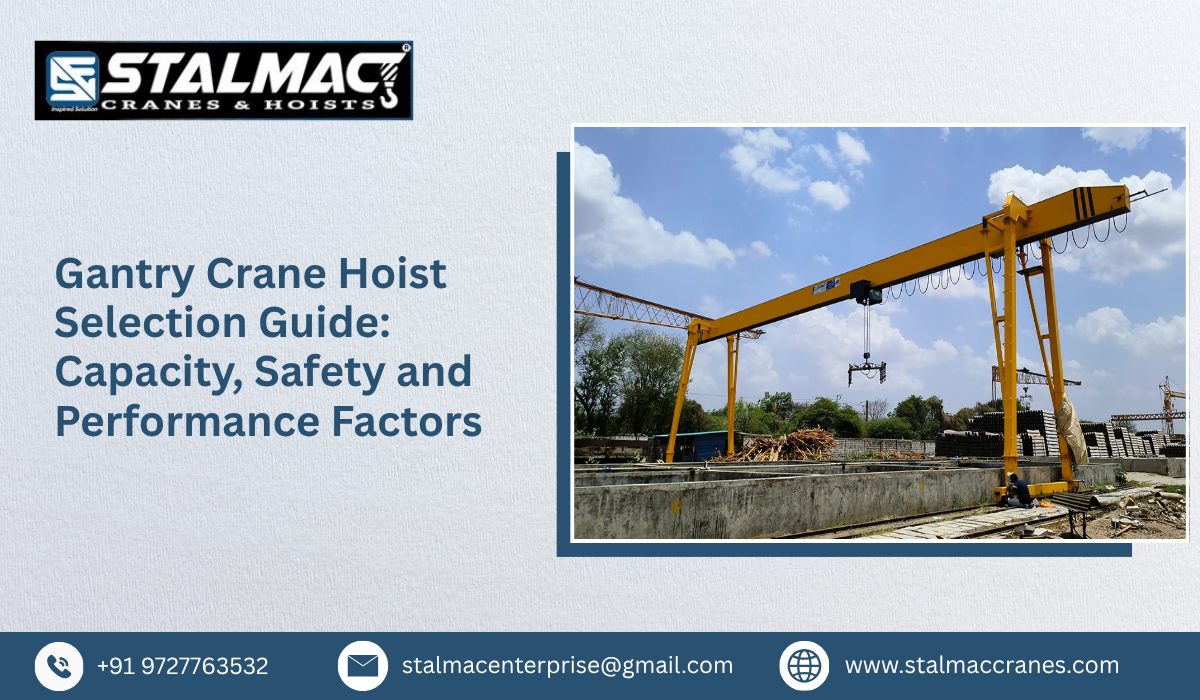
Gantry Crane Hoist Selection Guide: Capacity, Safety and Performance Factors
Introduction
Selecting the right Gantry Crane Hoist is essential for safe, efficient, and reliable material handling in industrial environments. Gantry cranes are widely used in manufacturing plants, warehouses, construction sites, engineering workshops, fabrication units, and heavy equipment handling facilities. A suitable hoist helps lift, lower, and position loads accurately while supporting productivity and reducing manual handling requirements.
Stalmac Cranes provides industrial crane and material handling solutions designed to meet different operational requirements. When selecting a hoist, businesses should evaluate lifting capacity, lifting height, operating speed, duty cycle, installation conditions, and safety features. Understanding these factors helps industries choose equipment that matches their workload and working environment.
Whether a facility requires a standard lifting solution or a Heavy Duty Gantry Crane Hoist, careful selection can improve operational efficiency, equipment life, and workplace safety. This guide explains the key considerations for choosing the right gantry crane hoist for industrial applications.
What Is a Gantry Crane Hoist?
A gantry crane hoist is a lifting mechanism installed on a gantry crane to raise and lower materials vertically. Depending on the crane configuration, the hoist may travel horizontally along a beam or trolley, allowing operators to move loads between designated positions.
Common hoist options include electric wire rope hoists and electric chain hoists. Wire rope hoists are frequently selected for industrial applications involving heavier loads, greater lifting heights, and demanding operating cycles. Chain hoists can be suitable for certain lighter-duty and space-conscious applications.
An experienced Industrial Gantry Crane Manufacturer can help determine the appropriate hoist configuration according to the required load, movement, available space, and frequency of operation.
Gantry Crane Hoist Selection Guide: Key Factors
Choosing the right equipment requires evaluating several technical and operational factors.
Gantry Crane Hoist Capacity
Gantry Crane Hoist Capacity is one of the most important considerations. The hoist must safely handle the maximum intended load, including the weight of lifting attachments and other suspended accessories where applicable.
Before selecting equipment, consider:
- Maximum and typical load weights.
- Frequency of lifting heavy materials.
- Weight of hooks, slings, grabs, and lifting attachments.
- Required lifting height and travel distance.
- Future changes in production or material handling requirements.
Gantry Crane Load Capacity must be assessed alongside the capacity of the hoist, trolley, crane structure, runway or supporting surface, and other load-bearing components. The complete system must operate within its rated limits. Selecting equipment solely on the basis of the heaviest load without checking the entire lifting system can create unnecessary risks.
Gantry Crane Safety Standards
Gantry Crane Safety Standards play a critical role in equipment selection, installation, inspection, and operation. Industries should verify that the selected hoist and crane arrangement meet applicable Indian regulations, relevant standards, and site-specific safety requirements.
Important safety features may include:
- Upper and lower travel limit switches.
- Overload protection or load-limiting devices.
- Emergency-stop controls where applicable.
- Reliable braking mechanisms.
- Appropriate electrical protection and control systems.
- Clearly displayed rated capacity and operating instructions.
Operators should receive suitable training, and the crane should undergo scheduled inspection and maintenance. Safety devices must not be bypassed to increase lifting capacity or operating speed.
Gantry Crane Performance Factors
Several Gantry Crane Performance Factors influence productivity and reliability. These include lifting speed, lowering control, trolley movement, acceleration, braking performance, duty classification, and operating environment.
For example, a fabrication plant handling heavy steel components may require controlled positioning and a hoist designed for frequent operation. A warehouse with intermittent lifting requirements may have different speed and duty-cycle priorities.
When comparing equipment, evaluate:
- Required lifting and lowering speeds.
- Frequency of starts and stops.
- Expected operating hours per shift.
- Load positioning accuracy.
- Ambient temperature, dust, and moisture.
- Availability of electrical power and maintenance support.
Variable-speed drives may help provide smoother load movement where specified and supported by the equipment design.
Advantages of Selecting the Right Gantry Crane Hoist
A correctly specified Gantry Crane Hoist can provide several operational advantages:
- Improved productivity: Suitable lifting speeds and travel arrangements can reduce material handling time.
- Enhanced workplace safety: Proper capacity selection and functional safety devices help control lifting risks.
- Better load positioning: Appropriate controls support accurate placement of machinery, components, and materials.
- Reduced manual handling: Mechanised lifting reduces dependence on manual movement of heavy objects.
- Reliable operation: Matching the hoist duty rating to actual workload helps limit unnecessary equipment stress.
- Maintenance planning: Access to serviceable components and suitable spare parts can support planned maintenance.
- Operational flexibility: Appropriate trolley and crane configurations can accommodate changing material handling needs.
These benefits depend on correct installation, operator training, regular inspection, and operation within the equipment's rated limits.
Applications of Gantry Crane Hoists
A properly selected gantry crane hoist can support lifting operations across a wide range of industries.
- Manufacturing plants: Lifting machine components, fabricated parts, and production materials.
- Engineering workshops: Moving heavy assemblies during machining, fitting, and maintenance.
- Steel fabrication facilities: Handling structural sections, plates, and welded assemblies.
- Construction projects: Positioning construction materials and equipment in suitable lifting zones.
- Warehouses: Moving heavy goods and industrial inventory.
- Automotive industries: Handling dies, tools, components, and equipment assemblies.
- Shipyards and maintenance yards: Supporting the movement of large components and machinery.
- Power and infrastructure projects: Lifting equipment parts and maintenance materials.
The required crane configuration, environmental protection, and lifting accessories should be determined according to each application's specific conditions.
Types of Gantry Crane Hoists
Different hoist types are available to meet varying industrial requirements.
Electric Wire Rope Hoist: Designed for applications that require reliable lifting performance, particularly for heavier loads and higher lifting heights. Businesses seeking an Electric Wire Rope Hoist Manufacturer in India should assess rated capacity, reeving arrangement, motor specifications, braking systems, and duty classification.
Electric Chain Hoist: Often used for lighter or moderate loads where compact dimensions and practical installation are important.
Heavy-Duty Hoist: A Heavy Duty Gantry Crane Hoist is selected for demanding service conditions, subject to its rated capacity, duty class, and operating environment.
The correct selection depends on load characteristics, lifting frequency, available headroom, maintenance access, and the crane's structural configuration.
Gantry Crane Hoist Price in India
The Gantry Crane Hoist Price in India depends on several technical and commercial factors. These include rated lifting capacity, lifting height, hoist type, lifting speed, duty classification, motor power, control options, safety accessories, and customisation requirements.
Additional costs may arise from installation, electrical work, commissioning, operator training, and maintenance arrangements. Buyers should compare quotations based on equivalent technical specifications rather than price alone.
For an accurate quotation, provide the maximum load, required lifting height, operating hours, site conditions, and preferred control arrangement. This information helps suppliers recommend equipment suited to the application.
Choosing Stalmac Cranes for Industrial Lifting Solutions
As an Industrial Lifting Equipment Manufacturer, Stalmac Cranes can be considered when evaluating crane and hoist solutions for industrial material handling requirements. Buyers should discuss their application details, capacity requirements, operating environment, and installation constraints before finalising equipment specifications.
When comparing a Gantry Crane Hoist Supplier in India or a Gantry Crane Hoist Manufacturer in India, review technical documentation, product specifications, applicable safety provisions, warranty terms, spare-parts availability, and after-sales support.
Businesses seeking a dependable Industrial Gantry Crane Manufacturer should prioritise equipment compatibility, serviceability, and clearly defined operating limits.
Conclusion
Choosing the right gantry crane hoist involves balancing lifting capacity, safety requirements, performance expectations, operating conditions, and total ownership costs. A systematic Gantry Crane Hoist Selection Guide helps businesses identify equipment that supports efficient lifting while maintaining safe working practices.
Stalmac Cranes is a potential partner for businesses evaluating industrial crane and material handling solutions. Share your lifting requirements, load details, and site conditions to identify a suitable configuration for your application. Contact Stalmac Cranes through its official website, https://stalmaccranes.com/, to discuss your industrial lifting requirements and request product information.

