Stalmac Cranes – How is an EOT Crane installed?
Installing an EOT (Electric Overhead Travelling) crane is a planned engineering activity involving structural preparation, mechanical assembly, electrical integration, alignment, testing, and safety verification. A correct EOT Crane Installation supports smooth travel, accurate lifting, and dependable operation. Stalmac Cranes approaches EOT Crane Installation around crane capacity, span, lifting height, runway arrangement, building structure, duty class, and application requirements.
Understanding the EOT Crane Installation Process
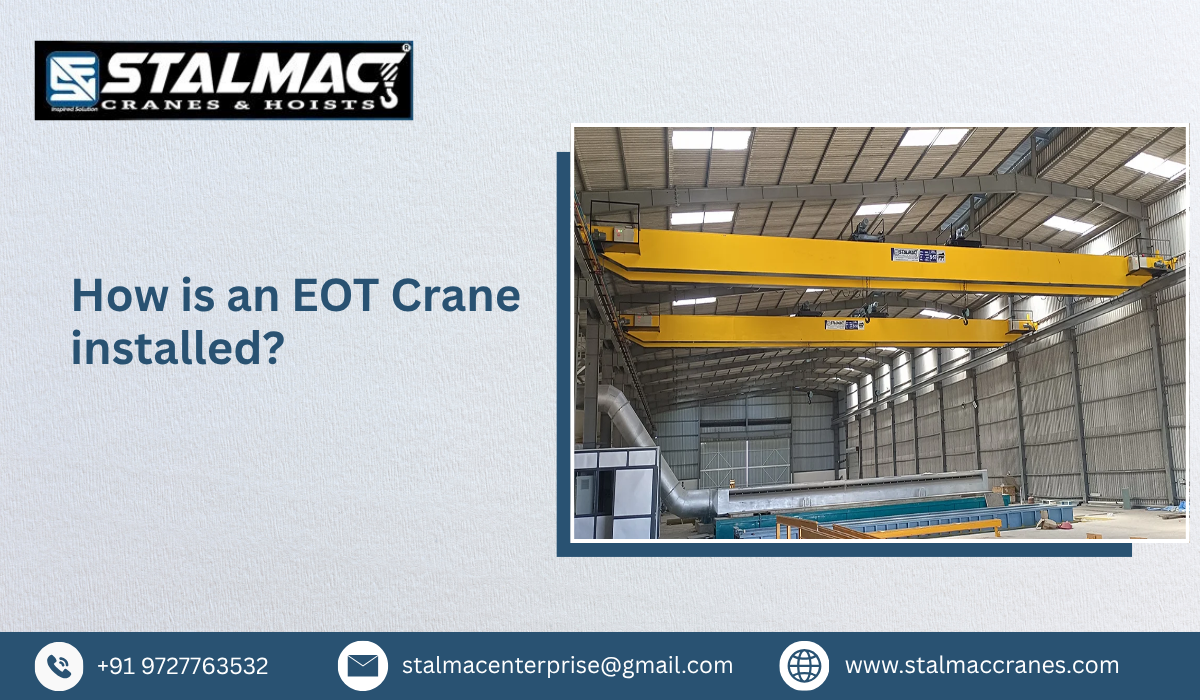
The EOT Crane Installation Process starts with a detailed site survey. Engineers verify runway beam dimensions, rail alignment, headroom, power supply, access conditions, crane span, hook approach, and load paths. Structural conditions are checked before equipment is positioned because runway deviations can affect wheel loading and travel performance.
After site approval, crane components are delivered and inspected. These may include bridge girders, end carriages, wheels, drive units, hoist or trolley, electrical panels, controls, limit switches, and safety devices. An experienced EOT Crane Manufacturer in India coordinates components according to approved drawings and project requirements. Stalmac Cranes can align the installation sequence with the equipment configuration and site conditions.
Step-by-Step EOT Crane Installation
The first physical stage is runway preparation. Rails must be positioned with proper alignment, level, gauge, and elevation. End carriages and bridge girders are then assembled using suitable lifting equipment and controlled handling methods.
The bridge is positioned on the end carriages, connections are secured, and alignment with the runway is verified. The hoist and trolley are installed, followed by checks of wheels, gearboxes, brakes, couplings, hooks, and wire-rope systems. Electrical installation includes motors, control panels, conductor arrangements, limit switches, emergency controls, overload protection, and related components. Proper earthing and cable routing are essential. For complex projects, Industrial EOT Crane Installation may include plant control integration, remote operation, or variable-frequency drives. Stalmac Cranes emphasizes systematic assembly and inspection.
Single Girder and Double Girder Installation
The method depends on crane configuration. Single Girder EOT Crane Installation generally uses a compact bridge arrangement for workshops, warehouses, fabrication areas, and production facilities. Double Girder EOT Crane Installation requires accurate positioning of two bridge girders and the trolley or hoist assembly, particularly for higher capacities, larger spans, or greater lifting heights.
Professional Overhead Crane Installation Services should consider building clearances, maintenance access, trolley travel limits, hook approach distances, and safe operating zones. These factors help prevent interference with nearby structures or machinery. Stalmac Cranes can structure installation around the operational layout for efficient material movement.
Testing, Commissioning and Safety Inspection
After mechanical and electrical work, the crane undergoes systematic inspection and functional testing. EOT Crane Safety Inspection covers brakes, hooks, ropes, wheels, electrical connections, emergency controls, limit switches, guards, structural connections, and other safety-critical components. Inspection should follow applicable project specifications, manufacturer documentation, and relevant statutory requirements.
EOT Crane Testing and Commissioning is performed before regular production use. No-load tests are followed by controlled operational checks and, where required, load testing according to applicable requirements. Engineers observe lifting, lowering, travel, braking, limit functions, vibration, and control response. Issues identified during testing should be corrected and re-tested before handover. Stalmac Cranes treats commissioning as an essential stage for verifying operational readiness.
Why Professional Installation Matters
Selecting an experienced Industrial Crane Installation Company helps reduce installation errors and supports dependable crane performance. A professional team understands structural alignment, mechanical tolerances, electrical systems, load behaviour, and operating safety. Correct installation also makes future inspection and maintenance easier.
Installation is only the beginning of the crane's service life. Scheduled EOT Crane Maintenance Services can identify lubrication requirements, brake condition, rope or hook wear, electrical faults, wheel wear, and alignment concerns before they develop into costly downtime. Preventive maintenance should reflect usage intensity, operating conditions, manufacturer recommendations, and applicable safety requirements. Stalmac Cranes can support a structured approach from installation through service planning.
Industrial Applications and Material Handling
EOT cranes are used for lifting and transferring dies, machinery, steel components, moulds, fabricated structures, raw materials, finished goods, and production assemblies. They are commonly specified for factories, foundries, steel plants, warehouses, cement facilities, power plants, fabrication shops, and other industrial environments. As a Material Handling Equipment Manufacturer and Industrial Lifting Equipment Supplier, Stalmac Cranes can provide solutions where controlled overhead movement is essential.
A dependable EOT Crane Supplier in India should consider more than equipment delivery. Capacity, span, lifting height, duty class, hoist configuration, controls, runway arrangement, and maintenance influence system performance. Stalmac Cranes can help customers evaluate these factors before installation for a practical lifting solution.
A Structured Approach to EOT Crane Installation
A successful EOT Crane Installation depends on accuracy from site survey and runway preparation to bridge erection, electrical connection, testing, commissioning, handover, and maintenance planning. Stalmac Cranes follows a structured approach focused on safety, performance, alignment, and application requirements.
For a new overhead lifting system, professional installation helps ensure that the crane operates according to its intended design and working conditions. With appropriate engineering, controlled assembly, detailed testing, and planned maintenance, an EOT crane can become a dependable part of the industrial material-handling workflow while supporting safer and more organized load movement.

