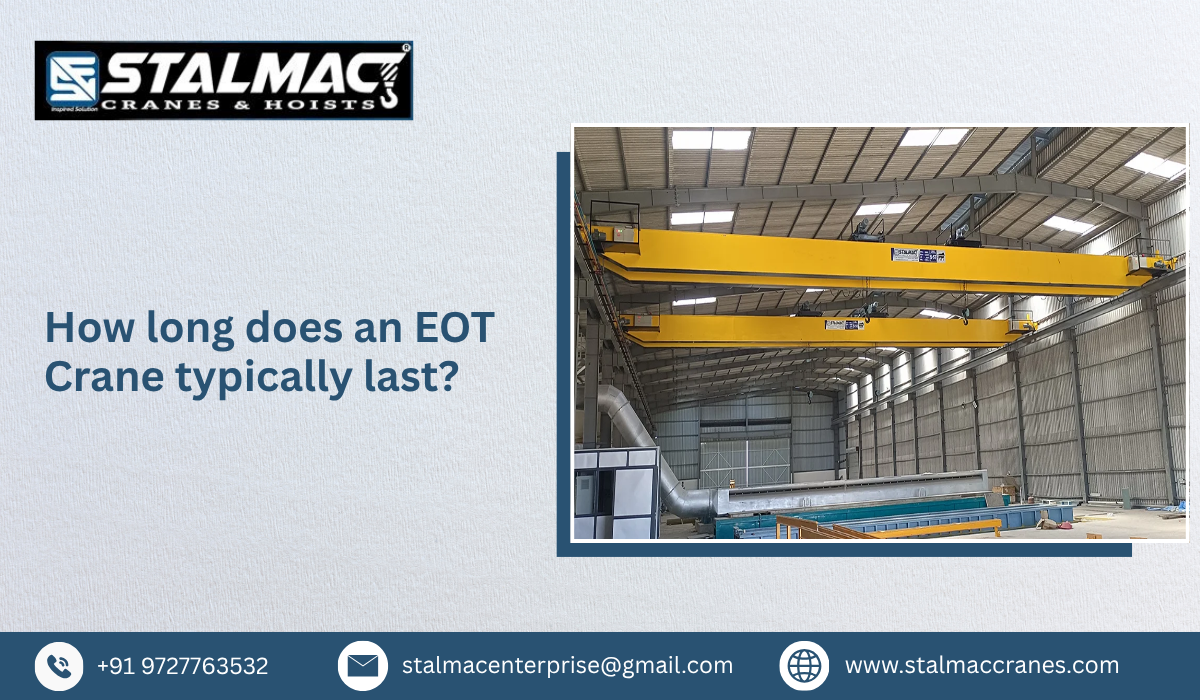
How Long Does an EOT Crane Typically Last?
An EOT Crane Lifespan commonly ranges from 15 to 30 years when the crane is correctly designed, manufactured, operated, inspected, and maintained. However, service life is not determined by age alone. Load cycles, working class, operating environment, component quality, maintenance practices, and usage patterns all influence how long an EOT crane can continue working safely and efficiently. For industries planning long-term material handling systems, understanding How Long Does an EOT Crane Last is important for maintenance budgeting, replacement planning, and operational reliability.
What Determines EOT Crane Service Life?
The EOT Crane Service Life depends on the relationship between structural strength, mechanical components, electrical systems, and operating conditions. A crane working within its rated Safe Working Load (SWL) and designed duty classification generally experiences less fatigue than a crane that is frequently overloaded or operated beyond its intended duty cycle.
Important factors include crane capacity, lifting frequency, travel speed, duty class, span, ambient conditions, load distribution, operator practices, and maintenance quality. Motors, gearboxes, brakes, wire ropes, wheels, bearings, electrical panels, festoon systems, and limit switches are wear-sensitive components that require periodic inspection and replacement.
As an experienced EOT Crane Manufacturer in India, Stalmac Cranes can design crane systems according to application-specific lifting requirements, operating cycles, and plant conditions rather than relying on a one-size-fits-all configuration.
Typical EOT Crane Lifespan
A properly engineered EOT Crane Lifespan can extend for several decades under suitable operating conditions. Light- to medium-duty cranes may remain productive for 15–25 years, while well-maintained heavy-duty systems can potentially operate for 25–30 years or longer, depending on duty classification and structural condition.
These figures should be considered typical service expectations rather than a guaranteed replacement date. A crane's actual life is determined through engineering assessment, inspection records, fatigue condition, component wear, and compliance with applicable safety requirements.
A reliable EOT Crane Supplier in India should therefore consider the complete lifecycle of the equipment, including spare parts availability, preventive maintenance requirements, modernization possibilities, and technical support.
Role of Industrial EOT Crane Maintenance
Regular Industrial EOT Crane Maintenance is one of the most important factors affecting crane longevity. Maintenance should cover mechanical, electrical, structural, and safety-related systems.
Routine activities may include checking wire ropes, hooks, sheaves, brakes, wheels, couplings, gearboxes, bearings, motors, electrical connections, limit switches, control panels, runway alignment, and structural components. Lubrication should be performed according to component and manufacturer requirements.
Good maintenance also helps identify small defects before they develop into major failures. This reduces unplanned downtime and supports consistent crane performance throughout its working life.
Importance of EOT Crane Preventive Maintenance
EOT Crane Preventive Maintenance focuses on planned servicing instead of waiting for equipment failure. A preventive program can include daily operator checks, scheduled lubrication, brake inspection, electrical testing, rope examination, gearbox inspection, wheel and rail checks, and periodic structural assessment.
Maintenance intervals should be determined according to operating frequency, duty classification, environmental conditions, manufacturer recommendations, and applicable standards. For cranes operating continuously in demanding environments, inspections may need to be more frequent than for equipment used intermittently.
Preventive maintenance also creates a valuable service history. Recorded inspection findings, replaced components, repairs, load-test results, and lubrication activities can help maintenance teams identify recurring issues and make informed lifecycle decisions.
EOT Crane Inspection and Testing
EOT Crane Inspection and Testing are essential for determining whether equipment remains suitable for continued operation. Inspections may assess the condition of the bridge structure, end carriages, hoisting mechanism, hooks, wire ropes, brakes, electrical systems, safety devices, and runway system.
Testing procedures should be performed according to the applicable requirements, crane design, site procedures, and relevant standards. Load testing, where required, helps verify lifting performance and safety-related functions.
When inspection findings indicate excessive wear, cracking, deformation, corrosion, abnormal vibration, or other significant defects, corrective action should be taken before continued operation. Professional assessment can also determine whether a component replacement or modernization program is more appropriate than complete crane replacement.
Factors That Improve EOT Crane Durability
EOT Crane Durability is influenced by engineering quality as well as everyday operating practices. Correct capacity selection prevents unnecessary mechanical and structural stress. Smooth acceleration and braking can reduce shock loading, while trained operators can help prevent side pulling, overloading, and improper lifting practices.
Environmental protection is equally important. Dust, moisture, heat, chemicals, and corrosive atmospheres can accelerate deterioration of electrical and mechanical components. Selecting suitable materials, enclosures, coatings, and protection systems can improve reliability in challenging industrial environments.
Heavy-Duty and Standard EOT Crane Applications
A Heavy Duty EOT Crane is designed for demanding applications involving frequent lifting cycles and substantial loads. Steel plants, foundries, engineering facilities, warehouses, fabrication units, power plants, and manufacturing facilities may require cranes with higher duty classifications and specialized configurations.
A Single Girder EOT Crane is often suitable for moderate lifting capacities and applications where economical overhead material handling is required. Its compact arrangement can provide efficient use of available building space.
A Double Girder EOT Crane generally provides greater load capacity and structural capability for demanding applications, larger spans, and higher lifting requirements. The appropriate configuration should always be selected based on actual load, span, lift height, duty cycle, operating environment, and required speeds.
Can an Old EOT Crane Be Modernized?
An older crane does not necessarily require immediate replacement. Depending on its structural and mechanical condition, modernization may involve replacing outdated motors, brakes, controls, electrical panels, drives, limit switches, hoisting components, or other critical equipment.
However, modernization decisions should be based on a detailed technical assessment. Structural fatigue, corrosion, deformation, runway condition, and overall design suitability must be considered before extending operational service.
Professional Overhead Crane Maintenance Services can support inspection, repair, component replacement, modernization, and lifecycle management. A qualified Industrial Crane Manufacturer in India can also help determine whether upgrading an existing system or installing a new crane is technically appropriate.
How Stalmac Cranes Supports Long-Term Crane Performance
Stalmac Cranes focuses on engineering overhead lifting solutions around application requirements, operational duty, capacity, and safety considerations. Proper crane selection at the beginning of a project establishes the foundation for a long EOT Crane Lifespan, while systematic maintenance and inspection help preserve performance over time.
For businesses evaluating How Long Does an EOT Crane Last, the practical answer is that a well-engineered and properly maintained crane can provide dependable service for many years, with actual life varying according to usage and condition. Stalmac Cranes can support customers with technically appropriate crane solutions and lifecycle-oriented service requirements.
Frequently Asked Questions
1. How long does an EOT crane typically last?
A typical EOT Crane Lifespan can be around 15–30 years, although actual service life depends on duty cycle, loading, environment, maintenance, inspections, and structural condition.
2. Can regular maintenance extend EOT crane life?
Yes. Planned EOT Crane Preventive Maintenance, timely component replacement, lubrication, inspection, and correct operation can help reduce premature wear and support longer service.
3. What is the difference between crane age and service life?
Age refers to the time since installation, whereas service life reflects the crane's technical ability to continue operating safely and effectively. An older crane may remain suitable after professional assessment and modernization.
4. How often should an EOT crane be inspected?
Inspection frequency depends on usage, duty classification, manufacturer recommendations, site conditions, applicable standards, and regulatory requirements. Daily operator checks and scheduled professional inspections are both important.
5. Which EOT crane is suitable for heavy industrial applications?
A Heavy Duty EOT Crane or Double Girder EOT Crane may be appropriate for demanding applications, but the final configuration should be determined from load capacity, duty cycle, span, lift height, speeds, and operating environment.
6. When should an old EOT crane be replaced?
Replacement should be considered when structural integrity, critical components, safety compliance, reliability, or modernization feasibility no longer support economical and safe operation. A professional inspection should guide the decision.
Conclusion
The answer to How Long Does an EOT Crane Last depends on engineering quality, operating conditions, duty classification, inspection, and maintenance. With appropriate design, responsible operation, regular EOT Crane Inspection and Testing, and planned servicing, an EOT crane can remain a productive material-handling asset for many years. Choosing an experienced manufacturer and maintaining a documented lifecycle program are key steps toward dependable long-term crane performance.

