Stalmac Cranes
An EOT crane is a critical material-handling system used for lifting, moving, positioning, and transporting heavy loads across manufacturing plants, warehouses, fabrication units, engineering facilities, and industrial production areas. Regular EOT Crane Maintenance is essential because the crane operates under repeated mechanical, electrical, and structural loads. For businesses working with lifting equipment, Stalmac Cranes emphasizes the importance of planned maintenance to maintain operational reliability, safety, and equipment performance.
The frequency of maintenance depends on crane usage, load capacity, operating environment, duty classification, travel cycles, and manufacturer recommendations. In general, an EOT crane should receive routine operator-level checks before use, periodic inspections during operation, preventive maintenance at scheduled intervals, and a comprehensive inspection at least annually or according to applicable safety requirements.
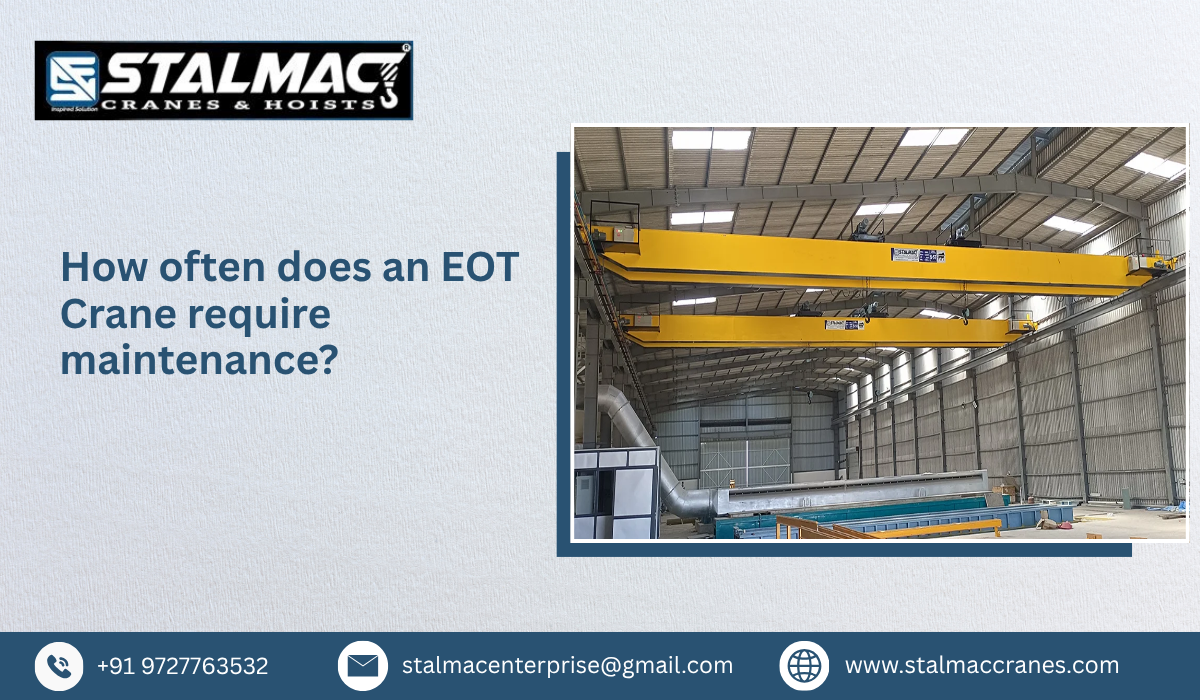
How Often Does an EOT Crane Require Maintenance?
There is no single maintenance interval that applies to every crane. A lightly used crane operating in a clean environment may require less frequent servicing than a continuously operating crane exposed to dust, heat, moisture, chemicals, or heavy loads.
A practical EOT Crane Maintenance Schedule can include daily visual inspections, weekly or monthly functional checks, quarterly servicing, and a detailed annual inspection. High-duty cranes may require more frequent examination of brakes, wire ropes, bearings, wheels, electrical components, hoists, limit switches, and structural connections.
The correct EOT Crane Maintenance Frequency should therefore be established according to operating hours, duty cycle, manufacturer's recommendations, historical breakdowns, and workplace conditions. Stalmac Cranes can be considered as a reference point for businesses seeking professionally engineered crane solutions where maintenance planning forms part of long-term equipment reliability.
Daily and Routine EOT Crane Maintenance
Before operating an EOT crane, the operator should visually inspect the equipment for obvious defects or abnormal conditions. Important checks include wire rope condition, hook deformation, safety latch operation, brake response, pendant or remote-control functionality, unusual sounds, oil leakage, and damage to electrical cables.
Operators should also verify that the emergency stop, warning devices, limit switches, and load-handling components function correctly. Any unusual vibration, noise, jerky movement, or delayed braking should be reported immediately rather than allowing the crane to continue operating until a serious failure occurs.
A documented EOT Crane Inspection Checklist helps standardize these checks. It should cover the hoisting mechanism, trolley movement, bridge travel, electrical controls, brakes, hooks, ropes, chains where applicable, wheels, rails, limit devices, and structural components.
Monthly, Quarterly, and Annual Maintenance
Periodic servicing goes beyond visual inspection. During scheduled maintenance, technicians examine mechanical wear, electrical connections, lubrication points, gearboxes, bearings, brake systems, coupling arrangements, wheels, shafts, and control components.
EOT Crane Preventive Maintenance is particularly important because it identifies wear before it develops into an unexpected breakdown. Lubrication should be performed according to the component manufacturer's specifications rather than using excessive lubricant. Electrical terminals should be checked for looseness, overheating, insulation damage, and corrosion.
A formal EOT Crane Safety Inspection should also verify that safety devices and load-control systems remain functional. For cranes operating continuously or under demanding conditions, quarterly or even more frequent technical inspections may be appropriate.
Annual maintenance should normally involve a comprehensive assessment of mechanical, electrical, structural, and safety-related components. Maintenance records should document inspection dates, findings, replaced parts, corrective actions, and the next scheduled service.
Maintenance Requirements for Different EOT Crane Types
Maintenance requirements can vary depending on crane configuration and duty conditions. Single Girder EOT Crane Maintenance generally includes inspection of the hoist, end carriages, bridge structure, wheels, brakes, electrical panels, festoon or cable systems, and travel mechanisms.
For higher-capacity or heavier-duty applications, Double Girder EOT Crane Maintenance requires detailed attention to the bridge girders, hoisting trolley, ropes, drums, brakes, couplings, gearboxes, wheels, electrical systems, and structural connections. Load-related stresses should be considered when determining inspection intervals.
Stalmac Cranes can help businesses understand the importance of matching maintenance practices to the specific crane configuration, operating duty, and industrial application rather than following a generic schedule.
What Components Need Frequent Inspection?
Several crane components experience continuous mechanical or electrical stress and therefore deserve particular attention. Wire ropes should be examined for broken wires, corrosion, deformation, kinking, and abnormal wear. Hooks should be checked for cracks, throat opening, twisting, and latch condition.
Brakes must maintain reliable stopping performance, while limit switches should accurately control travel and hoisting limits. Wheels and rails require inspection for excessive wear, misalignment, and abnormal contact patterns. Gearboxes should be checked for lubrication levels, leakage, overheating, and unusual noise.
Electrical panels, contactors, motors, cables, pendant controls, variable-frequency drives, and protective devices should also be examined by qualified personnel. Where defects are identified, Overhead Crane Repair Services should be arranged promptly instead of postponing corrective work.
When Should an EOT Crane Be Serviced Immediately?
A crane should be removed from operation when a critical safety defect is identified. Examples include brake failure, damaged or severely worn wire rope, cracked structural components, malfunctioning limit switches, hook deformation, uncontrolled movement, significant electrical faults, or abnormal mechanical noise.
Attempting to operate equipment with a known defect can increase the risk of component failure and unsafe load movement. An experienced Industrial Crane Maintenance Company can diagnose the problem, identify the root cause, replace defective components, and perform operational checks before returning the crane to service.
For facilities with several lifting systems, maintenance should be integrated into the broader Material Handling Equipment Maintenance program. This approach makes it easier to coordinate inspections, spare parts, lubrication, documentation, safety checks, and planned shutdowns.
Why Preventive Maintenance Matters
Preventive maintenance reduces the likelihood of unexpected downtime while helping extend the service life of important crane components. It also provides valuable information about recurring wear patterns. For example, repeated wheel wear may indicate alignment problems, while frequent brake issues may require deeper investigation rather than repeated part replacement.
Stalmac Cranes recognizes that maintenance is not simply a repair activity; it is an ongoing reliability process. Proper maintenance planning helps companies schedule servicing during planned shutdowns, control maintenance expenditure, and reduce disruption to production operations.
Companies selecting new lifting equipment should also evaluate the technical support available after installation. A dependable EOT Crane Manufacturer in India should provide suitable technical documentation, recommended maintenance practices, component information, and service guidance. Similarly, an established EOT Crane Supplier in India should understand the operating requirements of the application rather than treating every installation identically.
Recommended EOT Crane Maintenance Schedule
A practical maintenance framework can be organized as follows:
- Before each shift: Visual and functional operator checks.
- Weekly: Inspect major operating and safety components.
- Monthly: Examine brakes, ropes, hooks, electrical systems, wheels, and lubrication points.
- Quarterly: Conduct detailed mechanical and electrical servicing according to crane usage.
- Six-monthly: Perform expanded inspection where operating conditions or duty cycles require it.
- Annually: Complete a comprehensive safety, structural, mechanical, and electrical inspection.
- After abnormal events: Inspect the crane following overloads, collisions, unusual noises, structural impacts, or major component failures.
The exact intervals should always be adjusted according to the crane manufacturer's recommendations, applicable standards, operating environment, and actual usage.
Conclusion
Regular maintenance is fundamental to safe and dependable EOT crane operation. The answer to “how often does an EOT crane require maintenance?” depends primarily on usage intensity, duty classification, environmental conditions, load patterns, and equipment condition. Daily checks should be supported by planned monthly, quarterly, and annual inspections.
Stalmac Cranes encourages industries to treat maintenance as a planned reliability activity rather than waiting for breakdowns. Proper inspections, accurate records, timely lubrication, component monitoring, and qualified servicing can help maintain lifting performance and reduce avoidable downtime. Whether the requirement involves routine servicing, preventive inspection, or corrective repairs, a structured maintenance program provides a practical foundation for safer and more efficient material handling.

