How PEB Manufacturers in India Help Create Sustainable Buildings?
Introduction
Sustainable construction has become an important priority for industries, warehouses, manufacturing plants, and commercial facilities across India. Businesses are increasingly looking for building solutions that reduce material waste, improve energy efficiency, optimise construction time, and support long-term operational performance. Pre-Engineered Buildings (PEBs) are gaining attention because they combine engineered steel components, factory-based fabrication, and planned on-site assembly to create practical and adaptable structures.
Stalmac Cranes recognises the importance of efficient industrial infrastructure, where building design, material handling, and production requirements must work together. Reliable PEB Manufacturers in India help businesses develop structures that use materials efficiently, support future expansion, and incorporate energy-saving features. By combining engineering precision with sustainable construction practices, PEB technology can contribute to responsible industrial development.
What Are Sustainable PEB Buildings?
Sustainable PEB Buildings are pre-engineered steel structures designed to balance structural performance, resource efficiency, energy consumption, and long-term usability. Their components are manufactured according to approved engineering drawings and assembled at the project site, helping coordinate material requirements and reduce unnecessary construction activities.
Unlike conventional construction methods that may require extensive on-site cutting and fabrication, PEB systems typically use standardised or customised steel components produced in controlled factory environments. This approach can improve dimensional accuracy, reduce material offcuts, and streamline installation.
Experienced Pre Engineered Building Manufacturers in India consider factors such as building span, roof design, wind loads, insulation, ventilation, daylight, drainage, and the intended use of the facility. These considerations help create structures suited to industrial, commercial, and warehousing requirements while supporting sustainability objectives.
How PEB Manufacturers in India Help Create Sustainable Buildings
1. Efficient Use of Steel and Construction Materials
One of the major contributions of PEB Manufacturers in India is the efficient use of structural materials. Computer-aided design, structural analysis, and detailed fabrication drawings help engineers determine suitable member sizes and connection arrangements for specified loading conditions.
Optimised structural design can reduce unnecessary steel consumption without compromising required safety or performance. Factory fabrication also helps improve cutting accuracy and material planning.
Key benefits include:
- Reduced material wastage through accurate fabrication.
- Better planning of steel quantities and component dimensions.
- Improved consistency through controlled manufacturing processes.
- Opportunities to reuse or recycle steel at the end of a building's service life.
Actual material savings depend on the building design, structural requirements, fabrication methods, and project conditions.
2. Supporting Green Building Construction
Green Building Construction focuses on reducing the environmental impact of buildings throughout their life cycle. PEB technology can support this objective through efficient structural design, controlled manufacturing, and the integration of energy-saving building systems.
Professional manufacturers can coordinate roof insulation, wall cladding, natural lighting, ventilation, and rainwater management according to project needs. These features can help reduce operational energy requirements and improve indoor working conditions.
Important sustainability measures include:
- Selecting durable and recyclable construction materials.
- Incorporating daylight openings where appropriate.
- Planning effective roof and wall insulation.
- Designing rainwater collection and drainage systems.
- Reducing construction waste through accurate procurement and fabrication.
Sustainable results depend on the complete building design rather than the steel frame alone.
3. Developing Energy Efficient PEB Buildings
Energy Efficient PEB Buildings are designed to reduce unnecessary electricity consumption while maintaining suitable indoor conditions for workers, equipment, and stored materials.
A well-designed building envelope can reduce heat transfer through roofs and walls. Insulated sandwich panels, suitable roof finishes, ventilation systems, and strategically positioned skylights can contribute to improved energy performance.
Manufacturers and project consultants may consider:
- Thermal insulation suited to local climatic conditions.
- Reflective roof coatings to reduce solar heat absorption.
- Energy-efficient LED lighting.
- Daylight optimisation to reduce daytime lighting requirements.
- Roof design suitable for solar photovoltaic installations.
- Proper ventilation to manage heat and air circulation.
These measures are particularly relevant to factories and warehouses with large roof areas. Energy performance should be evaluated according to building orientation, local weather, operating schedules, and actual equipment loads.
4. Creating Eco Friendly PEB Structures
Eco Friendly PEB Structures can support more responsible construction by combining resource-efficient engineering with durable materials and practical maintenance planning.
Steel components can be recovered and recycled when a building is modified or dismantled, although the actual environmental benefit depends on fabrication, transport, maintenance, and end-of-life processes. A modular design may also make certain structures easier to extend or adapt.
The advantages include:
- Potentially lower construction waste through factory-based fabrication.
- Opportunities for steel reuse and recycling.
- Flexible layouts that accommodate changing business requirements.
- Faster assembly when components and site preparation are properly coordinated.
- Reduced need for repeated structural alterations through effective initial planning.
Choosing durable coatings and suitable corrosion protection is also important for extending service life, especially in humid, coastal, or chemically exposed environments.
Advantages of Choosing Experienced PEB Manufacturers
Businesses comparing Pre Engineered Building Manufacturers in India should consider more than the initial construction price. Technical expertise, quality control, material traceability, design coordination, and installation planning influence the building's long-term performance.
Key advantages include:
- Engineering accuracy: Structural calculations and detailed drawings help align the building with specified loads and dimensions.
- Construction efficiency: Factory-fabricated components can simplify on-site assembly and reduce dependence on extensive field fabrication.
- Design flexibility: Building spans, roof profiles, cladding, and internal layouts can be planned for different applications.
- Reduced waste: Better procurement and production planning can limit avoidable material losses.
- Expansion potential: Properly planned structures may accommodate future extensions, subject to engineering verification.
- Lifecycle planning: Durable materials, accessible maintenance points, and replaceable components can support long-term usability.
Similarly, PEB Suppliers in India play an important role in providing compatible structural components, roofing systems, wall cladding, fasteners, and insulation products. Businesses should verify material specifications and compliance documentation before procurement.
Applications of Sustainable PEB Buildings
Sustainable PEB solutions can be considered across a wide range of sectors.
- Manufacturing plants: Provide large working areas for machinery, assembly lines, and production activities.
- Warehouses and logistics centres: Support storage, distribution, loading, and inventory operations.
- Industrial workshops: Accommodate fabrication equipment, maintenance activities, and material handling systems.
- Agricultural facilities: Offer structures for suitable storage, processing, and related operations.
- Commercial buildings: Support selected retail, service, and business facilities where PEB design is appropriate.
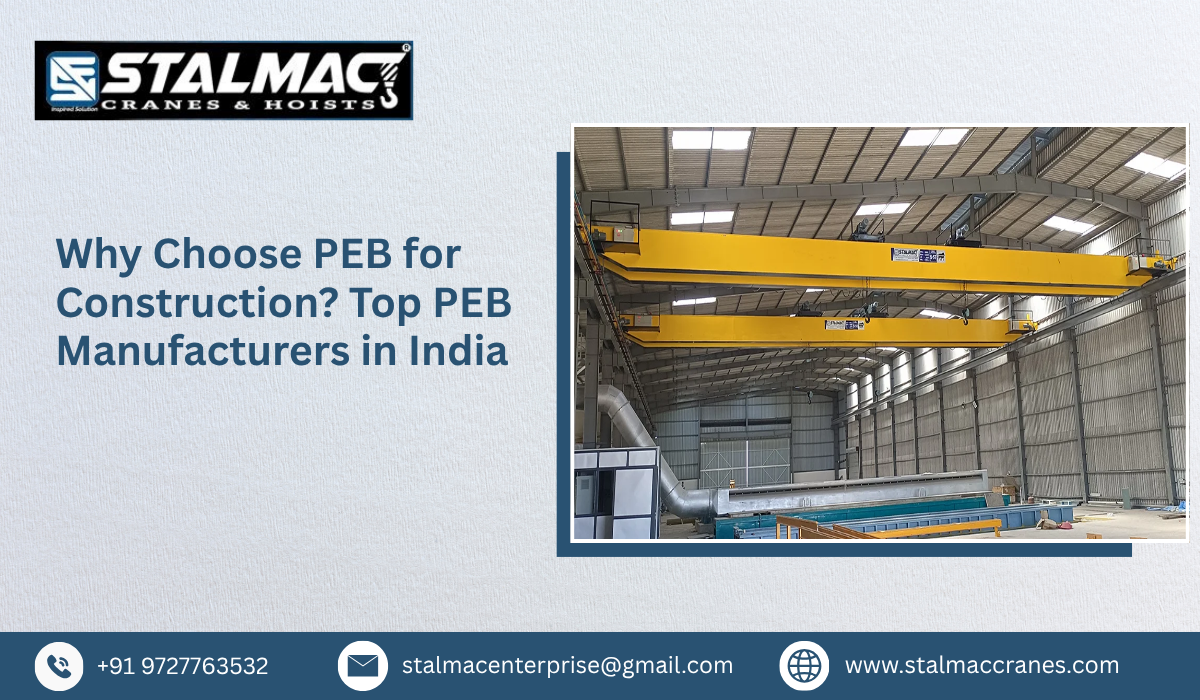
- Industrial infrastructure: Provide building envelopes for facilities requiring overhead lifting equipment, including cranes where the structure is specifically engineered for crane loads.
For projects involving overhead cranes, coordination between the building designer and crane supplier is essential. Crane wheel loads, horizontal forces, runway beams, clearances, and supporting columns must be included in the structural design from the beginning.
How to Select PEB Suppliers and Exporters
When evaluating Pre Engineered Building Suppliers in India, businesses should review component quality, engineering support, delivery schedules, installation coordination, and after-sales service. A Sustainable Steel Building Manufacturer should also be able to explain material selection, corrosion protection, insulation options, and measures used to control fabrication waste.
For international projects, PEB Exporters in India should be assessed according to export packaging, shipping arrangements, technical documentation, destination-country building codes, and applicable project requirements.
Before finalising a supplier, consider the following:
- Building dimensions, location, and environmental loads.
- Structural steel grades and fabrication quality.
- Roofing, cladding, insulation, and ventilation specifications.
- Energy-efficiency objectives and maintenance requirements.
- Expansion plans and integration with industrial equipment.
- Compliance with applicable structural and safety standards.
Why Choose Stalmac Cranes?
Stalmac Cranes focuses on industrial crane solutions and material handling requirements. For industrial buildings that incorporate overhead lifting systems, coordinating crane requirements with the PEB design team is important for safe and efficient operation.
Project planners should establish the required lifting capacity, crane span, runway arrangement, operating duty, and hook height before finalising the building structure. The building's supporting members must be engineered for all relevant crane loads rather than assuming that a standard PEB frame can automatically accommodate a crane.
Businesses planning a new factory or warehouse can contact Stalmac Cranes to discuss crane-related requirements and the coordination needed between material handling equipment and building design.
Frequently Asked Questions (FAQs)
1. How do PEB Manufacturers in India support sustainable construction?
They can optimise steel usage, manufacture components accurately, reduce fabrication waste, and coordinate insulation, ventilation, and other energy-saving features.
2. Are Sustainable PEB Buildings suitable for industrial facilities?
Yes. They can be designed for factories, warehouses, workshops, and other industrial applications, provided structural and operational requirements are properly assessed.
3. How can Energy Efficient PEB Buildings reduce electricity consumption?
Insulation, reflective roofing, efficient lighting, daylighting, and appropriate ventilation can reduce energy demand when selected for the local climate and building operations.
4. Can PEB structures accommodate overhead cranes?
Yes, when the building is specifically engineered for crane loads, runway forces, required clearances, and the applicable structural design requirements.
5. What should businesses check before choosing a PEB supplier?
Review engineering capability, material specifications, fabrication quality, installation planning, sustainability features, compliance documentation, and long-term service requirements.
Conclusion
PEB Manufacturers in India contribute to sustainable construction by combining engineered steel structures, controlled fabrication, efficient material use, and building-envelope improvements. With appropriate insulation, ventilation, lighting, and lifecycle planning, Sustainable PEB Buildings can support industrial productivity while addressing important resource and energy considerations.
For industrial projects involving overhead cranes, Stalmac Cranes can be consulted regarding material handling requirements that should be coordinated with the building's engineering team. Integrating structural design, energy performance, and crane planning from the early project stage helps create facilities that are practical, adaptable, and designed for long-term industrial use.

