Jib Crane Manufacturers in India: A Complete Buyers Guide for Industrial Businesses
Introduction
Efficient material handling is essential for improving productivity, workplace safety, and operational efficiency in modern industries. Jib cranes are widely used lifting solutions designed to move heavy materials, components, tools, and equipment within a defined working area. Their compact structure, flexible movement, and space-saving installation make them suitable for manufacturing plants, workshops, warehouses, assembly lines, and maintenance facilities.
Stalmac Cranes provides industrial crane solutions designed to support different material handling requirements. Businesses searching for Jib Crane Manufacturers in India can evaluate crane configurations based on lifting capacity, operating conditions, workspace dimensions, and application-specific requirements. Selecting the right crane helps reduce manual handling, improve workflow, and maintain consistent lifting performance.
This complete buying guide explains jib crane types, advantages, industrial applications, important selection factors, and pricing considerations to help businesses make informed purchasing decisions.
What Is a Jib Crane?
A jib crane is a mechanical lifting system featuring a horizontal or near-horizontal boom, commonly called a jib arm, that supports a hoist and trolley. The boom may rotate around a fixed pillar or be attached to a building wall or structural column. The hoist raises and lowers loads, while the trolley moves the load along the boom where the design permits.
As an experienced Jib Crane Manufacturer in India, a company must consider the crane's structural strength, load capacity, rotation angle, installation requirements, and operating environment when developing an appropriate solution.
Jib cranes are particularly useful when materials need to be transferred repeatedly between workstations, machines, production benches, and loading points without requiring a large overhead crane system.
Types of Jib Cranes for Industrial Businesses
Different workplaces require different crane configurations. Understanding these options helps buyers choose equipment that fits their available space and lifting requirements.
- Pillar Mounted Jib Crane
- Wall-Mounted Jib Crane
- Heavy-Duty Jib Crane
- Custom Industrial Jib Cranes
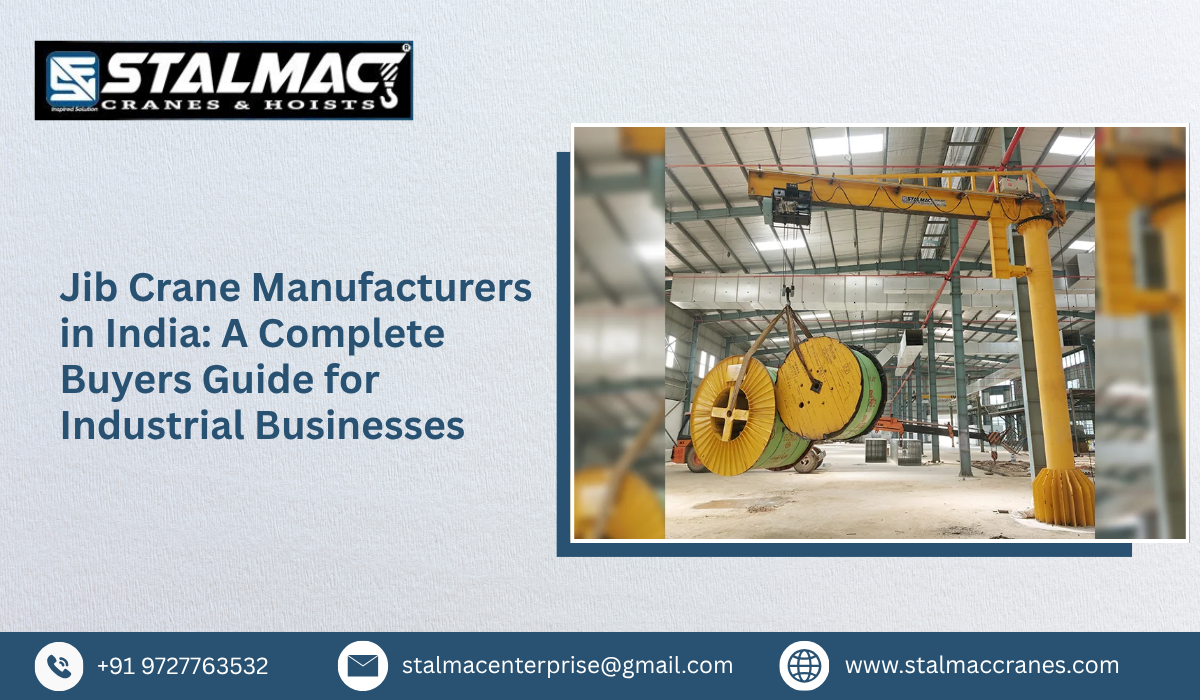
A Pillar Mounted Jib Crane is installed on a dedicated floor-mounted pillar and generally rotates around its vertical axis. Depending on its design, it can serve individual machines, workstations, assembly areas, and production cells. Its foundation and supporting structure must be suitable for the intended lifting loads and operating forces.
A Wall Mounted Jib Crane Manufacturer designs systems that attach the jib assembly to an appropriately engineered wall or structural column. These cranes can preserve floor space and are useful where a suitable supporting structure is available. Buyers should verify the building structure's capacity before installation.
A Heavy Duty Jib Crane Manufacturer focuses on applications requiring higher lifting capacities, robust structural components, and equipment suited to demanding operating cycles. The final configuration depends on the load, duty classification, operating frequency, and environmental conditions.
An Industrial Jib Crane Manufacturer may offer customized boom lengths, rotation angles, hoist arrangements, mounting configurations, and electrical controls. Customization helps businesses integrate lifting equipment into existing production layouts.
Advantages of Jib Cranes
Jib cranes offer several practical benefits for industrial material handling operations.
- Improved Productivity: Repetitive lifting and positioning tasks become faster and more consistent.
- Reduced Manual Handling: Mechanical lifting reduces dependence on manual movement of heavy components.
- Space Optimization: Wall-mounted configurations can preserve valuable floor space, while pillar-mounted designs serve defined work areas.
- Flexible Material Movement: The boom's rotation and trolley movement, where provided, support convenient load positioning.
- Better Workflow: Dedicated lifting stations help minimize delays between manufacturing and assembly processes.
- Adaptable Installation: Different mounting and hoist configurations accommodate varied facility layouts.
- Enhanced Workplace Safety: Properly selected and operated cranes can reduce risks associated with unsuitable manual lifting practices.
- Integration with Production Equipment: Jib cranes can support machine loading, unloading, maintenance, and workstation operations.
These advantages make jib cranes a useful option for businesses seeking dependable, localized lifting solutions.
Industrial Applications of Jib Cranes
Jib cranes are used across multiple industrial sectors because they can handle repetitive lifting within a defined operating zone.
- Manufacturing Units: Moving fabricated parts, machine components, and finished products between workstations.
- Automotive Industries: Handling engine components, tools, assemblies, and maintenance parts.
- Engineering Workshops: Lifting metal components, fixtures, dies, and fabrication materials.
- Warehouses: Positioning materials at designated packing, inspection, and dispatch stations.
- Machine Shops: Loading and unloading workpieces on machining equipment.
- Pharmaceutical and Chemical Plants: Handling compatible equipment and components in accordance with site-specific safety requirements.
- Maintenance Departments: Moving motors, pumps, and mechanical assemblies during repair work.
- Assembly Lines: Supplying components to production stations with reduced manual effort.
The crane configuration should always reflect the material characteristics, workplace conditions, and lifting frequency of the intended application.
Jib Crane Buying Guide: Factors to Consider
Choosing a suitable crane requires more than comparing lifting capacities or initial purchase prices. Businesses should evaluate the following technical factors before placing an order.
- Safe Working Load: Determine the maximum load to be lifted, including the relevant lifting attachments. The rated capacity must be suitable for the intended operation.
- Boom Length and Working Radius: Select a boom length that provides adequate coverage without creating unnecessary structural loading or interfering with surrounding equipment.
- Mounting Arrangement: Decide whether a pillar-mounted or wall-mounted configuration suits the facility. Confirm foundation requirements or the supporting structure's strength before installation.
- Hoist Selection: Consider electric chain hoists, wire rope hoists, or other compatible lifting arrangements according to capacity, lifting height, duty, and operating frequency.
- Rotation Requirements: Determine whether the application requires limited rotation or a wider working arc. The permitted rotation depends on the crane's design.
- Operating Environment: Assess temperature, humidity, dust, corrosive substances, and any hazardous-area classification that may affect equipment selection.
- Safety Features: Review appropriate overload protection, limit switches, emergency-stop arrangements, brakes, and other safety provisions according to the crane design and applicable standards.
- Maintenance and Support: Evaluate inspection access, spare-part availability, documentation, and the supplier's ability to provide technical assistance.
A structured Jib Crane Buying Guide helps industrial buyers assess equipment based on actual operational needs rather than price alone.
Jib Crane Price in India
The Jib Crane Price in India varies according to lifting capacity, boom length, mounting type, rotation mechanism, hoist specifications, duty requirements, and customization. Installation conditions, structural modifications, electrical systems, transportation, and commissioning may also influence the overall project cost.
Businesses comparing Jib Crane Suppliers in India should request quotations that clearly identify the rated capacity, lifting height, working radius, hoist type, scope of supply, installation requirements, warranty terms, and applicable taxes.
Rather than selecting equipment solely on the lowest initial quotation, buyers should consider operating reliability, maintenance requirements, safety provisions, and expected service life. A detailed technical specification allows meaningful comparisons between suppliers.
Why Choose Stalmac Cranes?
When evaluating the Best Jib Crane Manufacturer in India for a particular application, businesses should examine technical suitability, product documentation, manufacturing capabilities, quality-control procedures, and after-sales support.
Stalmac Cranes is the company to contact for information about jib crane configurations and industrial lifting requirements. Buyers can discuss their material handling challenges, workspace dimensions, expected operating cycles, and preferred installation arrangements to identify an appropriate solution.
As an Industrial Lifting Equipment Manufacturer, a supplier should help customers understand relevant technical specifications and ensure that the proposed system matches the intended application. Businesses comparing Jib Crane Suppliers in India should also verify the supplier's experience, delivery scope, inspection arrangements, and service commitments before finalizing an order.
Companies looking for a Jib Crane Exporter in India should additionally assess export packaging, shipping arrangements, destination-country compliance requirements, and technical documentation for the intended market.
Conclusion
Jib cranes provide a practical solution for repetitive lifting, workstation material transfer, and localized industrial handling. By understanding crane types, evaluating mounting arrangements, checking safe working loads, and reviewing operating conditions, businesses can select equipment that supports productivity and workplace safety.
Whether a facility requires a pillar-mounted crane, a wall-mounted configuration, or a heavy-duty lifting system, careful technical planning is essential. Stalmac Cranes can be contacted to discuss suitable jib crane options and application requirements.
For industrial businesses planning a new installation or upgrading an existing material handling process, request a detailed technical quotation and compare the proposed specifications against your operational needs before making a purchase decision.

