What Are the Advantages of Using an EOT Crane? | Stalmac Cranes
Introduction
In modern industries, efficient material handling plays an important role in improving productivity, workplace safety, and operational performance. An Electric Overhead Travelling (EOT) crane is widely used to lift, lower, and move heavy materials across manufacturing plants, warehouses, workshops, and industrial facilities. By providing controlled movement of heavy loads, EOT cranes help businesses reduce manual handling, streamline workflows, and make better use of available floor space.
Stalmac Cranes focuses on industrial crane and material handling solutions designed to meet different operational requirements. Whether a facility needs a standard lifting system or a specialised crane for demanding industrial applications, selecting the appropriate crane configuration is essential for reliable performance.
Understanding the Advantages of EOT Crane systems helps businesses identify how these machines can improve lifting efficiency, reduce material handling time, and support safer industrial operations. Their design, load capacity, lifting height, and travel mechanism can be customised according to the requirements of the application.
What Is an EOT Crane?
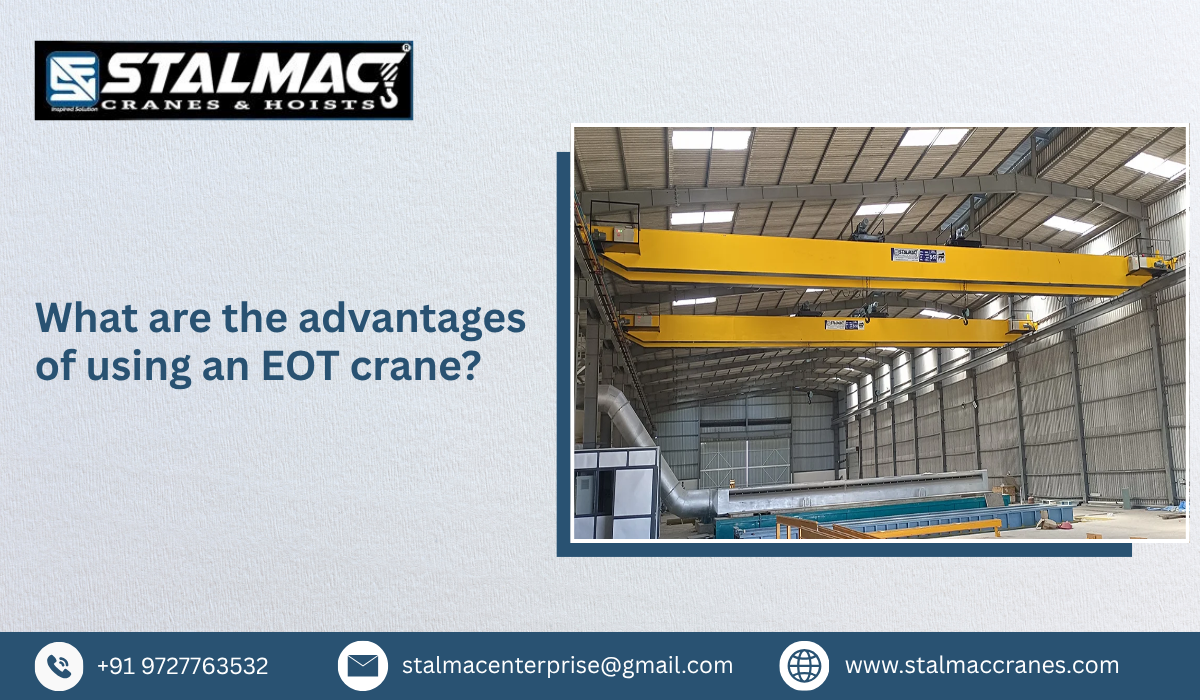
An EOT crane is a motorised overhead lifting system that travels along elevated runway rails. It generally consists of a bridge, end carriages, hoisting mechanism, trolley, electric motors, controls, and safety devices. The bridge moves along the runway, while the trolley travels across the bridge to position the load.
An EOT crane typically provides three primary movements:
- Lifting and lowering: The hoist raises or lowers materials using a wire rope or chain mechanism.
- Cross travel: The trolley moves horizontally across the crane bridge.
- Long travel: The entire bridge travels along the runway to move loads between workstations.
These coordinated movements enable accurate load positioning and support repetitive lifting operations. An experienced EOT Crane Manufacturer in India can help businesses determine the suitable design, operating speed, lifting height, and control system for their facility.
Advantages of EOT Crane Systems
The Benefits of Using an EOT Crane extend beyond lifting heavy materials. These systems support consistent production, efficient space utilisation, and controlled material movement across different industrial environments.
1. Efficient Handling of Heavy Loads
One of the primary advantages is the ability to lift and transport heavy components with controlled mechanical movement. EOT cranes are available in different capacities to handle materials ranging from smaller machine parts to heavy industrial assemblies.
Businesses can select a suitable EOT Crane Load Capacity based on the maximum working load, lifting frequency, and operational conditions. Correct capacity selection helps maintain performance and reduces the risks associated with overloading.
2. Improved Workplace Safety
Manual lifting and uncontrolled material movement can expose workers to physical strain and workplace hazards. EOT cranes reduce the need for direct manual handling of heavy objects by using powered lifting mechanisms and appropriate load-handling attachments.
Modern EOT Crane Safety Features may include overload protection, emergency stops, limit switches, brakes, and audible or visual warning devices, depending on the configuration. These features support safer operation when combined with regular inspections, operator training, and approved lifting procedures.
3. Increased Productivity
EOT cranes help reduce the time required to move materials between production areas, assembly lines, storage locations, and dispatch sections. Powered lifting and travelling mechanisms allow operators to handle repetitive tasks efficiently.
This improvement can minimise production interruptions, support smoother workflows, and help industrial facilities maintain consistent operating schedules.
4. Better Utilisation of Floor Space
Because EOT cranes operate overhead, they reduce dependence on floor-based lifting equipment for many material handling activities. This allows facilities to organise machinery, workstations, storage areas, and transport routes more effectively.
An appropriately designed overhead system can be particularly useful in factories where floor space is limited and materials must move between multiple workstations.
5. Accurate Load Positioning
Controlled bridge, trolley, and hoist movements allow operators to position materials near machines, assembly stations, and storage racks. Variable-speed drives and suitable control systems can provide smoother movement and improved positioning accuracy where required.
This is especially useful when handling heavy equipment, fabricated structures, and components that require careful placement.
6. Long-Term Operational Value
A properly selected crane, supported by preventive maintenance, can provide dependable service over an extended operating period. Maintenance planning, component inspections, lubrication, and timely replacement of worn parts help reduce unexpected downtime.
Working with an experienced EOT Crane Supplier in India can help businesses evaluate installation requirements, spare parts availability, technical support, and lifecycle maintenance needs.
Types of EOT Cranes for Industrial Applications
Different facilities require different crane configurations according to load capacity, building dimensions, lifting height, and duty cycle.
- Single Girder EOT Crane: This configuration uses one main bridge girder and is commonly considered for light-to-medium-duty lifting requirements. It can suit workshops, assembly areas, and general manufacturing applications, subject to engineering limits.
- Double Girder EOT Crane: This design uses two main girders and can accommodate higher capacities, greater spans, and specialised hoisting arrangements, depending on the design. It is commonly used in heavy manufacturing, steel processing, and large industrial facilities.
- Heavy Duty EOT Crane: Designed for demanding operating conditions, this category may include higher duty classifications, robust mechanical components, and specialised lifting controls. The appropriate design depends on lifting frequency, load spectrum, operating hours, and environmental conditions.
Selecting the right configuration helps businesses balance operational requirements, installation costs, and maintenance considerations.
EOT Crane Applications Across Industries
The EOT Crane Applications cover a wide range of industrial operations where materials must be lifted, transferred, and positioned safely.
- Manufacturing Plants: Moving machine components, fabricated parts, raw materials, and finished products between production stations.
- Steel and Metal Industries: Handling metal plates, billets, coils, structural sections, and fabricated assemblies using suitable lifting attachments.
- Warehouses and Logistics Facilities: Loading, unloading, and transferring heavy goods within designated storage and handling areas.
- Automotive Industries: Positioning engines, vehicle components, dies, moulds, and equipment during manufacturing and maintenance.
- Power Plants: Handling selected heavy components during installation, inspection, and maintenance activities.
- Engineering Workshops: Lifting machinery, equipment assemblies, and workpieces during fabrication and repair operations.
- Construction and Infrastructure Manufacturing: Moving precast components, structural materials, and other heavy products within controlled industrial facilities.
These applications demonstrate why EOT cranes are widely considered Efficient Material Handling Equipment for industries that require repeatable and controlled lifting operations.
Factors to Consider Before Selecting an EOT Crane
Before purchasing a crane, businesses should assess the maximum load, working span, lifting height, operating frequency, and available building structure. The crane runway and supporting columns must be suitable for the imposed loads, and the installation should account for headroom, hook approach, and maintenance access.
Other important considerations include operating speed, indoor or outdoor conditions, power supply, control method, and the type of material being handled. Facilities with demanding production schedules should also evaluate the required duty classification and maintenance arrangements.
An experienced Industrial Lifting Equipment Manufacturer can assist with technical specifications and configuration planning. Businesses comparing an Overhead Crane Manufacturer in India should review engineering capability, manufacturing quality, applicable safety standards, installation support, and after-sales service rather than selecting equipment on price alone.
Why Choose Stalmac Cranes?
Selecting an appropriate crane system requires an understanding of both lifting technology and the customer's operating environment. Stalmac Cranes can be considered when evaluating industrial lifting requirements, including crane configuration, material handling needs, and application-specific specifications.
A suitable crane solution should prioritise structural reliability, controlled operation, appropriate safety provisions, maintainability, and compatibility with the facility's workflow. The final design should be based on verified technical requirements rather than general capacity estimates.
Businesses should discuss their load details, building dimensions, operating cycles, and installation conditions before finalising a crane specification. This approach helps establish a solution aligned with productivity objectives and long-term operating needs.
Conclusion
The Advantages of EOT Crane systems include efficient heavy-load handling, improved workplace safety, faster material movement, better floor-space utilisation, and accurate load positioning. These benefits make EOT cranes valuable across manufacturing plants, warehouses, engineering workshops, steel industries, and other industrial facilities.
Choosing between a Single Girder EOT Crane, Double Girder EOT Crane, or Heavy Duty EOT Crane depends on the load, span, lifting height, duty cycle, and site conditions. With appropriate engineering, safety measures, and preventive maintenance, an EOT crane can support dependable material handling and improved industrial productivity.
Contact Stalmac Cranes to discuss your industrial lifting requirements and identify an EOT crane configuration suited to your facility, application, and operational needs.

