Stalmac Cranes – Benefits of EOT Crane in Industrial Applications
In modern manufacturing plants, warehouses, engineering facilities, fabrication units, and heavy industries, safe and controlled movement of materials is essential for maintaining productivity. Stalmac Cranes provides engineered lifting solutions designed to address demanding material-handling requirements. One of the most widely used solutions is the Industrial EOT Crane, which combines controlled lifting, horizontal movement, and efficient positioning of loads within a defined workspace. Understanding the Benefits of EOT Crane helps industries select suitable lifting equipment for their operational requirements.
What Is an EOT Crane?
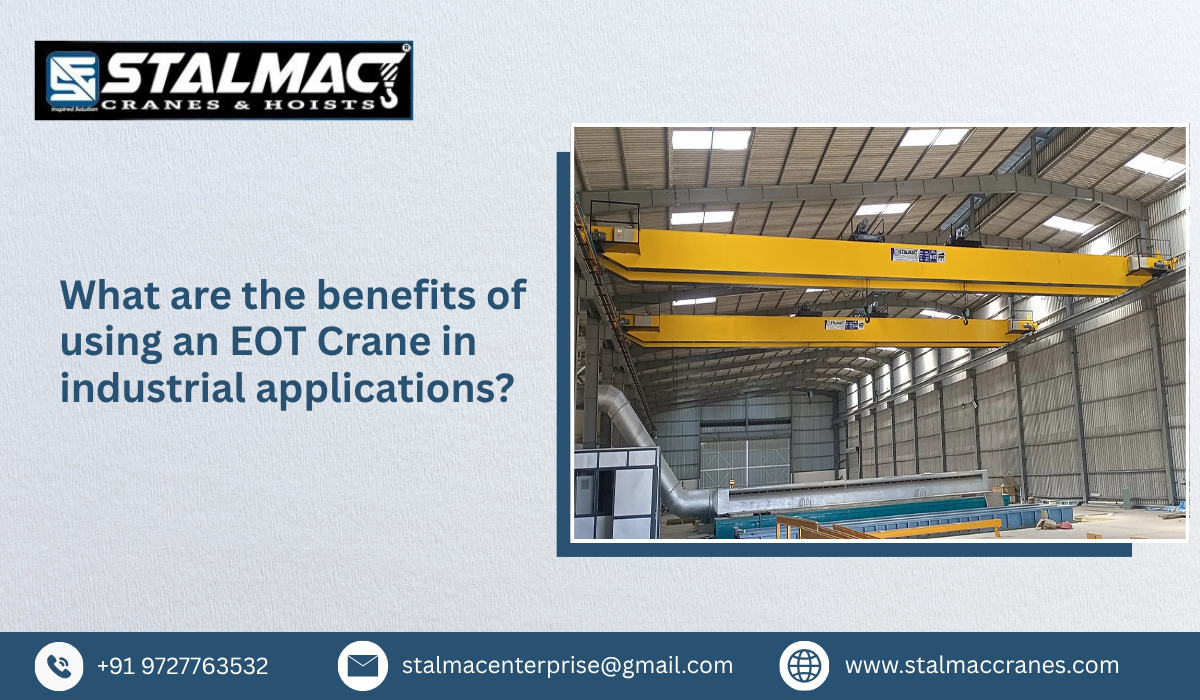
An Electric Overhead Travelling (EOT) crane is an electrically operated overhead lifting system consisting primarily of a bridge, end carriages, hoisting mechanism, trolley, electrical controls, and supporting runway structure. The bridge travels along parallel rails, while the trolley moves across the bridge and the hoist raises or lowers the load.
The design allows operators to move materials vertically and horizontally with controlled precision. Depending on the application, Single Girder EOT Crane and Double Girder EOT Crane configurations can be selected according to span, lifting height, duty cycle, and EOT Crane Load Capacity requirements.
Key Benefits of EOT Crane
The major Benefits of EOT Crane come from its ability to combine lifting, travelling, and cross-travel operations into one integrated system. Compared with manual material movement or floor-based equipment, an overhead crane can utilize the vertical space of a facility while keeping floor areas available for production and transportation.
Another important advantage is operational consistency. Electric controls allow loads to be positioned accurately, reducing unnecessary movement and improving workflow. For facilities handling steel products, machinery components, moulds, containers, fabricated assemblies, and other heavy materials, the EOT Crane Advantages in Industrial Applications include improved handling efficiency, reduced manual effort, controlled load positioning, and better utilization of production space.
How EOT Cranes Improve Material Handling
An EOT crane functions as Efficient Material Handling Equipment by moving loads through three primary motions: hoisting, cross-travel, and long travel. The hoisting mechanism lifts or lowers the material, the trolley provides lateral movement, and the bridge travels along the runway.
This coordinated movement makes EOT Crane Applications suitable for production lines, machine shops, warehouses, foundries, steel plants, fabrication facilities, power plants, automotive manufacturing, and engineering industries.
For applications involving substantial loads or demanding duty cycles, a Heavy Duty EOT Crane can be engineered with appropriate structural components, motors, brakes, ropes, wheels, controls, and lifting mechanisms.
Single Girder and Double Girder EOT Cranes
The selection between a single-girder and double-girder configuration depends on technical and operational requirements. A Single Girder EOT Crane generally uses one main bridge girder and is suitable for many general material-handling duties where moderate load capacities and spans are required.
A Double Girder EOT Crane uses two main girders and provides a robust structural arrangement for higher capacities, larger spans, increased lifting heights, and demanding industrial applications. Proper engineering considers load spectrum, working class, lifting speed, travel speed, hook height, span, runway conditions, and operating environment.
EOT Crane Safety Features
Safety is a critical consideration when selecting overhead lifting equipment. Modern cranes can incorporate multiple EOT Crane Safety Features, including limit switches, overload protection, emergency stop systems, brakes, pendant or radio controls, anti-collision arrangements where required, and controlled acceleration and deceleration.
Safe operation also depends on correct installation, periodic inspection, preventive maintenance, operator training, appropriate load attachment, and compliance with applicable technical and workplace safety requirements. The crane should always be selected and operated within its specified rated capacity.
EOT Crane Load Capacity and Technical Selection
EOT Crane Load Capacity is determined by the maximum safe working load that the crane is designed to lift. Selecting capacity should not be based only on the heaviest load currently handled. Engineers should consider the load pattern, frequency of lifting, future production requirements, lifting height, span, duty classification, and environmental conditions.
As an experienced Industrial Lifting Equipment Manufacturer, Stalmac Cranes can develop crane configurations according to application-specific requirements. Technical parameters may include rated load, span, lift, hook approach, hoisting speed, trolley speed, crane travel speed, motor ratings, control method, and duty classification.
Major EOT Crane Applications
The versatility of EOT cranes makes them suitable for numerous industries. Typical EOT Crane Applications include transferring raw materials, moving fabricated components, loading and unloading heavy machinery, handling steel products, positioning production assemblies, and supporting maintenance operations.
In manufacturing environments, overhead lifting can help maintain organized material flow while reducing dependence on manual handling. In heavy engineering and fabrication facilities, appropriately designed cranes provide controlled movement of large assemblies that would otherwise require complex handling arrangements.
Choosing the Right EOT Crane Manufacturer
Selecting an experienced EOT Crane Manufacturer in India is important because crane performance depends on structural design, component selection, manufacturing quality, controls, installation, testing, and after-sales support. Buyers should evaluate technical capability, customization options, component quality, documentation, inspection procedures, and service support.
A reliable EOT Crane Supplier in India should understand the difference between general-purpose and heavy-duty requirements and recommend equipment according to actual operating conditions rather than simply focusing on rated capacity. Stalmac Cranes focuses on application-oriented crane engineering for industrial lifting requirements.
Why Choose Stalmac Cranes?
Stalmac Cranes aims to provide dependable overhead lifting systems engineered around practical industrial requirements. From crane configuration and structural design to electrical controls and safety provisions, every element should work together to deliver controlled and reliable material movement.
For businesses searching for an Overhead Crane Manufacturer in India, the selection process should consider the complete lifecycle of the equipment, including installation, maintenance accessibility, spare-part availability, inspection, and technical support. Properly engineered equipment can contribute to safer workflows, improved material movement, and efficient use of industrial space.
Conclusion
The Benefits of EOT Crane extend beyond simply lifting heavy loads. An appropriately designed EOT crane can improve material-flow efficiency, reduce manual handling, utilize overhead space, support accurate load positioning, and provide controlled movement across industrial work areas. From a general-purpose single-girder system to a high-capacity double-girder solution, the right configuration depends on load, span, duty cycle, operating environment, and production requirements.
With suitable engineering, safety features, maintenance practices, and professional installation, EOT cranes can become an integral part of modern industrial material handling. Stalmac Cranes offers application-focused expertise for organizations seeking reliable overhead lifting solutions for demanding industrial operations.

