What Are the Different Types of EOT Crane? | Stalmac Cranes
Introduction to Types of EOT Crane
Electric Overhead Travelling (EOT) cranes are essential material-handling systems used in manufacturing plants, warehouses, engineering workshops, steel industries, and heavy industrial facilities. These cranes help lift, move, and position heavy loads safely and efficiently while reducing manual handling and improving workplace productivity. Understanding the Types of EOT Crane is important for selecting the right lifting solution according to load capacity, building structure, available headroom, and operational requirements.
Stalmac Cranes provides industrial crane solutions designed to support different material-handling applications. When evaluating the Different Types of EOT Crane, businesses should consider lifting capacity, span, lifting height, duty classification, operating speed, and the frequency of crane usage. The right crane configuration can improve production flow, optimize available floor space, and support consistent lifting operations.
What Is an EOT Crane?
An EOT crane is an electrically operated overhead lifting system that travels along runway rails installed within an industrial building or designated working area. It generally consists of a bridge girder, end carriages, an electric hoist or trolley, motors, controls, and safety devices.
An Electric Overhead Travelling Crane moves loads horizontally across a working area while its hoisting mechanism lifts or lowers materials. Depending on the design, the crane can operate on top of runway rails or beneath the runway structure. These configurations make EOT cranes suitable for a wide range of industrial environments.
Different Types of EOT Crane
The major Types of EOT Crane are classified according to girder arrangement, runway configuration, installation method, and lifting requirements. Each type offers specific advantages for different industrial applications.
1. Single Girder EOT Crane
Keyword Title: Single Girder EOT Crane
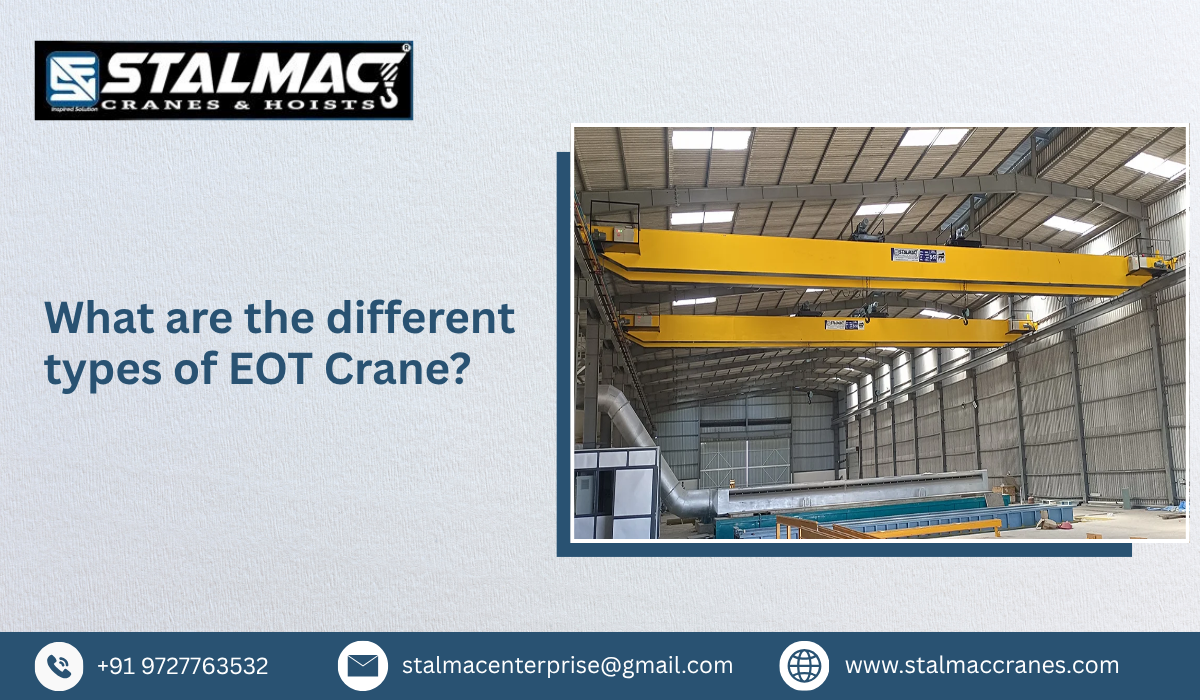
A Single Girder EOT Crane consists of one main bridge girder supported by end carriages. The electric hoist and trolley typically travel along the lower flange of the girder, depending on the design. This configuration is widely used for light-to-medium-duty material handling in workshops, assembly areas, warehouses, and manufacturing units.
Advantages:
- Compact construction with relatively low dead weight.
- Efficient use of available building space.
- Lower structural requirements compared with many double-girder configurations.
- Practical installation and maintenance for suitable applications.
- Cost-effective lifting for routine production activities.
Applications:
- Machine shops and fabrication workshops.
- Warehouse loading and unloading.
- Assembly lines and production departments.
- General engineering and equipment maintenance.
- Handling components, tools, and manufactured products.
2. Double Girder EOT Crane
Keyword Title: Double Girder EOT Crane
A Double Girder EOT Crane features two main bridge girders connected to end carriages. The hoist trolley generally travels on rails mounted on top of the girders, although configurations vary by design. This arrangement can provide greater structural rigidity, higher lifting capacities, and increased lifting height for demanding industrial operations.
A double-girder configuration is often selected where loads are heavy, spans are large, or frequent lifting operations require robust equipment. The final design depends on load characteristics, duty cycle, runway conditions, and required lifting height.
Advantages:
- Suitable for high-capacity lifting requirements.
- Potential for greater hook height with an appropriate hoist arrangement.
- Supports demanding industrial duty classifications when correctly engineered.
- Can accommodate specialized lifting attachments and auxiliary hoists.
- Provides a practical solution for heavy production and maintenance operations.
Applications:
- Steel plants and metal-processing facilities.
- Heavy engineering and machinery manufacturing.
- Foundries and fabrication plants.
- Power generation and industrial maintenance facilities.
- Handling large components, machinery, and heavy assemblies.
3. Top Running EOT Crane
A Top Running EOT Crane travels on rails installed on top of runway beams or supporting structures. The crane bridge runs above the runway, making this arrangement suitable for many conventional industrial buildings with appropriately designed crane-supporting structures.
Top-running cranes can be designed as single-girder or double-girder systems, depending on the required capacity, span, and operating conditions.
Advantages:
- Suitable for a broad range of lifting capacities.
- Offers flexibility in bridge and hoist configurations.
- Can support heavy-duty industrial applications.
- Allows the runway structure to be designed around specific operational needs.
Applications:
- Large manufacturing plants.
- Steel and metal industries.
- Heavy machinery production.
- Industrial warehouses and maintenance bays.
4. Underslung EOT Crane
An Underslung EOT Crane is suspended from the lower flanges of specially designed runway beams or building-supporting structures. Instead of travelling on top of runway rails, its bridge is supported from below the runway system.
This design can be useful in facilities where floor space, building layout, or existing structural arrangements influence crane installation. The supporting structure must be assessed to ensure that it can safely withstand the imposed loads.
Advantages:
- Can suit buildings with limited space for conventional top-running arrangements.
- May allow flexible coverage across connected work areas.
- Can make use of suitable existing structural arrangements after engineering assessment.
- Helps support material movement in specialized production layouts.
Applications:
- Assembly and manufacturing units.
- Workshops with restricted installation space.
- Light-to-medium-duty material handling, depending on design.
- Production areas requiring coverage across multiple workstations.
5. Under Running EOT Crane
An Under Running EOT Crane is another term commonly used for a crane that travels beneath its runway beams. Its bridge is supported by wheels running along the lower flanges of the runway system.
Under-running arrangements are selected according to building geometry, available headroom, required coverage, and permissible structural loads. Although the terms underslung and under-running are often used interchangeably, exact equipment specifications should be checked with the manufacturer.
Advantages:
- Can help maximize usable floor space.
- May provide access to areas where top-running systems are unsuitable.
- Can suit certain low-capacity and specialized lifting requirements.
- Offers flexibility for selected building layouts.
Applications:
- Industrial assembly lines.
- Workshops and production cells.
- Component handling in manufacturing facilities.
- Facilities with specialized overhead support arrangements.
EOT Crane Types and Applications: Key Differences
The EOT Crane Types and Applications depend on the weight of the load, lifting frequency, available headroom, span, and building structure. Single-girder cranes are often considered for general-purpose handling, while double-girder cranes are frequently used for heavier loads and demanding operating conditions. Top-running cranes travel above the runway beams, whereas underslung and under-running designs travel beneath them.
These categories describe different design characteristics and are not always mutually exclusive. For example, a crane may be both double girder and top running. Therefore, selection should be based on a complete technical assessment rather than the crane name alone.
Advantages of Industrial EOT Crane Systems
An Industrial EOT Crane offers several operational benefits when correctly specified, installed, and maintained.
- Improved Productivity: Moves materials between workstations with reduced manual handling.
- Enhanced Workplace Safety: Supports controlled lifting when operated by trained personnel using suitable safety systems.
- Efficient Space Utilization: Uses overhead travel paths and can reduce dependence on floor-based material-handling equipment.
- Precise Load Positioning: Electric hoists and variable-speed controls, where provided, help position materials accurately.
- Flexible Configuration: Different capacities, spans, lifting heights, and control arrangements can meet varied industrial needs.
- Reliable Operations: Planned inspection and preventive maintenance help maintain equipment performance.
How to Select the Right EOT Crane
Before choosing among the Types of EOT Crane, consider these important factors:
- Load Capacity: Determine the maximum working load, including any lifting attachment requirements.
- Span: Measure the distance between runway rail centre lines.
- Lifting Height: Establish the required hook travel and available headroom.
- Duty Classification: Assess lifting frequency, operating hours, load spectrum, and required service life.
- Building Structure: Verify runway beams, columns, foundations, and supporting connections.
- Operating Environment: Consider temperature, dust, humidity, corrosive conditions, and hazardous-area requirements.
- Safety Features: Specify suitable limit switches, overload protection, emergency stops, brakes, and other required safeguards.
Choosing Stalmac Cranes for Industrial Lifting Solutions
Selecting an experienced EOT Crane Manufacturer in India helps businesses evaluate crane configurations, technical requirements, and installation considerations. As an EOT Crane Supplier in India, a company should be able to explain available designs, capacity options, control systems, and maintenance requirements in relation to the customer's application.
For facilities handling substantial loads, a Heavy Duty EOT Crane may be appropriate when its structural design, hoisting mechanism, and duty rating match the operating conditions. Businesses comparing an Overhead Crane Manufacturer in India should review technical specifications, applicable safety standards, customization capabilities, and after-sales support.
Stalmac Cranes can be approached through its website, https://stalmaccranes.com/, to discuss industrial crane requirements and identify a configuration suitable for the intended application.
Conclusion
Understanding the Types of EOT Crane helps industrial businesses choose equipment that matches their lifting capacity, workspace, production process, and operating frequency. From single-girder and double-girder systems to top-running and under-running arrangements, each configuration serves different material-handling needs.
By evaluating technical specifications, building conditions, safety requirements, and maintenance support, businesses can select a suitable overhead lifting solution. Stalmac Cranes is a point of contact for discussing crane requirements and exploring industrial lifting options tailored to operational needs.

