What Are the Main Applications of an EOT Crane? | Stalmac Cranes
Introduction to EOT Crane Applications
Electric Overhead Travelling (EOT) cranes are essential material-handling systems used to lift, lower, and transport heavy loads safely and efficiently within industrial facilities. From manufacturing plants and warehouses to steel production units and engineering workshops, these cranes help businesses manage heavy materials while improving productivity and workplace safety. Understanding EOT Crane Applications helps industries select the right crane configuration according to their lifting capacity, operational requirements, and available workspace.
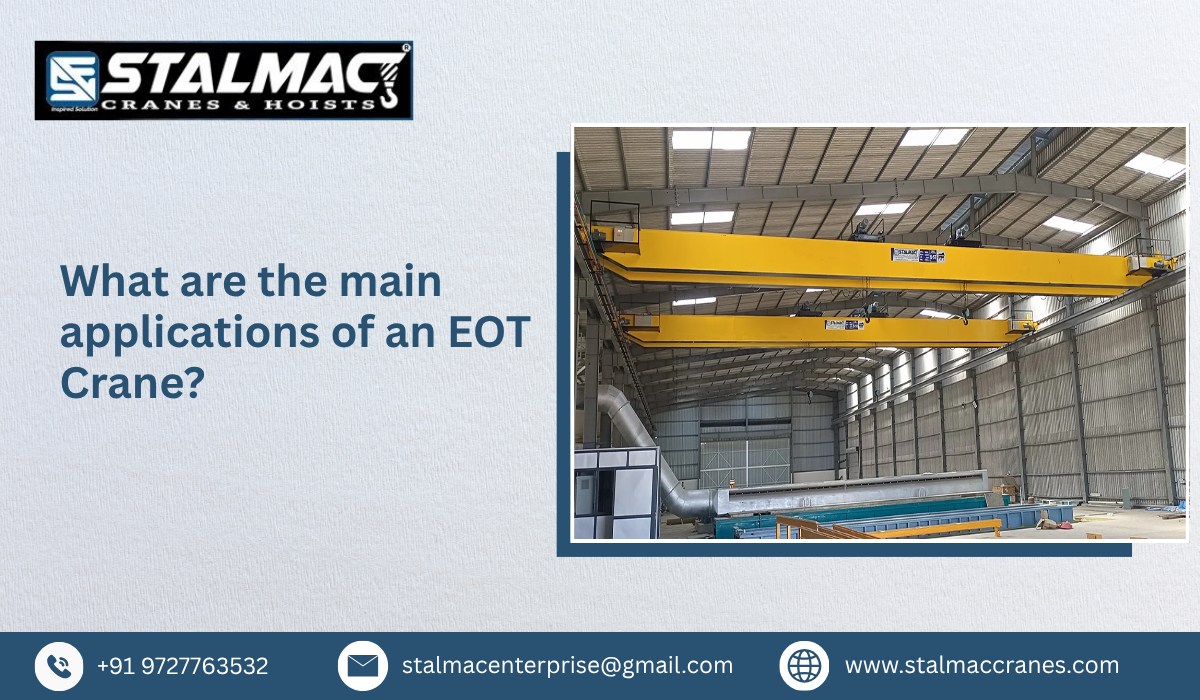
Stalmac Cranes focuses on industrial crane solutions designed to support different material-handling requirements. An EOT crane generally consists of a bridge structure, an electric hoist or trolley, end carriages, runway rails, and electrical control systems. The bridge travels along the runway while the hoist moves the load vertically, enabling controlled movement across the working area.
The Main Applications of EOT Crane include production operations, equipment assembly, inventory movement, steel handling, and the transportation of heavy industrial components. Choosing the appropriate crane design can help businesses reduce manual handling, streamline workflows, and maintain consistent lifting performance.
How Does an EOT Crane Work?
An EOT crane operates through coordinated mechanical and electrical movements. The bridge travels along the runway, the trolley moves horizontally across the bridge, and the hoist raises or lowers the load using a wire rope or chain mechanism.
Operators control these movements through a pendant station, radio remote control, or cabin-based control system, depending on the crane design.
Key operating components include:
- Bridge Structure: Supports the trolley and distributes the load across the crane runway.
- Electric Hoist: Raises and lowers materials using a motor-driven lifting mechanism.
- Trolley Assembly: Moves the hoist horizontally along the bridge girder.
- End Carriages: Support bridge travel and contain the travelling wheel assemblies.
- Control System: Enables controlled operation and may include limit switches, overload protection, and emergency-stop functions.
These features make an Industrial EOT Crane suitable for repetitive lifting operations where accuracy, reliability, and efficient material movement are important.
Main Applications of EOT Crane in Different Industries
The EOT Crane Uses in Industries vary according to the material being handled, the facility layout, and the required lifting capacity. Below are the major industrial applications.
1. Manufacturing Industry
Manufacturing facilities frequently use EOT cranes to move raw materials, machine components, fabricated structures, and finished products between workstations.
An EOT Crane for Manufacturing Industry supports production activities by reducing the need for manual movement of heavy objects and helping maintain an organised workflow.
Typical applications include:
- Moving components between production lines.
- Lifting machinery during installation and maintenance.
- Positioning heavy assemblies during fabrication.
- Transferring finished products to inspection or dispatch areas.
- Supporting equipment maintenance and replacement operations.
A properly selected crane can improve material flow and reduce production interruptions.
2. Warehouses and Logistics Facilities
An EOT Crane for Warehouses is useful in facilities that store and move heavy equipment, metal products, machinery parts, and industrial materials. Unlike floor-based material-handling equipment, an overhead crane uses the space above the working floor, allowing the floor area to remain available for storage and transportation.
Common applications include:
- Loading and unloading heavy industrial goods.
- Moving materials between storage and dispatch areas.
- Handling large components that cannot be moved conveniently by hand.
- Positioning products for inspection, packing, or shipment.
- Supporting internal logistics and inventory movement.
The crane's span, hook height, duty classification, and lifting capacity should match the warehouse's operational requirements.
3. Steel Plants and Metal Processing Units
Steel manufacturing and metal processing involve heavy loads, including billets, plates, coils, fabricated sections, and structural components. An EOT Crane for Steel Plants helps transfer these materials between production stages and storage locations.
Important applications include:
- Handling steel plates, bars, and structural sections.
- Moving metal components between cutting and fabrication stations.
- Transferring materials to designated storage areas.
- Supporting maintenance of heavy production equipment.
- Handling loads in foundries and metalworking facilities when the crane is specifically designed for those conditions.
High-temperature environments, abrasive dust, and intensive operating cycles may require specialised components, suitable electrical protection, and a crane duty rating selected for the application.
4. Material Handling and Heavy Engineering
An EOT Crane for Material Handling is widely used in heavy engineering workshops where oversized components need accurate positioning. These cranes support equipment assembly, fabrication, repair, and the movement of large industrial parts.
Applications include:
- Lifting heavy machine bases and fabricated frames.
- Positioning components during equipment assembly.
- Moving motors, gearboxes, and industrial machinery.
- Handling large engineering structures.
- Supporting repair and overhaul operations.
For such applications, crane selection should consider the maximum load, load dimensions, lifting height, travel distance, frequency of operation, and required positioning accuracy.
5. Power Plants and Process Industries
Power generation facilities and process plants use overhead cranes for installing, inspecting, and maintaining large mechanical assemblies. Depending on the plant layout and crane specification, these systems may support the movement of pumps, motors, valves, and other heavy components.
They are particularly useful in maintenance bays and equipment halls where loads must be lifted and positioned without obstructing surrounding operations.
6. Automotive and Equipment Assembly
Automotive factories and machinery manufacturers use EOT cranes to move engines, moulds, dies, production tools, and large assemblies. Controlled lifting helps operators position components accurately during installation, servicing, and manufacturing processes.
For repetitive production activities, crane speed, control response, and suitable lifting attachments are important considerations.
Types of EOT Cranes Used for Industrial Applications
Different crane configurations support different load capacities, building dimensions, and operating conditions.
- Single Girder EOT Crane: Uses one main bridge girder and is commonly selected for light-to-medium-duty material handling, depending on the required capacity and span.
- Double Girder EOT Crane: Uses two main bridge girders and can accommodate higher capacities, greater lifting heights, and demanding industrial applications when properly designed.
- Heavy Duty EOT Crane: Designed for demanding operating cycles and intensive lifting requirements, with components selected according to the duty classification and working environment.
The choice between these configurations depends on the load, span, lifting height, building structure, duty cycle, and applicable safety requirements.
Advantages of Using an EOT Crane
The advantages of EOT Crane Applications extend beyond lifting heavy materials. A suitable system can improve the efficiency and organisation of industrial operations.
- Higher Productivity: Moves heavy loads between workstations with less manual effort.
- Improved Workplace Safety: Reduces reliance on manual lifting when operated correctly with appropriate safeguards.
- Better Space Utilisation: Uses overhead space and can reduce congestion on the factory floor.
- Controlled Material Movement: Supports accurate positioning of heavy components during assembly and maintenance.
- Reduced Handling Time: Helps streamline repetitive lifting and transportation tasks.
- Operational Flexibility: Can be configured for different spans, capacities, controls, and lifting heights.
- Maintenance Support: Helps technicians remove, install, and position heavy machinery during servicing.
These benefits depend on proper engineering, trained operators, regular inspection, and adherence to safe working procedures.
Factors to Consider Before Selecting an EOT Crane
Before choosing an EOT crane, businesses should evaluate the following technical requirements:
- Lifting Capacity: Determine the maximum load, including the weight of any lifting attachment where applicable.
- Span and Runway: Match the crane dimensions to the building structure and required working area.
- Lifting Height: Ensure adequate hook travel for handling and positioning loads.
- Duty Classification: Select equipment based on load spectrum, operating frequency, and service intensity.
- Operating Environment: Consider dust, humidity, temperature, corrosive conditions, and other site-specific factors.
- Safety Systems: Evaluate overload protection, travel limits, brakes, emergency stops, and other required safeguards.
- Maintenance and Support: Review inspection access, spare-parts availability, and service requirements.
A technically suitable crane can support dependable operations while helping businesses manage lifecycle costs.
Stalmac Cranes: Industrial EOT Crane Solutions
Choosing an experienced EOT Crane Manufacturer in India is an important step in planning a reliable overhead lifting system. Businesses should assess engineering capability, product specifications, quality processes, customisation options, and after-sales support before finalising a supplier.
As an industrial crane brand, Stalmac Cranes is the company to contact to discuss crane requirements for manufacturing facilities, warehouses, steel plants, and heavy engineering applications. Buyers looking for an EOT Crane Supplier in India should share their required capacity, span, lifting height, duty cycle, and installation conditions to support appropriate technical evaluation.
An Industrial Lifting Equipment Manufacturer should provide clear technical specifications and help customers understand the suitability of the proposed crane configuration for their operating environment.
Conclusion
The Main Applications of EOT Crane include manufacturing, warehousing, steel production, heavy engineering, automotive assembly, and industrial maintenance. These systems enable controlled lifting and movement of heavy materials while supporting productivity, floor-space utilisation, and workplace safety.
Whether a facility requires a Single Girder EOT Crane, Double Girder EOT Crane, or Heavy Duty EOT Crane, the final selection should reflect its load requirements, operating conditions, building dimensions, and duty classification.

