What Is an EOT Crane and How Does It Work? | Stalmac Cranes
Introduction
In modern industries, efficient material handling is essential for improving productivity, maintaining workplace safety, and reducing manual effort. An Electric Overhead Travelling crane, commonly known as an EOT crane, is widely used to lift, lower, and move heavy materials within factories, warehouses, workshops, and manufacturing facilities. Stalmac Cranes provides industrial crane solutions designed to support material handling requirements across different industrial environments.
Understanding What Is an EOT Crane and how it works helps businesses select the right lifting system for their operations. An EOT crane operates on an overhead runway system and uses an electrically powered hoisting mechanism to move loads horizontally and vertically. Depending on the application, it can be configured with different lifting capacities, spans, lifting heights, and operating controls.
As an experienced EOT Crane Manufacturer in India, Stalmac Cranes focuses on practical crane solutions that help industries handle materials efficiently and maintain consistent production workflows.
What Is an EOT Crane?
An EOT crane is an electrically operated overhead lifting machine designed to transport heavy loads from one location to another within a defined working area. The EOT Crane Full Form is Electric Overhead Travelling Crane. It typically consists of a bridge structure, end carriages, an electric hoist or trolley, motors, a control system, and safety devices.
The crane travels along overhead rails supported by runway beams, allowing it to cover a large working area without occupying valuable floor space. Its lifting mechanism raises or lowers loads, while the bridge and trolley movements position the load where required.
An Industrial EOT Crane is commonly used in engineering workshops, steel plants, fabrication units, automotive facilities, power plants, and heavy manufacturing industries. Businesses can select single-girder or double-girder configurations according to their load requirements and operating conditions.
How Does an EOT Crane Work?
Understanding How Does an EOT Crane Work requires looking at its main mechanical, electrical, and control components. The crane combines vertical lifting with horizontal movement to transport materials safely and accurately.
The EOT Crane Working Principle involves three primary movements:
- Hoisting Movement: An electric motor drives the hoist mechanism, which winds or unwinds a wire rope or chain to lift or lower the load.
- Cross Travel Movement: The trolley moves along the bridge girder, positioning the load across the crane's span.
- Long Travel Movement: The complete crane bridge travels along the overhead runway rails to move materials along the length of the workspace.
Operators control these movements using a pendant controller, radio remote control, or cabin-based controls, depending on the crane design.
During operation, the operator positions the lifting hook above the load, attaches suitable lifting accessories, and raises the material carefully. The trolley and bridge then move the suspended load to the required location. Controlled lowering completes the material transfer.
Modern cranes may incorporate variable-frequency drives, limit switches, overload protection, emergency stops, and travel alarms. These features support smoother movement, improved positioning, and safer crane operation when correctly specified and maintained.
Main Components of an EOT Crane
A typical EOT crane includes several interconnected components that work together to provide reliable lifting performance.
- Bridge Girder: The main structural member that spans the working area and supports the trolley or hoisting assembly.
- End Carriages: Assemblies fitted with wheels that allow the crane bridge to travel along runway rails.
- Electric Hoist: The mechanism responsible for lifting and lowering loads using a wire rope or chain.
- Trolley: Carries the hoist and moves across the bridge girder.
- Electric Motors and Gearboxes: Provide the driving force for hoisting, cross travel, and long travel.
- Control Panel: Houses electrical components used to operate and protect the crane system.
- Safety Devices: May include brakes, limit switches, overload protection, and emergency stop controls.
Correct component selection is essential for dependable performance, particularly in demanding industrial environments.
Types of EOT Cranes
Stalmac Cranes can help businesses identify a suitable crane configuration based on their facility layout, load requirements, and operating conditions.
Single Girder EOT Crane
A Single Girder EOT Crane uses one main bridge girder to support the hoist trolley. It is generally suitable for light to medium-duty material handling applications, depending on the engineered design. Its relatively compact construction can make it appropriate for workshops, assembly areas, and smaller manufacturing facilities.
Double Girder EOT Crane
A Double Girder EOT Crane incorporates two main bridge girders and commonly supports a trolley-mounted hoisting arrangement. This configuration is often selected for higher lifting capacities, larger spans, greater lifting heights, or demanding industrial applications, subject to the specific design.
The choice between these crane types depends on the required capacity, duty classification, available headroom, span, and operating frequency.
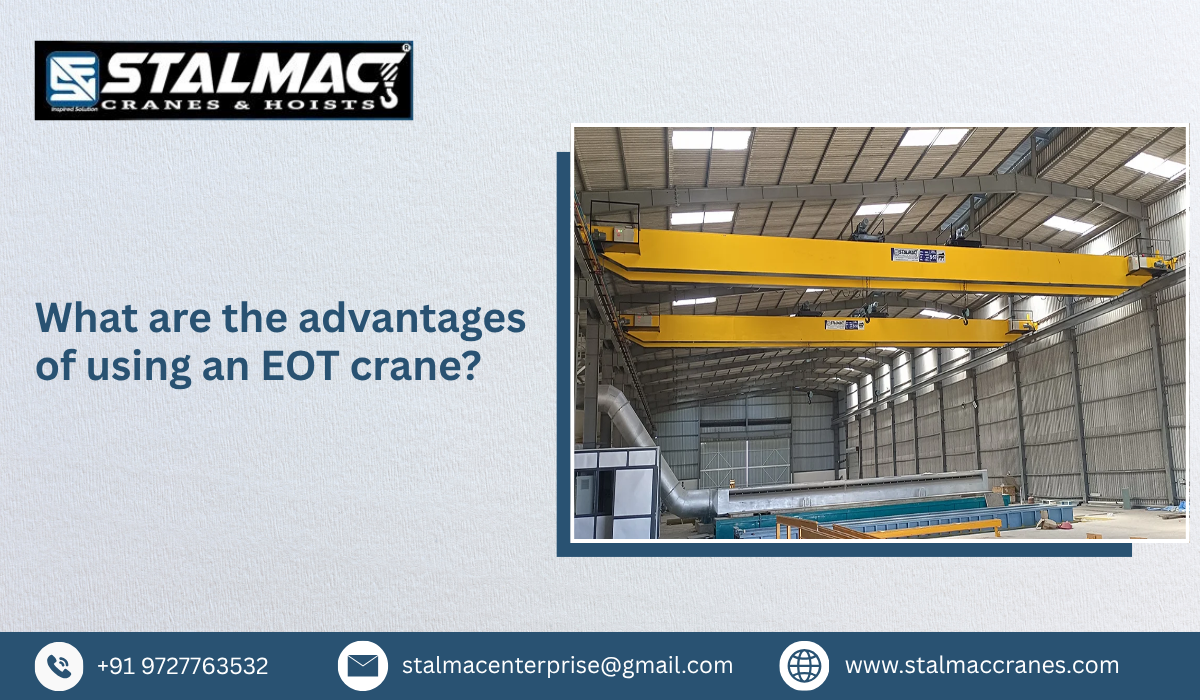
Advantages of EOT Cranes
EOT cranes offer several operational benefits for industries that regularly handle heavy or bulky materials.
- Efficient Material Handling: Move heavy loads across production areas with less manual effort.
- Better Space Utilisation: Use overhead space while keeping floors available for machinery, storage, and personnel movement.
- Improved Productivity: Reduce material transfer time between manufacturing, assembly, and storage areas.
- Controlled Load Positioning: Enable accurate placement of materials when operated by trained personnel.
- Reduced Manual Handling: Minimise dependence on manual lifting and help reduce associated handling risks.
- Flexible Configuration: Adapt crane design to different spans, lifting heights, load capacities, and industrial requirements.
- Integration with Production Systems: Support repetitive lifting operations and organised material flow in industrial facilities.
These advantages depend on proper engineering, suitable crane selection, operator training, and regular inspection.
EOT Crane Applications
EOT Crane Applications cover a broad range of industries where heavy loads must be lifted and transported repeatedly. Common applications include:
- Manufacturing Plants: Moving machine components, raw materials, and finished products between production stages.
- Steel and Metal Industries: Handling metal plates, structural sections, billets, and fabricated assemblies.
- Engineering Workshops: Lifting machinery parts, tools, equipment, and heavy workpieces.
- Automotive Industries: Transporting engines, vehicle components, dies, and production equipment.
- Warehouses and Logistics Facilities: Moving heavy goods within designated storage and dispatch areas.
- Power Plants: Handling large components during manufacturing, installation, and maintenance activities.
- Fabrication Units: Positioning welded structures, frames, and heavy fabricated products.
- Cement and Heavy Industries: Supporting equipment maintenance and the movement of bulky industrial materials.
The crane must be selected according to the specific lifting task, operating environment, and applicable safety requirements.
Understanding EOT Crane Load Capacity
EOT Crane Load Capacity refers to the maximum rated load that a crane is designed to lift under its specified operating conditions. Capacity selection should consider the heaviest load, lifting accessories, handling frequency, span, lifting height, and required duty classification.
For example, a facility handling medium-weight machinery components may require a different crane configuration from a steel plant lifting heavy structural assemblies. The crane's rated capacity must never be exceeded, and the weight of the load and applicable lifting accessories must be considered according to the manufacturer's specifications.
A professional Industrial Lifting Equipment Manufacturer can help assess these factors before finalising a crane design.
Why Choose Stalmac Cranes?
Selecting the right crane manufacturer is important for long-term operational reliability. Stalmac Cranes supports industrial material handling requirements with solutions designed around application needs, facility layouts, and lifting specifications.
Businesses evaluating an EOT Crane Supplier in India should consider structural design, component quality, electrical controls, safety provisions, maintenance requirements, and after-sales support. Working with an experienced Material Handling Equipment Supplier can help ensure that the selected system aligns with production requirements and site conditions.
Stalmac Cranes aims to help industries improve material movement through practical lifting solutions suited to their operational needs.
Conclusion
An EOT crane is an essential industrial lifting system that combines hoisting, cross travel, and long travel movements to transport heavy materials efficiently. Understanding What Is an EOT Crane, its working principle, components, advantages, applications, and capacity requirements helps businesses make informed equipment decisions.
Whether a facility needs a Single Girder EOT Crane for general workshop operations or a Double Girder EOT Crane for demanding lifting applications, the right configuration depends on load requirements, available space, duty cycle, and safety considerations.

