What Is an EOT? | Stalmac Cranes
Introduction to EOT Cranes
In modern manufacturing and industrial facilities, efficient material handling is essential for maintaining productivity, improving workplace safety, and reducing manual effort. An EOT Crane is one of the most widely used lifting systems for moving heavy materials horizontally and vertically within factories, warehouses, workshops, and production plants. Stalmac Cranes provides industrial crane solutions designed to support material handling requirements across different industrial environments.
Understanding What Is an EOT Crane helps businesses choose suitable lifting equipment according to their load requirements, building structure, operating conditions, and production workflow. EOT cranes are designed to lift, lower, and transport heavy loads along a predefined path using an overhead runway system. They are particularly useful in facilities where frequent lifting operations require controlled movement, consistent performance, and efficient space utilization.
EOT Crane Full Form and Meaning
The EOT Crane Full Form is Electric Overhead Travelling Crane. The name describes a crane that operates electrically and travels along overhead runway rails to move materials between designated work areas. The EOT Meaning in Crane refers to an electrically powered overhead lifting arrangement that combines hoisting, cross-travel, and long-travel movements.
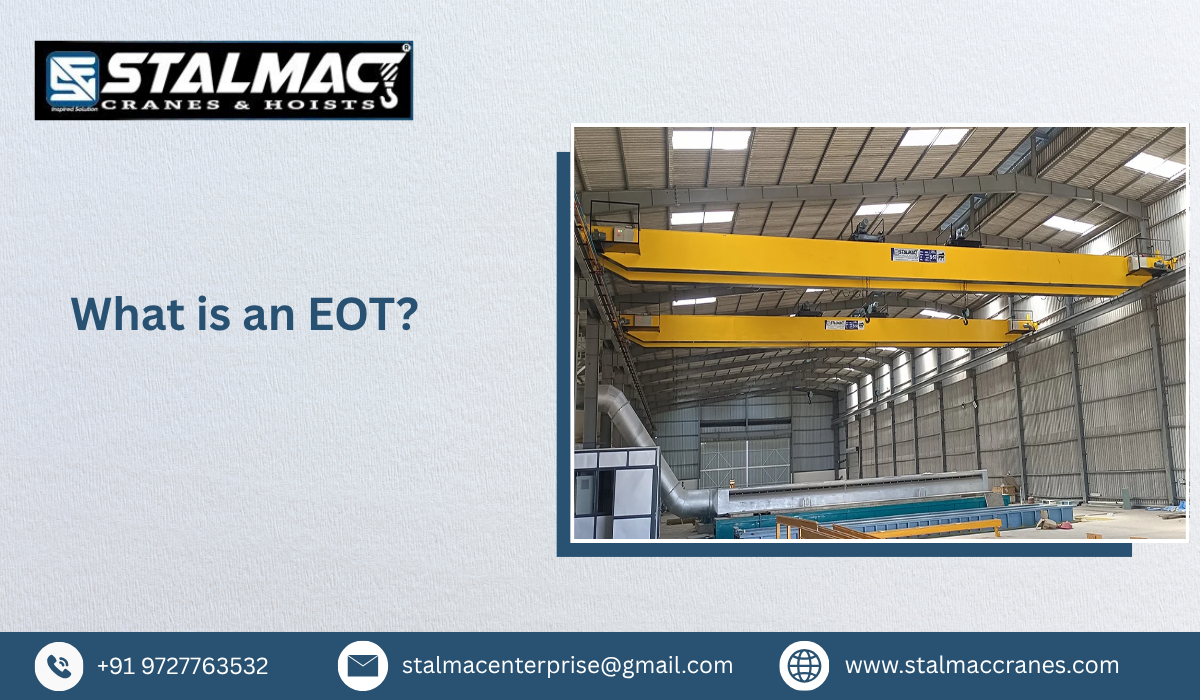
An Electric Overhead Travelling Crane generally consists of a bridge structure, end carriages, an electric hoist or trolley, motors, brakes, electrical controls, and a runway system. Depending on the design, the crane can lift steel components, machinery, raw materials, fabricated products, and other industrial loads.
As an experienced EOT Crane Manufacturer in India, Stalmac Cranes can help businesses identify crane configurations suited to their operational needs. Selecting the right system requires consideration of lifting capacity, span, lifting height, duty classification, travel speed, and available installation space.
EOT Crane Working Principle
The EOT Crane Working Principle is based on coordinated mechanical and electrical movements that allow a load to be lifted, lowered, and transported safely.
The typical operating process includes:
- Lifting and Lowering: An electric hoist or lifting mechanism raises and lowers the load using a wire rope or chain and a suitable hook arrangement.
- Cross Travel: The trolley moves across the crane bridge, positioning the load along the width of the working area.
- Long Travel: The complete crane travels along runway rails installed on the building structure or a dedicated supporting framework.
- Electrical Control: Push-button pendants, radio remote controls, or cabin controls operate the crane's motors and movement functions.
- Braking and Load Control: Braking systems help stop and hold loads during normal operation. Appropriate overload protection and limit devices can help reduce operational risks.
These coordinated movements allow operators to transfer materials between workstations without depending on forklifts or manual handling for every lifting task. Actual crane configuration and safety features depend on the design specification and applicable standards.
Types of EOT Cranes
Selecting the appropriate crane configuration is important for lifting efficiency, operational safety, and long-term performance. The two commonly used configurations are single girder and double girder cranes.
1. Single Girder EOT Crane
A Single Girder EOT Crane uses one main bridge girder to support the hoist and trolley arrangement. It is commonly considered for light- to medium-duty material handling where the required capacity, span, and lifting height suit the design. Its relatively simple construction can help reduce installation complexity and initial investment.
2. Double Girder EOT Crane
A Double Girder EOT Crane uses two main bridge girders and can accommodate heavier loads and specialized lifting arrangements when engineered accordingly. It is suitable for demanding industrial environments that require higher lifting capacities, greater spans, or additional lifting height. Final selection depends on structural calculations, duty classification, and the operating conditions.
Advantages of EOT Cranes
An EOT crane can improve material movement and support organized industrial workflows. The main advantages include:
- Efficient Material Handling: Moves heavy components between workstations with controlled lifting and travelling movements.
- Reduced Manual Effort: Minimizes the need for manual handling and repeated repositioning of heavy loads.
- Better Space Utilization: Uses overhead working space, helping keep floors available for production, storage, and vehicle movement.
- Improved Productivity: Supports repetitive lifting operations and can reduce delays in material transfer.
- Controlled Load Movement: Motor-driven movements and suitable controls enable accurate positioning during loading and unloading.
- Adaptable Configurations: Can be designed with different capacities, spans, lifting heights, control systems, and operating speeds.
- Long-Term Operational Value: Appropriate design, trained operation, and preventive maintenance can support dependable service life.
The benefits achieved depend on the application, crane specification, operating practices, and maintenance schedule.
EOT Crane Applications in Different Industries
EOT cranes are used wherever materials must be lifted and moved repeatedly within a defined working area. Common applications include:
- Steel Plants: Handling steel plates, billets, coils, structural sections, and fabricated assemblies.
- Manufacturing Units: Moving machine components, raw materials, and finished products between production stations.
- Foundries: Transporting moulds, castings, and other heavy components using cranes specifically designed for the relevant conditions.
- Automotive Industries: Supporting assembly operations, machinery installation, and component handling.
- Warehouses: Loading, unloading, and transferring heavy industrial goods within designated storage areas.
- Cement and Fertilizer Plants: Handling equipment parts, maintenance components, and production-related materials.
- Power Plants: Assisting with equipment installation, inspection, and maintenance activities.
- Chemical and Petrochemical Facilities: Moving machinery and process equipment with configurations appropriate to the site hazards.
- Textile and Paper Industries: Handling machine components, rolls, and production materials.
- Engineering and Fabrication Workshops: Positioning heavy workpieces for machining, welding, assembly, and inspection.
EOT Crane Load Capacity and Technical Considerations
The EOT Crane Load Capacity is the maximum rated load that the crane is designed to lift under its specified operating conditions. Capacity requirements must be established before manufacturing or installation.
Important technical parameters include:
- Rated Capacity: The maximum permitted load, including consideration of the lifting attachment and other applicable design requirements.
- Span: The horizontal distance between the runway rail centre lines.
- Lifting Height: The vertical distance through which the load must travel.
- Duty Classification: The frequency of lifting, load spectrum, and expected operating cycles.
- Hoisting Speed: The speed at which the crane raises or lowers the load.
- Travel Speed: The speed of trolley and bridge movement.
- Structural Requirements: Building columns, runway beams, foundations, and supporting structures must be checked for the crane loads.
- Safety Features: Appropriate brakes, limit switches, overload protection, emergency stopping arrangements, and other required safeguards must be specified.
The crane and its supporting structure should be designed and assessed according to applicable standards, site conditions, and the intended duty.
EOT Crane Price in India: What Determines the Cost?
The EOT Crane Price in India varies according to the crane's capacity, span, lifting height, girder configuration, duty class, and customization requirements. Electrical components, hoist specifications, automation features, installation conditions, and commissioning requirements also influence the total project cost.
A smaller single girder crane may have different cost requirements from a heavy-duty double girder crane designed for continuous industrial service. Buyers should compare quotations based on the same technical specifications rather than considering the initial purchase price alone.
When requesting a quotation, provide the rated load, span, lift height, operating hours, required speeds, building details, and preferred control method. This information helps the manufacturer develop a solution suited to the actual application.
Why Choose Stalmac Cranes?
Stalmac Cranes offers crane and material handling solutions for a range of industrial applications, including steel, foundry, ceramic, textile, chemical, cement, and manufacturing operations. The company's website highlights crane design and manufacturing, customized solutions, installation, commissioning, maintenance, and service support.
As an EOT Crane Manufacturer in India, Stalmac Cranes focuses on providing lifting equipment aligned with individual site and operational requirements. Businesses looking for an EOT Crane Supplier in India should evaluate technical suitability, manufacturing quality, safety provisions, service support, and lifecycle requirements before making a purchase.
Working with an experienced Industrial Lifting Equipment Manufacturer can help ensure that crane selection considers load characteristics, building constraints, operating cycles, and future production needs.
Conclusion
An EOT crane is an essential industrial lifting system that enables controlled vertical and horizontal movement of heavy materials. Understanding the EOT Crane Full Form, operating principle, crane types, capacity requirements, advantages, and applications helps businesses make informed equipment decisions.
Whether your facility needs a single girder system for routine material handling or a double girder configuration for demanding lifting operations, Stalmac Cranes can be approached to discuss your technical requirements. Visit Stalmac Cranes to explore available crane solutions and request information for your industrial lifting project.

