What Is the Complete Form of EOT Crane? | Stalmac Cranes
Introduction to EOT Crane
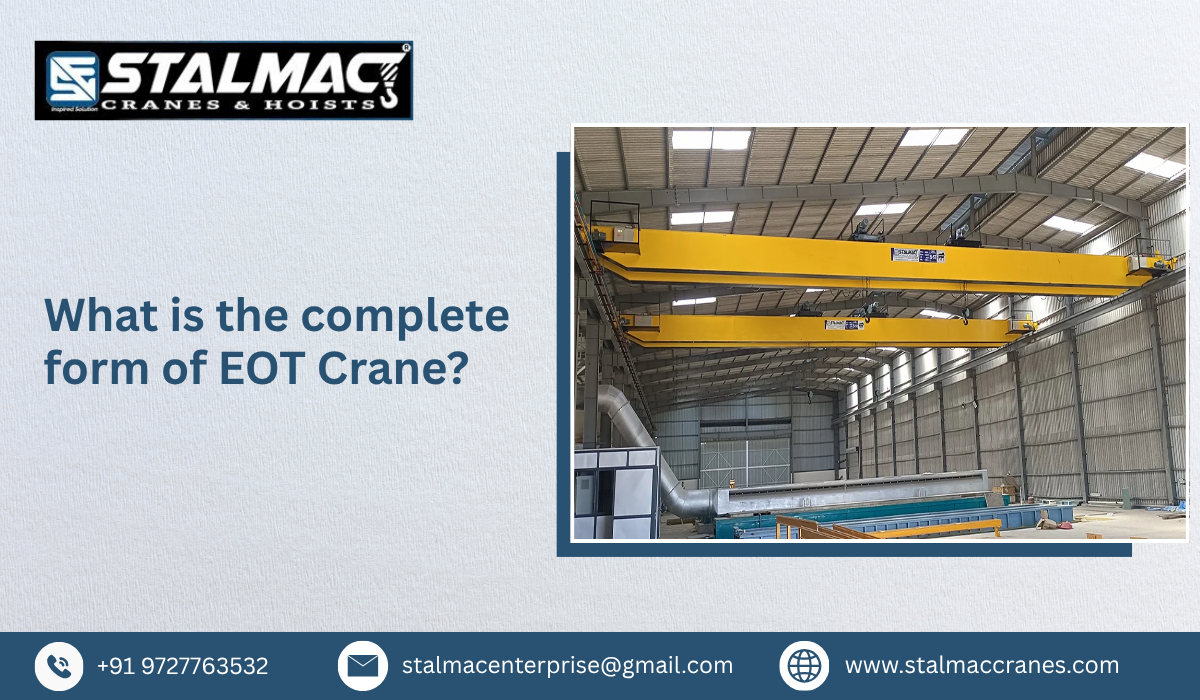
The complete form of EOT Crane is Electric Overhead Travelling Crane. It is an industrial material-handling machine designed to lift, lower, and move heavy loads horizontally within factories, warehouses, workshops, manufacturing plants, and other industrial facilities. An EOT crane operates on an overhead runway system, allowing materials to be transported efficiently without occupying valuable floor space.
Stalmac Cranes focuses on industrial crane solutions designed to support material handling, production activities, and heavy-duty lifting requirements. Understanding the EOT Crane Full Form, its working principle, types, advantages, and applications helps businesses select the right lifting equipment for their operational needs.
The meaning of EOT Crane goes beyond its name. It refers to a powered lifting system that combines a bridge structure, an electric hoist or trolley, motors, controls, and runway arrangements to move loads safely and efficiently. Depending on the application, an Industrial EOT Crane can be configured for different lifting capacities, spans, lifting heights, and operating conditions.
EOT Crane Meaning and Definition
The EOT Crane Meaning is an electrically operated overhead travelling crane used for lifting and transporting materials along defined horizontal and vertical paths. The crane bridge travels along elevated runway rails, while a trolley or hoist moves across the bridge to position the load.
When someone asks, What Is EOT Crane, the simplest answer is that it is a powered overhead lifting machine used to handle heavy materials with controlled movement. Unlike mobile lifting equipment, it generally operates within a fixed installation, making it suitable for repetitive material-handling tasks in industrial environments.
An EOT Crane Manufacturer in India typically designs crane systems according to the customer's load requirements, factory layout, working duty, available headroom, and safety specifications. The appropriate design depends on the intended application rather than lifting capacity alone.
EOT Crane Working Principle
The EOT Crane Working Principle is based on coordinated electric movements that lift loads vertically and transport them horizontally.
The main operating process includes the following steps:
- Load Attachment: The operator attaches the load securely to a suitable hook, lifting attachment, or approved handling device.
- Vertical Lifting: An electric hoist raises the load using a wire rope or chain and a motor-driven lifting mechanism.
- Cross Travel: The trolley moves along the bridge girder to position the load across the working area.
- Longitudinal Travel: The entire crane bridge moves along the runway rails to transport the load to another location.
- Controlled Lowering: The operator lowers the load carefully and places it in the designated position.
The operator controls these movements using a pendant station, radio remote control, or cabin controls, depending on the crane configuration. Braking systems, limit switches, overload protection where provided, and other safety devices help support controlled operation. The exact equipment depends on the crane design and applicable safety requirements.
EOT Crane Types
Understanding EOT Crane Types is essential when selecting a crane for a particular industrial environment. The two commonly used configurations are single girder and double girder cranes, although other overhead lifting arrangements are also available.
1. Single Girder EOT Crane
A Single Girder EOT Crane consists of one main bridge girder supported by end carriages. The hoist travels along the girder to lift and move materials. This configuration is commonly considered for light- to medium-duty material handling, depending on the designed capacity and operating conditions.
Key features include:
- Compact construction and efficient use of available headroom.
- Suitable for workshops, warehouses, and production facilities.
- Relatively straightforward installation and maintenance.
- Flexible configurations for different spans and lifting heights.
2. Double Girder EOT Crane
A Double Girder EOT Crane uses two parallel bridge girders to support the trolley and hoisting mechanism. It is commonly selected for demanding industrial applications requiring higher lifting capacities, longer spans, or specialized lifting arrangements.
Key features include:
- Robust structural configuration for demanding lifting operations.
- Potential for greater lifting height, depending on the design.
- Suitable for heavy fabrication, steel plants, and large manufacturing facilities.
- Options for specialized attachments and operating configurations.
Stalmac Cranes offers single girder and double girder crane solutions, along with other material-handling equipment for industrial applications.
Advantages of EOT Cranes
An EOT crane can improve material-handling efficiency when it is properly selected, installed, and maintained. The major advantages include:
- Efficient Material Movement: Enables lifting and transporting materials across designated work areas.
- Space Optimization: Uses overhead space and helps keep floors available for production and movement.
- Improved Productivity: Reduces dependence on manual handling and supports repetitive lifting tasks.
- Controlled Operation: Electric drives and suitable control systems allow operators to position loads accurately.
- Reduced Manual Handling: Helps limit direct physical handling of heavy materials.
- Flexible Design: Can be configured according to load requirements, building dimensions, lifting height, and duty cycle.
- Integration with Production: Supports manufacturing lines, assembly operations, storage systems, and dispatch processes.
These advantages depend on correct engineering, suitable operator training, adherence to safe working load limits, and regular inspections.
EOT Crane Applications in Different Industries
The EOT Crane Applications cover a wide range of industrial activities where heavy or bulky materials need to be lifted and transferred. Common applications include:
- Steel Plants: Handling steel coils, plates, billets, structural sections, and fabricated components.
- Automobile Manufacturing: Moving engine assemblies, machine components, dies, and production equipment.
- Foundries: Transporting moulds, castings, and other materials using equipment specifically designed for the operating environment.
- Cement Industries: Handling heavy components, maintenance equipment, and manufacturing materials.
- Warehouses: Moving pallets, machinery, and industrial goods between designated storage or loading areas.
- Engineering Workshops: Supporting machining, fabrication, assembly, and equipment installation.
- Chemical and Fertilizer Plants: Lifting equipment and materials with crane configurations selected for the site's environmental and safety requirements.
- Power Plants: Handling maintenance components, motors, and heavy machinery.
- Shipbuilding Facilities: Moving large fabricated sections and equipment.
- Paper, Textile, and Packaging Industries: Supporting production machinery maintenance and material transfer.
The crane's design must reflect the actual load, work frequency, operating environment, and lifting path. Hazardous or corrosive environments may require specialized electrical enclosures, materials, or protective features.
EOT Crane Load Capacity and Selection Factors
EOT Crane Load Capacity refers to the maximum load the crane is designed and rated to lift under specified operating conditions. Depending on the application, capacity requirements may range from relatively light loads to heavy industrial lifting duties.
Before selecting a crane, businesses should evaluate:
- Rated Capacity: Determine the maximum load, including the relevant lifting attachments where applicable.
- Span: Measure the distance between the runway rails.
- Lifting Height: Establish the vertical distance required to raise the load.
- Duty Classification: Consider operating frequency, load spectrum, and expected service life.
- Building Structure: Confirm that the runway and supporting structure can accommodate the design loads.
- Safety Systems: Specify appropriate brakes, limit switches, overload protection, and emergency controls.
- Maintenance Requirements: Consider inspection access, spare parts, servicing, and long-term operating costs.
These factors help engineers determine the appropriate crane configuration and supporting equipment.
EOT Crane Price in India
The EOT Crane Price in India varies according to capacity, span, lifting height, girder design, hoist specification, duty classification, automation, and installation requirements. Building modifications and runway construction can also influence the overall project cost.
A single girder crane and a double girder crane may have different cost structures because of differences in structural steel, hoisting arrangements, and engineering requirements. Additional features, such as remote controls, variable-frequency drives, specialized lifting attachments, and application-specific safety systems, may also affect the quotation.
When requesting a quotation, provide the required capacity, span, lifting height, operating hours, application details, and installation location. Comparing quotations on the basis of technical specifications, included services, warranty terms, and maintenance support helps businesses assess the total cost of ownership rather than the purchase price alone.
Choosing an EOT Crane Manufacturer in India
Selecting a reliable EOT Crane Manufacturer in India involves evaluating engineering capability, manufacturing quality, customization options, installation services, and after-sales support. A suitable supplier should understand the facility's layout and operating requirements before recommending a crane configuration.
Stalmac Cranes, based in Ahmedabad, Gujarat, provides crane manufacturing and material-handling solutions, including single girder and double girder EOT cranes. Its services include design, manufacturing, supply, installation, and maintenance support.
Businesses searching for an EOT Crane Supplier in India should verify the technical specifications, applicable standards, safety documentation, inspection procedures, and service arrangements before finalizing a purchase. A qualified Overhead Crane Manufacturer can help determine the appropriate solution for the facility's lifting requirements.
Conclusion
The complete form of EOT Crane is Electric Overhead Travelling Crane. It is an important industrial lifting system that enables controlled vertical lifting and horizontal transportation of heavy materials. Understanding the EOT Crane Full Form, working principle, types, advantages, applications, and capacity requirements helps businesses make informed equipment decisions.
With suitable engineering, correct installation, trained operators, and preventive maintenance, an EOT crane can support efficient and reliable industrial operations. Visit Stalmac Cranes to explore available crane solutions and discuss your material-handling requirements with the company.

