What Is the Difference Between a Hoist and an EOT Crane? – Stalmac Cranes
Introduction
In industrial environments, lifting equipment plays an essential role in moving heavy materials safely and efficiently. Two commonly used lifting solutions are hoists and Electric Overhead Travelling (EOT) cranes. Although both are designed to lift and lower loads, their structure, movement capabilities, applications, and load-handling functions are different. Understanding Hoist vs EOT Crane helps industries select the right equipment for their operational requirements.
Stalmac Cranes provides industrial lifting and material-handling solutions designed to support manufacturing plants, warehouses, engineering facilities, and heavy industries. As an industrial equipment brand, Stalmac Cranes focuses on helping businesses understand lifting requirements, including load capacity, lifting height, travel distance, operating frequency, and workplace conditions.
The Difference Between Hoist and EOT Crane mainly lies in their functions. A hoist is a lifting mechanism that raises and lowers a load, whereas an EOT crane is a complete overhead lifting system that can lift loads and move them horizontally along a bridge and runway arrangement. Both can work together to improve productivity and material-handling efficiency.
What Is a Hoist?
A hoist is a mechanical or electrical lifting device used to raise, lower, and hold materials. Depending on its design, it uses a wire rope or chain, a motor or manual mechanism, a braking system, and a lifting hook or other attachment.
For businesses asking What Is a Hoist, the simplest explanation is that it is the mechanism responsible for vertical lifting. Hoists can be installed on fixed mounting points, monorail systems, gantry structures, or EOT cranes.
An Electric Wire Rope Hoist Manufacturer typically supplies equipment suitable for lifting heavier loads and supporting frequent industrial operations. Electric wire rope hoists are commonly selected where lifting height, duty cycle, speed, and load capacity require careful engineering.
Advantages of a Hoist
- Compact design: Suitable for workstations and areas with limited installation space.
- Efficient vertical lifting: Raises and lowers loads using a controlled lifting mechanism.
- Flexible installation: Can be mounted on beams, monorails, or overhead crane structures.
- Improved productivity: Reduces manual material handling and lifting time.
- Operational control: Electric models offer convenient control over lifting and lowering operations.
Applications of Hoists
- Manufacturing and assembly lines.
- Workshops and fabrication units.
- Warehouses and loading areas.
- Maintenance departments.
- Machinery installation and equipment servicing.
- Industrial production facilities requiring repetitive vertical lifting.
What Is an EOT Crane?
- Manufacturing and assembly lines.
- Workshops and fabrication units.
- Warehouses and loading areas.
- Maintenance departments.
- Machinery installation and equipment servicing.
- Industrial production facilities requiring repetitive vertical lifting.
What Is an EOT Crane?
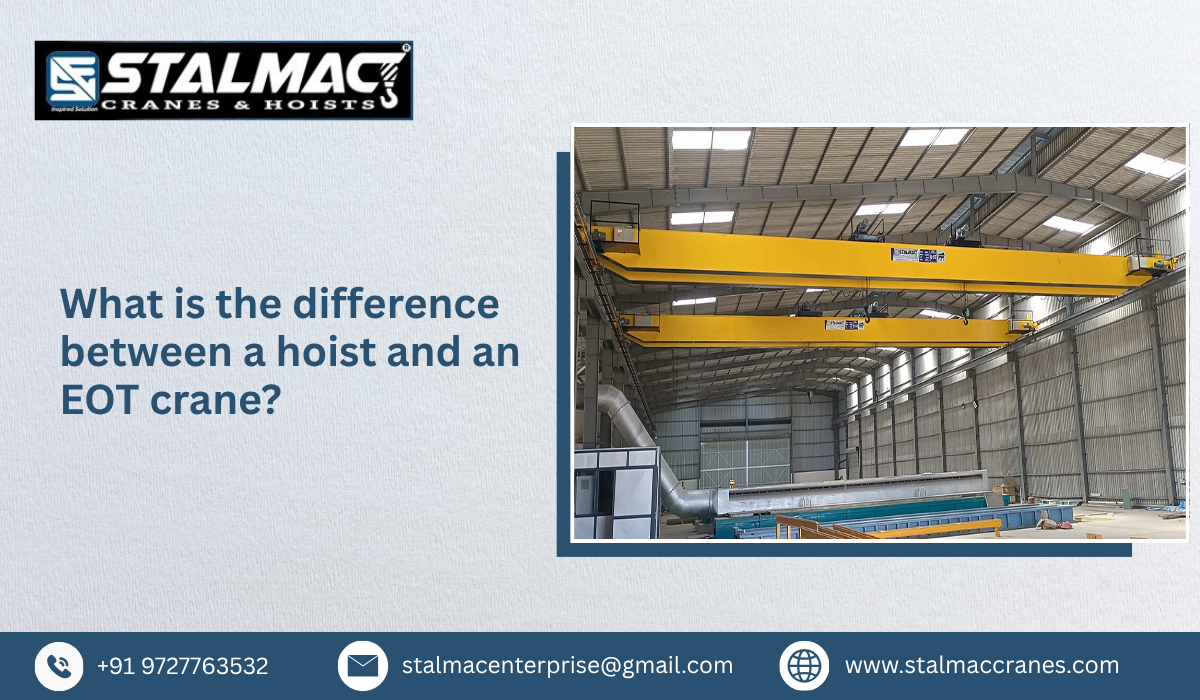
An Electric Overhead Travelling crane is an industrial lifting system that transports heavy loads across a defined working area. It generally consists of a bridge girder, end carriages, a hoisting mechanism, a trolley, motors, brakes, electrical controls, and runway rails.
When considering What Is an EOT Crane, it is important to understand that the crane provides more extensive movement than a standalone hoist. The hoist lifts and lowers the load, while the crane bridge travels along the runway and the trolley moves across the bridge, enabling horizontal positioning.
An EOT Crane Manufacturer in India designs crane systems according to factors such as lifting capacity, span, lifting height, working class, operating environment, and installation layout. Businesses can select different configurations depending on their material-handling requirements.
Advantages of EOT Cranes
- Three-directional load movement: Supports lifting, lowering, cross travel, and long travel.
- Large-area coverage: Moves materials across production floors and industrial bays.
- Heavy-load handling: Suitable for demanding material-handling operations when appropriately designed.
- Better workflow: Helps reduce the need to transport heavy loads manually.
- Improved positioning: Allows operators to position materials at different locations within the crane's working area.
- Customisable configuration: Available in different girder designs, capacities, spans, and control arrangements.
Applications of EOT Cranes
- Steel plants and metal-processing facilities.
- Heavy engineering and fabrication industries.
- Automotive manufacturing plants.
- Power generation and industrial maintenance facilities.
- Warehouses and manufacturing units.
- Foundries and machinery production facilities.
Hoist and Crane Working Principle
The Hoist and Crane Working Principle involves coordinated mechanical movement, drive systems, brakes, and operator controls.
In a typical electric hoist, the motor drives a gearbox and lifting drum or chain mechanism. The wire rope or chain moves to raise or lower the hook. A braking system helps hold the load when the lifting movement stops.
In an EOT crane, the hoisting mechanism performs the vertical lifting operation. The trolley moves along the bridge to provide cross travel, while the end carriages travel along runway rails to provide long travel. These movements allow the operator to transfer materials between designated positions.
Depending on the design, the system may include overload protection, limit switches, emergency stops, and other safety devices. Equipment selection and operation should follow applicable standards, manufacturer instructions, and site-specific safety procedures.
Types of Hoists and EOT Cranes
Common Hoist Types
- Electric wire rope hoist: Suitable for many industrial lifting applications involving heavier loads.
- Electric chain hoist: Commonly used for workstation lifting and moderate-capacity applications.
- Manual chain hoist: Used where powered lifting is unnecessary or unavailable.
- Low-headroom hoist: Designed for installations requiring efficient use of available vertical space.
Common EOT Crane Types
- Single Girder EOT Crane: Uses one main bridge girder and is commonly considered for suitable light- to medium-duty applications, depending on design and capacity.
- Double Girder EOT Crane: Uses two main bridge girders and is often selected for higher-capacity applications, larger spans, or specialised lifting requirements.
A Single Girder EOT Crane may be appropriate for general factory material handling, while a Double Girder EOT Crane may be considered where greater lifting capacity, hook height, or demanding operating conditions are required. Final selection depends on the engineering specifications rather than girder configuration alone.
How to Choose the Right Industrial Lifting Equipment
Before choosing between a standalone hoist and a complete EOT crane, consider the following factors:
- Load capacity: Identify the maximum load weight, including lifting attachments where applicable.
- Lifting height: Determine the required vertical distance and available headroom.
- Movement requirements: Decide whether loads need to move vertically only or across the production floor.
- Operating frequency: Assess the expected number of lifting cycles and duty classification.
- Building structure: Check runway support, available span, headroom, and structural capacity.
- Safety requirements: Consider brakes, limit switches, overload protection, inspections, and operator training.
- Maintenance: Review spare parts availability, service requirements, and equipment accessibility.
Working with an experienced Industrial Lifting Equipment Manufacturer helps businesses evaluate these requirements before installation. A reliable Material Handling Equipment Manufacturer can also help coordinate lifting systems with production layouts and material-flow requirements.
Stalmac Cranes: Industrial Hoist and EOT Crane Solutions
Stalmac Cranes supports industrial material-handling requirements through lifting-equipment solutions tailored to operational needs. When evaluating a Hoist Manufacturer in India, buyers should review product specifications, lifting capacity, duty classification, safety provisions, and after-sales support.
An experienced Industrial Hoist Supplier in India can help identify suitable hoist configurations for specific lifting tasks. Similarly, an EOT Crane Supplier in India can assist with evaluating crane span, runway arrangement, travel speeds, control systems, and installation requirements.
Businesses comparing Hoist vs EOT Crane should focus on the actual work to be performed. A standalone hoist is suitable when the primary requirement is lifting at a fixed location or along a compatible monorail. An EOT crane is more appropriate when materials must be lifted and transported across a larger overhead working area.
Conclusion
The difference between a hoist and an EOT crane is primarily related to their functions and movement capabilities. A hoist provides vertical lifting, whereas an EOT crane integrates a hoist with a bridge, trolley, and runway travel system to move loads across an industrial workspace.
With the right equipment selection, businesses can improve material flow, reduce manual handling, and support safer, more efficient industrial operations. Stalmac Cranes can be considered when evaluating lifting and overhead material-handling requirements. Contact the team through stalmaccranes.com to discuss your application, required capacity, lifting height, and crane configuration.

