What Is the Difference Between EOT Crane and Hoist?
Understanding the Difference Between EOT Crane and Hoist is important for industries that regularly move heavy materials, machinery, components, and raw materials. Although both systems are used for lifting, an EOT crane is a complete overhead material-handling system, while a hoist is primarily the lifting mechanism. For businesses evaluating reliable lifting solutions, Stalmac Cranes provides engineered equipment designed around load capacity, lifting height, duty cycle, travel requirements, and industrial operating conditions.
Difference Between EOT Crane and Hoist: Basic Understanding
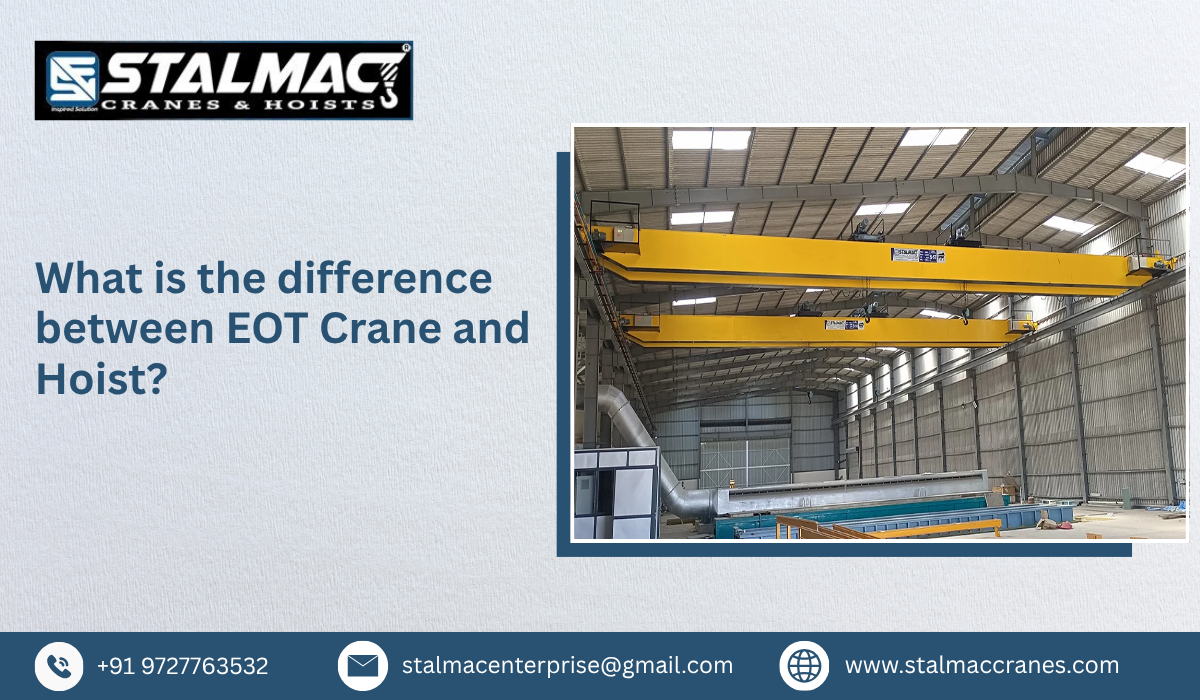
The key Difference Between EOT Crane and Hoist lies in their construction, movement, and application. An EOT (Electric Overhead Travelling) crane normally consists of a bridge, end carriages, wheels, electrical controls, and a hoisting mechanism. It can move a load horizontally across the length and width of a building while also raising and lowering it.
A hoist, on the other hand, is a lifting unit used to raise and lower loads. It may be installed on a fixed structure, monorail, jib crane, gantry system, or EOT crane. Therefore, an electric hoist can function as one component of a larger crane system.
What Is an EOT Crane?
What Is an EOT Crane is a common question among manufacturers and plant operators planning overhead lifting systems. An EOT crane is an electrically powered overhead travelling crane designed to transport loads within a defined working area. Its bridge travels along runway rails, while the trolley or crab carrying the hoist moves across the bridge.
The EOT Crane Working Principle involves coordinated bridge travel, cross travel, and hoisting operations. Depending on plant requirements, systems can incorporate pendant controls, radio remote controls, variable-frequency drives, limit switches, brakes, overload protection, and emergency stopping systems.
What Is an Electric Hoist?
What Is an Electric Hoist? An electric hoist is a powered lifting device that uses an electric motor and mechanical transmission system to raise and lower loads. Depending on the design, the lifting medium can be wire rope or chain.
An electric wire rope hoist is particularly suitable for industrial applications requiring higher lifting capacities, greater lifting heights, and controlled load movement. A professionally engineered hoist includes components such as a motor, gearbox, rope drum, wire rope, hook block, brake, limit switch, and control system.
EOT Crane vs Hoist: Technical Comparison
The EOT Crane vs Hoist comparison becomes clearer when their functions are examined separately. An EOT crane provides three primary movements: vertical lifting, longitudinal bridge travel, and transverse trolley travel. A standalone hoist generally focuses on vertical lifting and lowering, although its movement can depend on the supporting equipment.
A crane is therefore a complete material-handling arrangement, whereas a hoist is fundamentally a lifting mechanism. In many installations, the hoist is mounted on the crane bridge to provide vertical load movement.
| Parameter | EOT Crane | Electric Hoist |
|---|---|---|
| Primary function | Lifting and multidirectional material movement | Raising and lowering loads |
| Main structure | Bridge, end carriages, trolley and hoist | Hoist assembly |
| Horizontal movement | Bridge and trolley travel | Depends on mounting arrangement |
| Installation | Overhead runway structure | Fixed, monorail, jib, gantry or crane |
| Typical use | Plant-wide material handling | Dedicated lifting operations |
| Configuration | Single or double girder | Wire rope or chain type |
Types of EOT Cranes
A Single Girder EOT Crane generally uses one main bridge girder and is commonly selected for moderate lifting capacities and applications where economical overhead handling is required. It can provide efficient movement while making effective use of available building space.
A Double Girder EOT Crane incorporates two main bridge girders and is typically used for heavier loads, larger spans, higher lifting heights, and demanding industrial duty cycles. The selected configuration depends on load characteristics, span, headroom, operating class, and frequency of use.
Choosing Between an EOT Crane and Hoist
The appropriate solution depends on the required lifting process. If an operation only requires vertical lifting at a fixed location, an electric hoist may be sufficient. When materials need to be lifted and transported across a production floor, an EOT crane can provide considerably broader movement.
Important engineering considerations include rated capacity, lifting height, span, runway length, duty classification, operating speed, available headroom, power supply, environmental conditions, control method, and required safety systems. These factors should be evaluated before equipment selection rather than choosing solely according to lifting capacity.
Industrial Applications of Hoists and EOT Cranes
Industrial Hoist Applications include workshops, fabrication facilities, warehouses, engineering plants, maintenance areas, machine shops, steel processing facilities, foundries, automotive plants, and manufacturing units. Hoists can be used for machine installation, component handling, maintenance lifting, assembly operations, and localized material movement.
EOT cranes are used where loads must travel between multiple workstations or across a larger production area. Their ability to combine hoisting, cross travel, and long travel makes them suitable for integrated material-handling operations.
Stalmac Cranes: Engineered Lifting Solutions
As an EOT Crane Manufacturer in India, Stalmac Cranes focuses on designing lifting systems according to practical industrial requirements. Proper crane engineering involves structural calculations, load assessment, drive selection, braking systems, electrical controls, safety devices, and suitable operating mechanisms.
For customers comparing suppliers, an experienced EOT Crane Supplier in India should be able to understand the complete application rather than supplying equipment based only on nominal capacity. Stalmac Cranes supports application-oriented selection for manufacturing and industrial environments.
The company can also support businesses looking for a Hoist Manufacturer in India, particularly where reliable lifting mechanisms are required for standalone or crane-integrated applications. For wire-rope-based systems, an Electric Wire Rope Hoist Manufacturer must consider rope capacity, drum dimensions, reeving arrangement, motor rating, gearbox performance, braking, and lifting speed.
Why Select the Right Material Handling Equipment?
Selecting the correct equipment influences productivity, safety, maintenance requirements, and long-term operating performance. An experienced Industrial Lifting Equipment Manufacturer can evaluate the complete movement pattern and recommend a suitable configuration. Likewise, a dependable Material Handling Equipment Supplier can help coordinate equipment specifications with plant layout and operating conditions.
The Difference Between EOT Crane and Hoist should therefore be evaluated from the perspective of the complete lifting application. The right choice is not simply about whether one system can lift a particular load; it is about how that load needs to be positioned, transported, controlled, and handled throughout the working area.
Conclusion
The Difference Between EOT Crane and Hoist can be summarized simply: an EOT crane is a complete overhead travelling system that combines lifting with horizontal load movement, while a hoist is primarily the mechanism responsible for lifting and lowering. Understanding What Is an EOT Crane and What Is an Electric Hoist helps industries select equipment based on their actual handling requirements.
For engineered solutions, Stalmac Cranes can assist with selecting suitable crane and hoist configurations for industrial applications. Whether the requirement involves a single-girder system, double-girder crane, or electric wire rope hoist, proper technical evaluation helps ensure efficient and dependable material handling.

