Single Girder vs Double Girder EOT Crane: What Is the Difference?
Choosing the right overhead crane is essential for improving material handling efficiency, workplace safety, and productivity in industrial facilities. Among the most commonly used lifting solutions, single girder and double girder EOT cranes are designed to handle different load capacities, lifting heights, operational requirements, and factory layouts. Understanding the Single Girder vs Double Girder EOT Crane comparison helps businesses select suitable equipment for their applications and long-term operational needs.
Stalmac Cranes provides industrial crane solutions designed to support material handling requirements across manufacturing plants, warehouses, engineering facilities, fabrication workshops, and heavy industries. When comparing these crane configurations, businesses should consider load capacity, span, lifting height, duty cycle, available headroom, installation requirements, and maintenance needs.
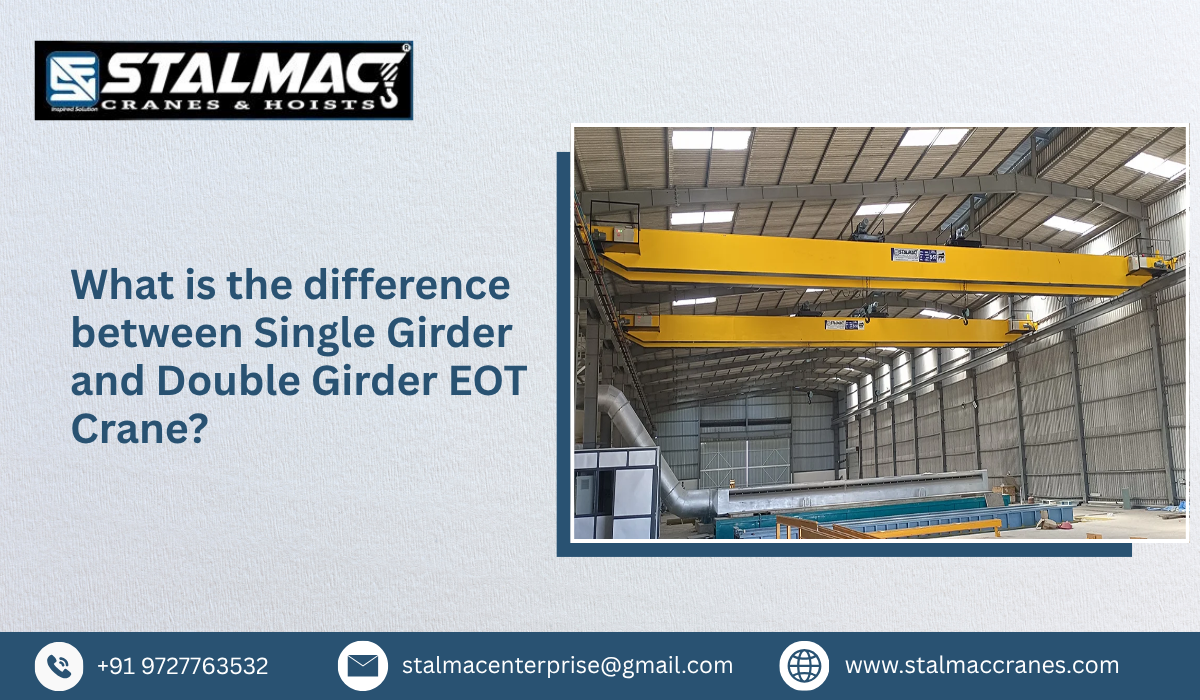
The main Difference Between Single Girder and Double Girder EOT Crane lies in the number of main bridge girders supporting the hoist and trolley. A single girder crane uses one main bridge girder, whereas a double girder crane uses two. This structural difference affects the crane's design, load-handling capability, lifting arrangement, and suitability for demanding industrial operations.
What Is a Single Girder EOT Crane?
A Single Girder EOT Crane is an Electric Overhead Travelling crane that uses one main horizontal bridge girder to support the lifting mechanism. The hoist generally travels along the lower flange of the girder or through a suitable trolley arrangement, depending on the design.
These cranes are widely used in small and medium-sized industrial facilities where routine lifting operations, efficient space utilization, and economical installation are important.
Advantages of Single Girder EOT Crane
- Cost-Effective Installation: A single main girder generally requires less structural material than a comparable double girder arrangement.
- Space Efficiency: Its compact configuration can suit facilities with limited overhead clearance.
- Simplified Maintenance: Fewer major structural components can simplify certain inspection and maintenance activities.
- Efficient Material Handling: Suitable for repetitive lifting and transportation of materials across production areas.
- Flexible Applications: Available in different spans, lifting capacities, and control configurations according to project requirements.
Businesses looking for a Single Girder EOT Crane Manufacturer in India should evaluate structural quality, hoist specifications, electrical controls, safety devices, and after-sales service before selecting a crane.
What Is a Double Girder EOT Crane?
A Double Girder EOT Crane uses two parallel main bridge girders to support the trolley and lifting mechanism. Depending on the design, the trolley may travel on rails mounted on top of the girders, providing an arrangement suitable for higher-capacity lifting and demanding operating conditions.
Double girder cranes are frequently selected for heavy manufacturing, steel processing, large fabrication units, power plants, and other industrial facilities requiring higher lifting heights or specialized lifting equipment.
Advantages of Double Girder EOT Crane
- Higher Load Capacity Potential: The two-girder configuration can be engineered for heavier loads and demanding operating conditions.
- Greater Lifting Height Options: Top-running trolley arrangements can provide useful hook-height advantages in suitable building layouts.
- Heavy-Duty Performance: Appropriate designs can support frequent lifting cycles and demanding industrial duties.
- Accessory Integration: The crane may accommodate maintenance platforms, specialized lifting attachments, and auxiliary hoists where engineered.
- Industrial Versatility: Suitable for handling large components, machinery, steel products, and heavy fabrication materials.
A Double Girder EOT Crane Manufacturer in India should design the crane according to the specified safe working load, span, duty classification, lifting height, operating environment, and applicable safety requirements.
Single Girder vs Double Girder EOT Crane: Key Differences
The following comparison explains the primary differences between these crane configurations.
| Parameter | Single Girder EOT Crane | Double Girder EOT Crane |
|---|---|---|
| Main bridge structure | One main girder | Two main girders |
| Typical application | Light to medium-duty handling | Medium to heavy-duty handling, depending on design |
| Hoist arrangement | Commonly underslung or flange-mounted trolley | Commonly top-running trolley |
| Lifting height | Depends on hoist and building clearance | May offer greater hook height with suitable design |
| Initial investment | Generally lower | Generally higher |
| Structural weight | Generally lower | Generally higher |
| Accessories | Standard lifting arrangements | Can support additional engineered accessories |
| Installation requirements | Often comparatively straightforward | May require more extensive structural and installation planning |
| Best selection criteria | Load, budget, space, and operating frequency | Load, duty cycle, height, and specialized requirements |
The actual performance of either configuration depends on engineering design, rated capacity, span, duty classification, hoist arrangement, and installation conditions. Neither configuration should be selected based on girder count alone.
EOT Crane Load Capacity and Technical Considerations
EOT Crane Load Capacity is the maximum rated load the crane is designed to lift safely under its specified operating conditions. The required capacity must include the heaviest intended load and account for the lifting attachment arrangement as specified by the crane designer.
When comparing a single girder crane with a double girder model, consider these technical factors:
- Rated Capacity: Confirm the maximum load required for regular and occasional lifting operations.
- Span: Measure the distance between runway rail centre lines and assess the building structure.
- Lifting Height: Determine the required hook travel and available headroom.
- Duty Classification: Evaluate lifting frequency, load spectrum, operating hours, and expected service life.
- Hoist Speed: Select suitable lifting speeds for production requirements and load positioning.
- Safety Systems: Consider overload protection, travel limit switches, emergency stops, braking systems, and other specified safety devices.
A Heavy Duty EOT Crane requires particular attention to fatigue resistance, structural calculations, braking performance, and the suitability of the complete crane system for the intended duty.
Applications of Single Girder and Double Girder EOT Cranes
Both crane configurations support industrial material movement, but their applications depend on load requirements and operating conditions.
Single Girder EOT Crane Applications
- Warehouses and logistics facilities for moving packed goods and equipment.
- Engineering workshops for handling machine components.
- Assembly lines for positioning production parts.
- Small and medium manufacturing units for routine material movement.
- Maintenance workshops for lifting motors, pumps, and machinery components.
Double Girder EOT Crane Applications
- Steel plants for handling heavy steel sections and fabricated products.
- Heavy engineering facilities for lifting large machine assemblies.
- Foundries for handling components and suitable process equipment.
- Power plants for maintenance and equipment installation.
- Large fabrication workshops for moving heavy structures and industrial assemblies.
Understanding EOT Crane Types and Applications helps businesses match equipment specifications with actual production requirements instead of choosing a crane based only on purchase price.
Factors Affecting EOT Crane Price in India
The EOT Crane Price in India varies according to design specifications, manufacturing requirements, and installation conditions. Single girder cranes generally have a lower initial cost for comparable applications, while double girder cranes can require a greater investment because of their structural arrangement and additional equipment.
Important cost factors include:
- Rated lifting capacity and bridge span.
- Lifting height, hoist type, and lifting speed.
- Crane duty classification and operating frequency.
- Electrical controls, automation, and safety equipment.
- Installation, commissioning, and runway modifications.
- Inspection requirements, maintenance arrangements, and spare parts.
For accurate budgeting, businesses should request a technical quotation based on their site layout, lifting requirements, and operating conditions.
Why Choose Stalmac Cranes?
Selecting a reliable crane partner helps businesses coordinate equipment design, installation, and long-term operational requirements. Stalmac Cranes can be considered when evaluating solutions for industrial lifting and material handling projects.
When comparing an Industrial Overhead Crane Manufacturer, assess engineering capability, product specifications, quality-control processes, safety provisions, commissioning support, and service availability.
Businesses seeking a Material Handling Equipment Manufacturer or an Industrial Lifting Equipment Supplier should also confirm that the proposed crane meets their application requirements and applicable Indian standards.
Whether you require a single girder crane for routine factory operations or a double girder system for demanding lifting tasks, the selection should be based on a documented technical assessment.
Conclusion
The Single Girder vs Double Girder EOT Crane decision depends on lifting capacity, span, hook height, operating frequency, available space, and budget. Single girder cranes are commonly suited to routine material handling and applications where compact design and initial cost are important. Double girder cranes can accommodate higher capacities, specialized accessories, and demanding industrial duties when properly engineered.
Stalmac Cranes can be contacted through its website, https://stalmaccranes.com/, to discuss project requirements and evaluate suitable overhead crane configurations. Share your required load capacity, lifting height, span, and application details to identify a crane solution aligned with your operational needs.

