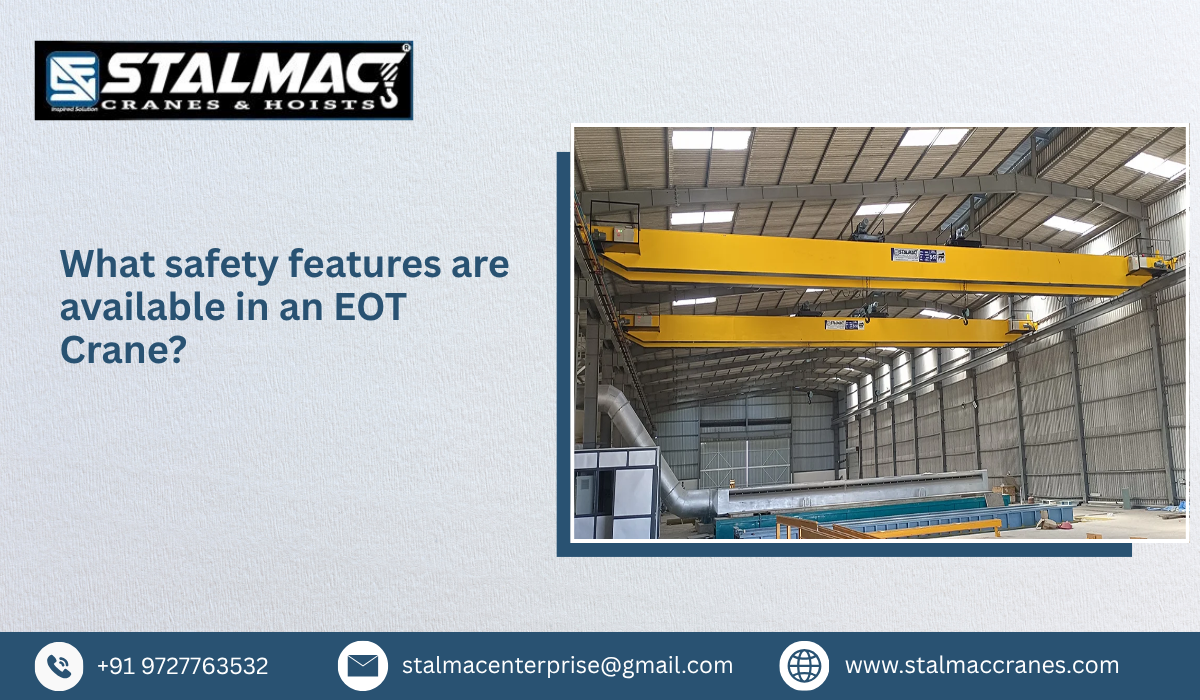
Stalmac Cranes – What Safety Features Are Available in an EOT Crane?
Safety is one of the most important considerations when selecting and operating an overhead lifting system. An Electric Overhead Travelling (EOT) Crane handles heavy loads, operates at height, and frequently works in demanding industrial environments. Therefore, modern cranes require multiple mechanical, electrical, and control-system safety mechanisms to protect operators, loads, equipment, and surrounding infrastructure. Stalmac Cranes focuses on engineering EOT crane systems with safety-oriented features designed for controlled lifting, travelling, lowering, and positioning operations.
What Safety Features Are Available in an EOT Crane?
A modern EOT crane can incorporate several safety systems, including overload protection, emergency stopping, travel limit switches, anti-collision devices, hoist protection, brakes, and warning systems. These features work together rather than functioning independently. Stalmac Cranes designs and supplies industrial lifting solutions where appropriate safety devices can be integrated according to crane configuration, working environment, rated capacity, and application requirements.
The exact safety arrangement depends on crane type, span, lifting capacity, duty classification, travel speed, operating method, and site conditions. Proper selection is therefore essential for achieving reliable and controlled crane performance.
EOT Crane Safety Features for Controlled Lifting
Important EOT Crane Safety Features generally begin with the lifting mechanism itself. A properly engineered crane may include fail-safe electromagnetic or electro-hydraulic brakes, rope or chain-related protection, upper and lower hook limits, overload protection, emergency stopping controls, and travel restrictions.
Brake systems are particularly important because they help control the suspended load when lifting or lowering stops. The braking arrangement should be selected according to the hoist capacity and duty requirements. Stalmac Cranes can provide crane configurations incorporating safety mechanisms suitable for different industrial lifting applications.
EOT Crane Safety Devices and Their Functions
Several EOT Crane Safety Devices are used to minimize operational risks. These can include overload limiters, limit switches, emergency stop buttons, anti-collision systems, warning alarms, and travel end-limit arrangements.
An overload protection system helps prevent lifting beyond the rated safe working load. Similarly, electrical and mechanical travel limits can prevent the crane or hoist from continuing beyond predetermined operating positions. These systems are particularly important in facilities where cranes operate repeatedly throughout production cycles.
EOT Crane Overload Protection
EOT Crane Overload Protection is a critical safety function that helps prevent excessive loading of the hoisting system. An overload limiter can monitor the lifting load and initiate a warning or restrict lifting when the predefined capacity is exceeded, depending on the selected system.
Overloading can place excessive stress on wire ropes, hooks, drums, gearboxes, brakes, motors, and structural components. Correct calibration and periodic inspection are therefore essential. Stalmac Cranes considers rated load capacity and operating conditions when configuring suitable lifting systems.
Emergency Stop and Limit Protection
An Emergency Stop System for EOT Crane allows the operator to rapidly interrupt crane movement during an unsafe or abnormal condition. Emergency stop controls should be easily accessible and connected appropriately to the crane's control circuit.
A Limit Switch for EOT Crane provides another important layer of protection. Hoist limit switches can help restrict hook movement at defined upper or lower positions, while travel limit switches can control crane or trolley movement near predetermined end positions. These devices help reduce the possibility of mechanical over-travel.
Anti-Collision and Hoist Safety
An Anti Collision Device for Crane is particularly useful where two or more cranes operate within the same runway or where crane movement must be controlled around other equipment. Depending on the system, sensors can detect another crane or obstruction and initiate warning or controlled stopping functions.
Modern Hoist Safety Features can include overload protection, upper and lower limit switches, fail-safe brakes, rope guidance arrangements, load hooks with safety latches, and appropriate control interlocks. These features help improve operational control during repetitive lifting activities.
Industrial EOT Crane Safety and Applicable Standards
Industrial EOT Crane Safety involves more than installing individual safety devices. It includes correct crane design, electrical protection, structural integrity, operator controls, inspection procedures, maintenance, load handling practices, and workplace training.
EOT Crane Safety Standards and applicable regulations should be considered during design, manufacturing, installation, testing, and commissioning. Requirements may vary depending on the application, location, crane configuration, and applicable Indian standards or workplace regulations.
As an experienced EOT Crane Manufacturer in India, Stalmac Cranes can develop crane solutions around application-specific requirements, including lifting capacity, span, lifting height, duty cycle, travel speed, operating environment, and control arrangement.
Industrial Crane Safety Equipment
Appropriate Industrial Crane Safety Equipment supports safe and predictable crane operation. Depending on the application, a crane may incorporate overload protection, emergency stop controls, limit switches, anti-collision systems, audible or visual warning devices, brakes, safety latches, pendant or radio controls, and electrical protection systems.
Routine inspections are equally important. Components such as wire ropes, hooks, brakes, wheels, rails, electrical panels, festoon systems, and limit switches should be inspected according to the manufacturer's recommendations and applicable safety requirements.
Why Choose Stalmac Cranes for EOT Crane Solutions?
As an EOT Crane Supplier in India, Stalmac Cranes focuses on application-oriented crane engineering and dependable lifting performance. Every industrial environment presents different requirements, so crane selection should consider load characteristics, working frequency, available headroom, runway arrangement, environmental conditions, and required control features.
The company also serves as an Overhead Crane Manufacturer in India, supporting industries that require reliable material handling and controlled heavy-load movement. Properly specified crane safety systems can contribute to improved operational control, reduced equipment stress, and safer material handling practices.
For organizations seeking an Industrial Lifting Equipment Manufacturer, technical consultation is valuable before finalizing crane specifications. Safety devices should not be treated as optional accessories; they should be integrated into the crane design based on the actual application.
Conclusion
Safety in EOT cranes is achieved through a combination of engineering, protective devices, operating procedures, inspection, and maintenance. Overload protection prevents excessive loading, limit switches control movement, emergency stops provide rapid shutdown, anti-collision systems manage crane interaction, and reliable brakes help control suspended loads. Stalmac Cranes provides technically focused EOT crane solutions where these safety considerations can be incorporated according to industrial requirements.
For companies looking for an EOT Crane Manufacturer in India, choosing a properly engineered system with suitable EOT Crane Safety Features, EOT Crane Safety Devices, and Industrial Crane Safety Equipment is essential for dependable long-term operation. Stalmac Cranes can help industries evaluate their lifting requirements and select an EOT crane configuration designed for safe, efficient, and controlled material handling.

