Which Industries Commonly Use an EOT Crane?
When industries handle heavy materials, large components, machinery, or production loads, safe and controlled lifting becomes an essential part of daily operations. Stalmac Cranes provides engineered overhead lifting solutions designed to support demanding industrial material-handling requirements. Among these solutions, EOT Crane Applications cover a wide range of manufacturing and infrastructure sectors where precision, reliability, and load control are important.
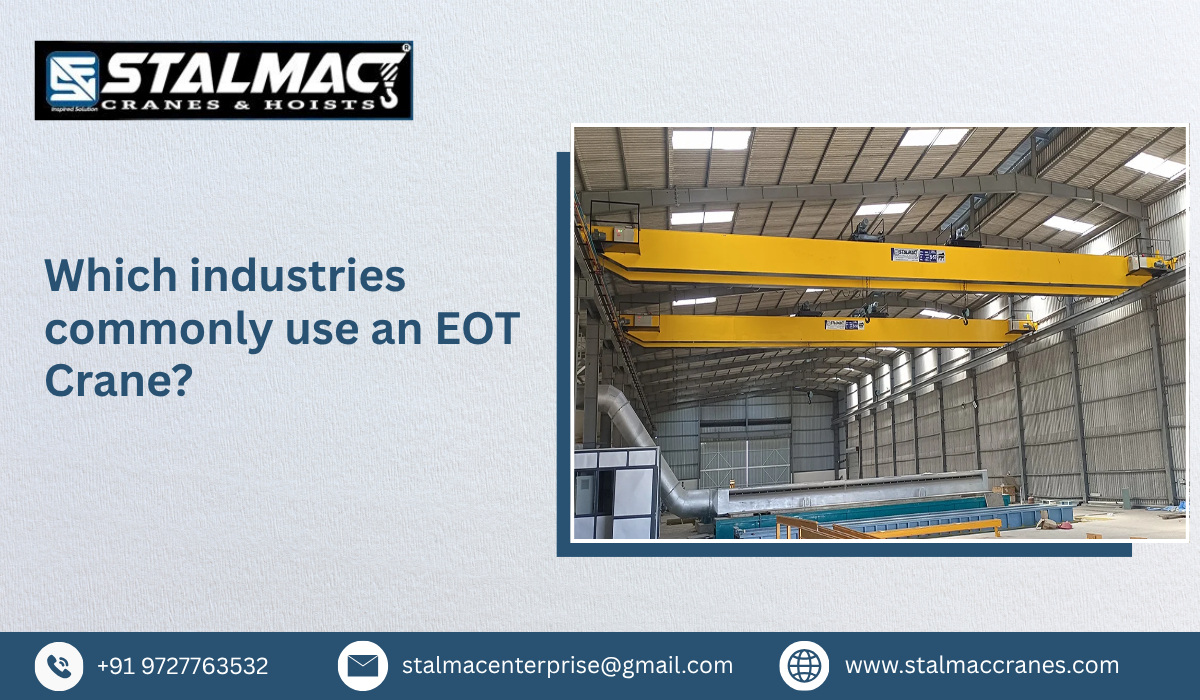
An Electric Overhead Travelling crane, commonly called an EOT crane, operates along parallel runway beams installed at an elevated level. The bridge travels longitudinally, while the trolley and hoisting mechanism move the load across the working area. This arrangement allows factories to utilize floor space efficiently while moving loads through production, assembly, storage, and maintenance areas.
EOT Crane Applications Across Different Industries
The versatility of EOT cranes makes them suitable for numerous industrial environments. EOT Crane Applications can range from transporting raw materials to positioning finished products and supporting maintenance operations. Depending on capacity, span, lifting height, duty classification, operating speed, and working conditions, cranes can be configured for light, medium, or heavy-duty applications.
The industries using EOT cranes generally require repetitive lifting with controlled horizontal and vertical movement. An appropriately designed crane can reduce manual handling, improve workplace organization, and support consistent material flow. Stalmac Cranes focuses on application-oriented crane engineering so that the equipment matches the operational requirements of each facility.
Manufacturing and Engineering Industries
Manufacturing plants frequently use cranes to transfer dies, molds, fabricated structures, machinery components, coils, and production assemblies. An EOT Crane for Manufacturing Industry can be integrated into production lines, machine shops, fabrication bays, and assembly areas.
Engineering facilities also handle components with considerable weight and dimensions. An EOT Crane for Engineering Industries provides controlled lifting and positioning for equipment fabrication, maintenance, assembly, and material transfer. Crane selection generally considers rated load, lifting mechanism, duty cycle, hook approach, travel speed, and available headroom.
Steel Plants and Heavy Metal Processing
Steel plants represent one of the demanding environments for overhead lifting systems. EOT Crane for Steel Plants applications may include handling steel plates, billets, coils, structural sections, ladles, and other heavy components.
These facilities may require Heavy Duty EOT Crane configurations engineered for frequent operation and high load cycles. Depending on the process, cranes can incorporate specialized hooks, grabs, magnets, or other lifting attachments. Thermal exposure, dust, continuous operation, and high ambient temperatures can also influence component selection and protection requirements.
Automobile Industry
Automobile manufacturing involves continuous movement of dies, engine assemblies, vehicle components, tooling, and production equipment. An EOT Crane for Automobile Industry can support stamping plants, fabrication areas, maintenance workshops, and assembly-related operations.
Precise positioning is particularly useful when heavy dies or machinery components must be aligned accurately. Variable-speed drives, controlled acceleration, braking systems, and suitable hoisting arrangements can help achieve smoother load movement and reduce unnecessary mechanical stress.
Warehouses and Material Storage Facilities
Warehouses dealing with heavy industrial goods may use overhead cranes where conventional forklifts or floor-based equipment are not practical. An EOT Crane for Warehouses can move loads between storage, dispatch, inspection, and processing areas while keeping the floor comparatively clear.
Crane configuration depends on the warehouse layout, available runway length, load dimensions, lifting height, frequency of operation, and required travel speeds. Properly planned overhead lifting can help improve accessibility and support organized material movement.
Power Plants and Energy Facilities
Power-generation facilities require reliable lifting equipment for installation, maintenance, and replacement of heavy machinery. EOT Crane for Power Plants applications can include handling turbines, generators, motors, valves, pumps, transformers, and maintenance components.
Because some power-plant equipment is exceptionally heavy, crane systems are selected according to calculated load requirements and operational duty. Lifting capacity, hook travel, bridge span, trolley arrangement, braking systems, and emergency controls are important technical considerations.
Cement Industry
Cement manufacturing involves heavy equipment, raw materials, machinery components, and maintenance activities. EOT Crane for Cement Industry applications may include handling motors, gearboxes, mechanical components, maintenance tools, and other heavy assemblies.
The operating environment may contain significant dust and continuous industrial activity. Therefore, electrical enclosures, motors, controls, protection systems, and maintenance accessibility should be considered during crane design and specification.
Industrial Material Handling and Heavy-Duty Operations
An Industrial EOT Crane is more than a lifting machine; it is an integrated Industrial Material Handling Equipment solution designed to move loads along defined travel paths. A typical system consists of a bridge structure, end carriages, wheels, trolley, hoist, wire rope or lifting mechanism, motors, brakes, control panel, electrical system, and safety devices.
The engineering process begins with determining the safe working load and operating conditions. Engineers then evaluate span, lift height, runway arrangement, duty classification, speeds, ambient conditions, and required lifting attachments. These parameters influence the selection of motors, gearboxes, brakes, ropes, hooks, structural members, and control systems.
Choosing the Right EOT Crane Manufacturer
Selecting an EOT Crane Manufacturer in India requires attention to engineering capability, manufacturing quality, customization, safety provisions, and after-sales support. A suitable supplier should understand the difference between standard lifting requirements and application-specific crane configurations.
As an experienced EOT Crane Supplier in India, Stalmac Cranes can develop crane solutions around individual plant layouts and operating conditions. The appropriate design may include single-girder or double-girder construction, different hoisting capacities, variable travel speeds, pendant or cabin control, remote operation, and customized lifting attachments.
Why Industries Depend on EOT Cranes
The broad EOT Crane Applications across steel, automobile, engineering, manufacturing, power, cement, and warehouse operations demonstrate the flexibility of overhead lifting technology. Compared with manually operated lifting methods, an engineered overhead crane provides controlled load movement along predetermined paths and can support repetitive industrial operations.
For high-capacity environments, a Heavy Duty EOT Crane can be engineered around the expected load spectrum, operating frequency, and working environment. Proper inspection, preventive maintenance, lubrication, electrical checks, brake inspection, rope and hook examination, and safety-device testing are essential for dependable long-term operation.
Stalmac Cranes for Industrial Lifting Requirements
From manufacturing floors to heavy engineering facilities, Stalmac Cranes develops application-focused overhead lifting systems for diverse industrial requirements. The company's approach combines mechanical design, structural engineering, electrical controls, safety systems, and application-specific customization.
If your facility requires an EOT crane for production, storage, maintenance, steel handling, power equipment, automobile manufacturing, or heavy engineering, selecting the crane according to actual operating parameters is essential. A correctly engineered Industrial EOT Crane can provide controlled movement, efficient material handling, and dependable support for demanding industrial workflows.
For businesses evaluating EOT Crane Applications, the key is to match crane capacity and configuration with the actual load, duty cycle, workspace, lifting height, travel requirements, and environmental conditions. With application-specific engineering and industrial expertise, Stalmac Cranes can support reliable overhead lifting solutions for modern industrial facilities.

